
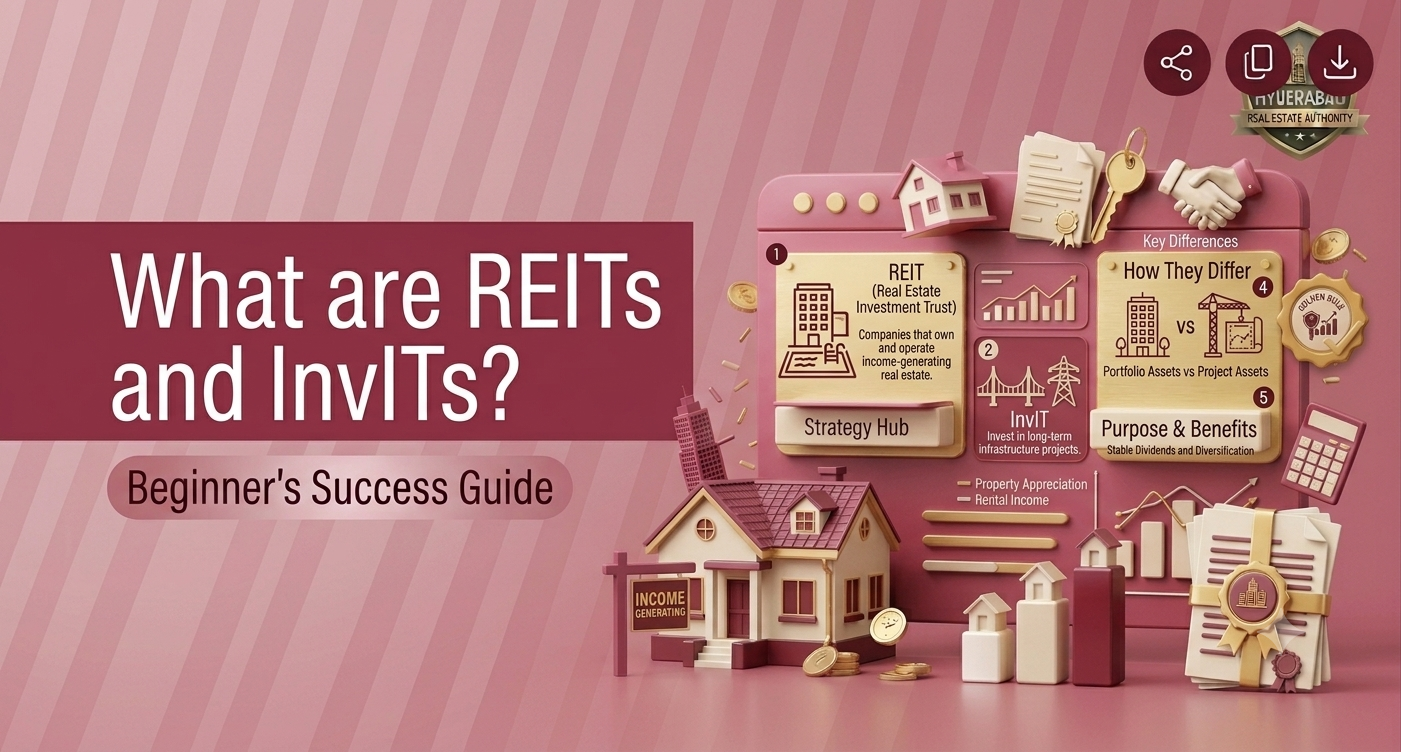
Your plain-language guide to understanding REITs and InvITs — how they work, what makes them different, how REIT IPO GMP matters, and how to invest in real estate through these SEBI-regulated instruments.
India’s Real Estate and Infrastructure — Now Investable by Everyone
If someone told you ten years ago that you could invest in real estate — specifically in the Grade-A office towers leased by Microsoft, Amazon, and Goldman Sachs — for ₹15,000, most people would have laughed. Today, that is not just possible but also SEBI-regulated, stock-exchange-listed, and generating quarterly income for hundreds of thousands of retail investors across India. The vehicles that made this possible is what are REITs and InvITs—two investment structures that have quietly transformed who gets access to India’s most valuable physical assets.
So what are REITs and INVITs? At their core, both are regulated trusts that pool money from multiple investors, acquire large-scale income-producing assets, and distribute the income back to unitholders—like dividends but from buildings and highways rather than companies. Understanding REITs and InvITs is no longer optional for serious investors. As of mid-2025, the combined market capitalization of InvITs and REITs on Indian exchanges has crossed ₹9 lakh crore—a number that reflects how rapidly these instruments have moved from institutional niche to mainstream wealth-building tool.
This guide answers what are REITs and InvITs in plain language, explains how each works, what makes them different, what REIT IPO GMP means and why it matters to investors, and how you can begin understanding REITs and InvITs deeply enough to invest with confidence.
What is a REIT? — Real Estate Investment Trust Explained
Definition: What is REIT in Simple Terms
A Real Estate Investment Trust, or REIT, is a SEBI-regulated trust that owns and manages a portfolio of income-generating commercial properties—office parks, shopping malls, warehouses, hotels, and data centers. When you buy REIT units on the NSE or BSE, you become a partial owner of all those properties. The rental income those properties generate is collected by the trust and distributed to you as a unitholder — typically every quarter. By SEBI mandate, a listed REIT must distribute at least 90% of its net distributable cash flow to investors.
In India, five REITs are currently listed: Embassy Office Parks REIT (India’s first, listed April 2019), Mindspace Business Parks REIT, Brookfield India Real Estate Trust, Nexus Select Trust (India’s first retail REIT), and Knowledge Realty Trust REIT — which raised ₹4,800 crore in its August 2025 IPO and is now India’s largest office REIT by gross asset value at over ₹61,998 crore. What REITs and InvITs are becomes clearer when you realize that these trusts collectively own over 129 million square feet of India’s finest Grade-A office space.
How Does a REIT Work? The Structure Explained
The structure behind what are REITs and InvITs involve three layers: the Sponsor (typically a large real estate developer who contributes the initial assets), the Manager (a professional management company responsible for running the portfolio and maximizing returns), and the Trustee (an independent entity that holds the assets and protects unitholder interests). The trust owns properties directly or through SPVs (special purpose vehicles). Rental income flows up from SPVs to the trust, which then distributes it to investors. SEBI requires at least 80% of a REIT’s assets to be completed and income-generating, limiting development risk significantly. Know more about REITs vs. buying property in our deep dive article.
Types of REITs in India
• Equity REITs: Own and operate physical properties, earning through rent. All currently listed Indian REITs are equity REITs.
• Mortgage REITs: Finance real estate purchases and earn through interest on loans. Not yet prominent in India.
• Hybrid REITs: Combine equity and mortgage approaches. Rare in the current Indian market.
• SM REITs (Small & Medium REITs): SEBI’s 2024 framework enabling fractional commercial property ownership from ~₹10 lakh through regulated platforms.
Currently Listed REITs in India (2025)
Embassy Office Parks REIT: Largest by AUM; Bangalore-focused office portfolio
Mindspace Business Parks REIT: Hyderabad + Pune + Mumbai + Chennai offices
Brookfield India Real Estate Trust: Mumbai, NCR, Bangalore, Kolkata offices
Nexus Select Trust: India’s first retail REIT; 17 malls across 14 cities
Knowledge Realty Trust (KRT) REIT: Largest by GAV (₹61,998 Cr); Mumbai, Hyderabad, Bengaluru, Chennai
What is InvIT? — Infrastructure Investment Trust Explained

Definition: What is InvIT in Simple Terms
If understanding REITs and InvITs is about grasping how ordinary investors access extraordinary assets, then what are REITs and InvITs on the InvIT side translates to: you invest in India’s roads, power grids, renewable energy projects, and gas pipelines without building or operating any of them. An Infrastructure Investment Trust—InvIT—works identically to a REIT in structure, but the assets inside are infrastructure projects rather than commercial buildings. A highway generates toll revenue instead of rent. A power transmission line generates wheeling charges instead of lease income. That revenue, net of costs, flows to you as a unitholder.
India’s first InvIT—IRB InvIT Fund—was listed in May 2017, followed by IndiGrid (power transmission) in June 2017. Since then, InvITs and REITs together have expanded to 23 listed InvITs as of 2025, spanning roads, power, renewable energy, gas pipelines, and telecom towers. Government-backed InvITs — such as PowerGrid InfraInvIT Trust (promoted by Power Grid Corporation of India) and Highways Infrastructure Trust — are particularly attractive for risk-conscious investors seeking sovereign-adjacent cash flows.
Gov / Official | Ministry of Finance — Infrastructure and Capital Markets Policy — Union Ministry of Finance — policy framework supporting InvIT growth under India’s National Infrastructure Pipeline.
How Does an InvIT Work?
The mechanics of what are reits and invits nearly identical. An infrastructure developer (Sponsor) creates the InvIT trust, transfers ownership of operational projects to it, and the trust issues units to investors through an IPO. Revenues from tolls, transmission charges, or capacity contracts are collected at the project level, pass through to the trust, and are distributed to unitholders. SEBI mandates that at least 80% of InvIT assets must be operational revenue-generating projects — the remaining 20% can be under-construction assets or listed debt instruments of infrastructure companies.
Key InvITs Listed in India
• IRB InvIT Fund: Highways — 13 road projects; India’s first listed InvIT (2017)
• IndiGrid (IndigGrid Infrastructure Investment Trust): Power transmission networks across multiple states
• PowerGrid InfraInvIT Trust: Government-backed; Power Grid Corporation of India as Sponsor
• Highways Infrastructure Trust: Backed by National Highways Authority of India (NHAI) assets
• Oriental InfraCommerce InvIT: Mix of road and telecom infrastructure assets
Check out NITI Aayog — National Infrastructure Pipeline (NIP) — a government think tank overseeing India’s $1.4 trillion infrastructure investment programme — the backbone of InvIT opportunity.
InvITs and REITs—Full Side-by-Side Comparison
The clearest way to consolidate understanding REITs and InvITs is a direct comparison. Here is how InvITs and REITs differ across every metric an investor cares about:
| Parameter | REIT | InvIT |
| Asset Type | Commercial real estate (offices, malls, warehouses) |
Infrastructure (roads, power lines, pipelines) |
| Revenue Source | Rental income from long-term leases |
Tolls, tariffs, transmission charges |
| Capital Appreciation |
Moderate — linked to property valuations |
Limited — infrastructure depreciates |
| Risk Profile | Moderate — occupancy and lease-renewal risk |
Moderate-High — traffic volumes, policy risk |
| Min. Investment |
Rs.10,000-15,000 (listed units) |
Rs.10,000+ (publicly listed) |
| Liquidity | High — traded on NSE/BSE like equities |
Moderate — improving with listings |
| SEBI Classification |
Equity (reclassified 2025) |
Hybrid |
| Distribution Req. |
90%+ of net distributable cash flow |
90%+ of net distributable cash flow |
| India Examples | Embassy, Mindspace, Brookfield, Nexus, KRT |
IRB InvIT, IndiGrid, PowerGrid, Highways |
SEBI reclassified REITs as equity instruments in September 2025, while InvITs remain in the hybrid category. This distinction now allows equity mutual funds to include REITs in their portfolios — significantly widening the REIT investor base and boosting REIT IPO GMP sentiment in upcoming listings.
For authoritative answers to common investor questions about both instruments, on securities markets is the most reliable and up-to-date resource, updated directly by the regulator as rules evolve. For investors wondering how what are reits and invits fits within a broader investment strategy, see our complete guide on simple ways to invest in real estate, which situates REITs alongside four other accessible strategies so you can choose the approach that best fits your capital and goals.
REIT IPO GMP — What It Is and Why It Matters

Understanding REIT IPO GMP: The Basics
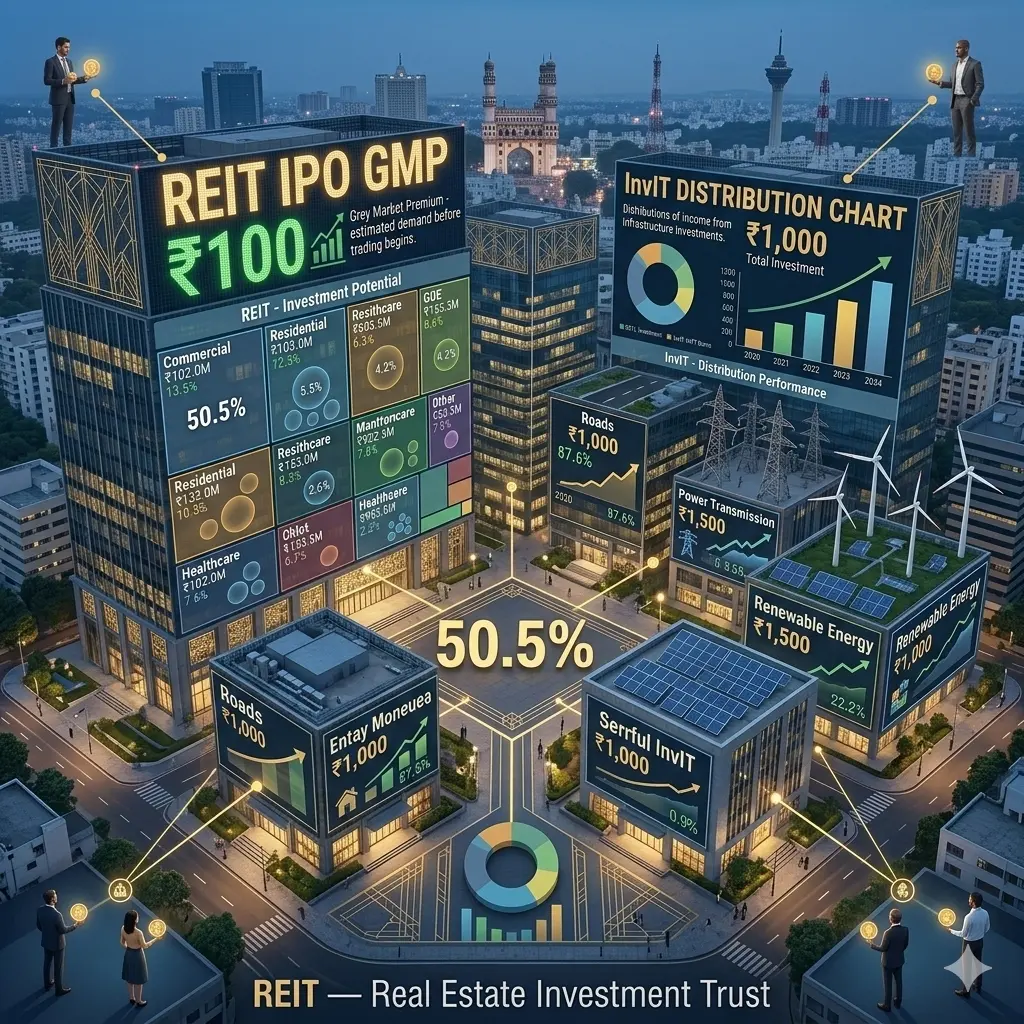
When a new REIT raises money from the public through an Initial Public Offering (IPO), there is a period between subscription close and official stock exchange listing during which units are traded informally in what is called the grey market. The REIT IPO GMP — Grey Market Premium — is the price premium at which REIT units trade in this informal market above their issue price. If a REIT IPO GMP shows Rs.+5 on an issue price of Rs.100, the grey market is suggesting the REIT may list at approximately Rs.105 on its first trading day. It is an unofficial, unregulated indicator of investor sentiment before the official listing.
REIT IPO GMP in Practice: Knowledge Realty Trust Case Study
The most recent major REIT IPO GMP event in India was the Knowledge Realty Trust (KRT) REIT IPO, which opened on August 5, 2025 at an issue price of Rs.100 per unit with a minimum lot of 150 units (minimum investment Rs.15,000). The REIT IPO GMP for KRT REIT was approximately Rs.+1.5 during subscription — reflecting measured but positive sentiment. The issue was managed by Kotak Mahindra Capital and listed on both BSE and NSE on August 18, 2025. Investors tracking the REIT IPO GMP used it alongside the Red Herring Prospectus, which was available for review on the BSE India disclosures portal before the listing date.
How to Track REIT IPO GMP Responsibly
– Monitor REIT IPO GMP through established platforms — IPOWatch, Chittorgarh, or InvestorGain — which aggregate grey market data from market participants.
– Cross-reference REIT IPO GMP with the Red Herring Prospectus (RHP), available on SEBI’s official portals and the BSE/NSE disclosure systems.
– A REIT IPO GMP of zero does not disqualify the investment — income-focused REITs with strong distribution track records often list flat but deliver superior long-term income.
– Never invest in grey market transactions themselves — the REIT IPO GMP is an information signal, not an investable market. SEBI does not regulate grey market trading.
REIT IPO GMP Warning: Verify Before You Act
REIT IPO GMP is an unofficial indicator with no legal standing. Before acting on any REIT IPO GMP signal, verify that any advisor quoting REIT IPO GMP data is SEBI-registered using SEBI’s official intermediary check portal. If you encounter manipulative or fraudulent claims about REIT IPO GMP performance, you can report any fraudulent REIT IPO GMP claims directly on SCORES — SEBI’s official Complaints Redress System, which handles investor grievances across all regulated instruments including InvITs and REITs.
How to Invest in REITs and InvITs in India
Step-by-Step: Investing in REITs
Investing in REITs to invest in real estate through understanding REITs and InvITs requires nothing more than a Demat account with any SEBI-registered broker. Before you begin, take time to study the NISM certification material for REIT and InvIT distributors—the National Institute of Securities Markets publishes free study guides covering every aspect of REIT and InvIT mechanics, tax treatment, and risk assessment in accessible plain language.
1. Open a Demat account with a SEBI-registered broker — Zerodha, Groww, HDFC Securities, ICICI Direct, or Upstox.
2. Complete your KYC — PAN card and Aadhaar-linked mobile number are mandatory.
3. Search for the REIT by name on the NSE/BSE — Embassy (EMBASSY), Mindspace (MINDSPACE), Brookfield (BIRET), Nexus (NEXUS), or Knowledge Realty Trust (KRTR).
4. Buy units at the prevailing market price. Minimum purchase is typically 1 unit in the secondary market (Rs.300-500 for most REITs post-splits).
5. Distributions are credited to your linked bank account quarterly. Monitor reports on BSE/NSE and the REIT’s investor relations portal.
Step-by-Step: Investing in InvITs
Investing in publicly listed InvITs and REITs follows the same Demat-and-broker route. For private InvITs (minimum typically Rs.1 crore+), access is through institutional channels and SEBI-registered category II AIF managers. Whether investing in REITs, InvITs, or direct property, the discipline of verification never changes—always verify the underlying real estate assets through RERA India to confirm regulatory compliance. And if you are approaching invest in real estate for the first time, grounding yourself in the 5 golden rules of property investment on SpaceLivings before your first purchase will protect you from the most common and costly beginner mistakes.
Tax Treatment of REITs and InvITs — What Investors Must Know
H3 — REIT Distribution Tax Breakdown
One of the most asked questions in understanding REITs and InvITs is tax treatment. REIT distributions have three components, each taxed differently:
– Dividend component: Taxable at the investor’s applicable income tax slab rate.
– Interest component: Taxable at slab rate with a 10% TDS if income exceeds Rs.5,000 per financial year.
– Return of capital: Tax-free at distribution; adjusts the cost of acquisition for capital gains calculation at exit.
Capital gains on unit sale: Short-Term Capital Gains (STCG — holding 1 year or less) at 15%. Long-Term Capital Gains (LTCG — holding more than 1 year) on gains above Rs.1 lakh at 10% without indexation — aligned with equity taxation post SEBI’s 2025 reclassification of REITs.
InvIT Distribution Tax
InvIT distributions remain classified as hybrid instruments under SEBI’s 2025 framework — LTCG after 36 months is taxed at 20% with indexation benefit, while gains within 36 months are added to income at slab rate. For foreign investors, FPI and NRI investors should review the RBI’s FEMA guidelines, which govern the repatriation of income from Indian REITs and InvITs. For investors evaluating REITs for their Hyderabad-based portfolios, understanding the GHMC and HMDA regulatory environment that governs those underlying commercial assets is equally important — especially for Mindspace REIT and KRT REIT unitholders with significant Hyderabad exposure.
Risks and Rewards of Investing in REITs and InvITs
Rewards of Understanding REITs and InvITs
– Regular quarterly or semi-annual income from professionally managed institutional-grade assets.
– Diversification across multiple properties, cities, or infrastructure projects within a single unit purchase.
– Liquidity — sell units on NSE/BSE within a trading session, unlike physical property which takes months.
– SEBI-grade regulatory oversight, mandatory independent valuations, and quarterly disclosure requirements.
– Access to assets previously available only to institutional investors — Grade-A offices, national highways, power grids.
Risks to Understand Before Investing
– Market price volatility: REIT and InvIT unit prices fluctuate with broader stock market sentiment—even when underlying assets perform well.
– Occupancy risk for REITs: falling office occupancy directly reduces rental income and distribution.
– Traffic and volume risk for InvITs: highway toll collections depend on vehicle volumes, fuel prices, and competing routes.
– Interest rate risk: rising rates increase REIT/InvIT borrowing costs and can compress distributions.
– REIT IPO GMP risk: grey market signals are not predictive—a strong REIT IPO GMP can reverse by listing day.
In 2025, India’s listed REITs delivered a total return of approximately 29.68%, significantly outperforming broader market indices. For investors focused on Hyderabad’s real estate corridors—which feature prominently in Mindspace and KRT REIT portfolios—understanding local market dynamics adds a valuable layer of analysis to the macro-level understanding REITs and InvITs picture. Past performance does not guarantee future results, but the trajectory of InvITs and REITs in India reflects a maturing, increasingly institutional asset class.
FAQs
Q1. What is REIT and InvIT in one sentence each?
REIT: A SEBI-regulated trust owning income-generating commercial properties, distributing at least 90% of rental income to unitholders quarterly — verify the full framework on the SEBI official website. InvIT: A SEBI-regulated trust owning operational infrastructure assets — roads, power lines, gas pipelines — distributing toll, transmission, and tariff income to unitholders. Both allow you to invest in real estate and infrastructure from Rs.10,000.
Q2. What is the difference between what is reits and invits in terms of underlying assets?
REITs invest in commercial real estate; InvITs invest in infrastructure. Compare the two regulatory frameworks by reading the REIT Regulations and InvIT Regulations on SEBI’s portal. The key divergence is that REITs now carry equity classification while InvITs remain hybrid—affecting tax treatment and mutual fund eligibility.
Q3. What is REIT IPO GMP and should I use it to decide whether to apply?
REIT IPO GMP is the unofficial premium at which REIT units trade in gray markets before listing. It is unregulated and frequently inaccurate—always verify that any source quoting REIT IPO GMP figures is a SEBI-registered intermediary. Use it as a one-directional signal alongside the REIT’s distribution history, occupancy rate, and sponsor quality.
Q4. How do I verify that a REIT or InvIT is genuinely SEBI-regulated?
Use the SEBI Intermediary Check portal to verify any REIT manager or advisor. Check listing disclosures on BSE India or NSE India. Study the NISM official REIT/InvIT module to deepen your understanding REITs and InvITs before investing.
Q5. What is the minimum amount needed to invest in InvITs and REITs?
For listed InvITs and REITs in the secondary market, minimum is typically 1 unit — approximately Rs.200-500 for REITs and Rs.100-200 for InvITs. Track current unit prices on NSE India for live data before placing any order.
Q6. How is REIT income taxed compared to InvIT income in India?
REIT: dividend and interest components taxed at slab rate; LTCG above Rs.1 lakh at 10% without indexation (equity treatment post 2025). InvIT: LTCG after 36 months at 20% with indexation; STCG added to income at slab rate. Verify current rules on the SEBI FAQs portal before filing.
Q7. Where can I complain if I face a problem with my REIT or InvIT investment?
File your complaint on SCORES — SEBI’s official Complaints Redress System. Always transact through SEBI-verified intermediaries only — unregistered platforms have no regulatory accountability.
Q8. Are InvITs and REITs suitable for long-term wealth building?
Yes — primarily as income instruments. REITs have delivered total returns of 11-30% in India depending on the year. For a full comparison against owning physical property, read our article on REIT vs Buying Property: which is safer and more profitable.