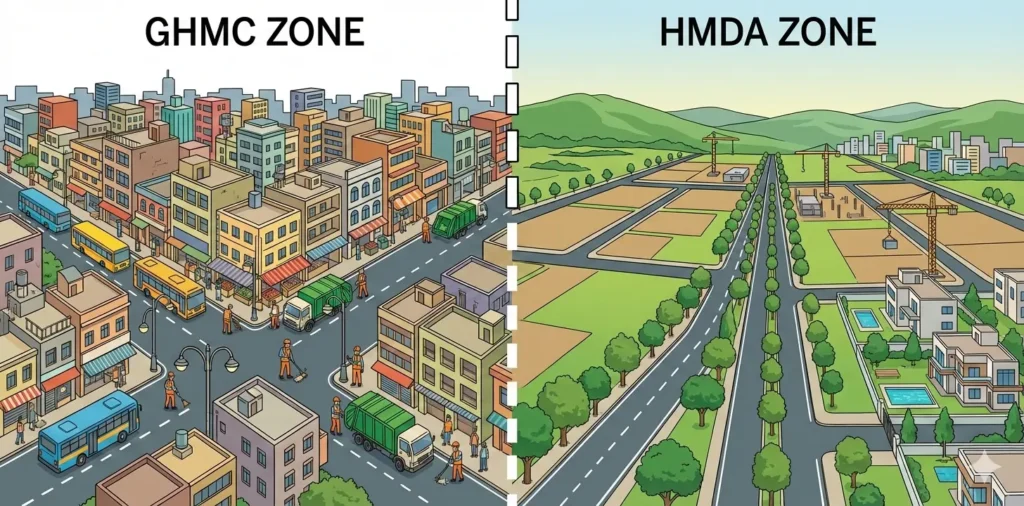
The Two Bosses of Hyderabad Nobody Told You About
Here is the difference between GHMC and HMDA. Imagine you’ve just found your dream plot in Hyderabad. The location is perfect. The price makes you feel like you have won the lottery. You are already mentally placing your sofa, arguing about whether the kitchen wall should be terracotta or beige. And then someone asks, “Is this under GHMC or HMDA?” and you stare at them blankly, the way you stare at the Wi-Fi router when the internet is down—certain something important is happening, but you have absolutely no idea what.
Welcome to the single most confusing—and most important—question in Hyderabad’s real estate market. The difference between GHMC and HMDA isn’t just bureaucratic trivia. The difference between GHMC and HMDA determines who approves your building plan, how tall your structure can go, what rules you must follow, and crucially, whether the plots in Hyderabad you’re eyeing are legally sound or a slow-motion disaster waiting to happen.
Both GHMC—the Greater Hyderabad Municipal Corporation—and HMDA—the Hyderabad Metropolitan Development Authority—govern development in and around Hyderabad. But they do it differently, at different scales, with different powers, and for different purposes. Think of GHMC as the mayor of the city and HMDA as the chief architect of the entire metropolitan region. One keeps the lights on. The other decides where the next neighborhood gets built.
This article breaks down the difference between GHMC and HMDA limits in plain English—with a side of wit, because honestly, civic governance deserves it. By the end, you’ll know exactly who does what, why it matters for your property investment, and how to verify which authority governs any plot or project you’re considering in Hyderabad.
A Brief History
To understand the difference between the GHMC and the HMDA moment, you need about three beats of history. Don’t worry—no test at the end.
The Municipal Corporation of Hyderabad (MCH)—the father
There was the Municipal Corporation of Hyderabad (MCH), formed in 1955 under the Hyderabad Municipal Corporation Act. MCH governed just 173 square kilometers of the double cosmopolises of Hyderabad and Secunderabad. It was headed by a mayor with fairly limited powers and a municipal commissioner with extensive further powers. It handled the basics: roads, water, sanitation, and trying its best to keep one of India’s most chaotic cosmopolises from completely falling incrementally.
Also, Hyderabad grew. Fast. So in April 2007, MCH was immingled with 12 girding megalopolises and 8 gram panchayats from the Ranga Reddy and Medak sections to form the Greater Hyderabad Municipal Corporation—GHMC. The governance expanded from 173 sq km to roughly 626 sq km, divided into 5 zones, 18 circles, and 150 wards. The delegation remained the same—collaborative services and communal governance—just at an important, much larger scale. The difference between GHMC and HMDA. The difference between GHMC and HMDA.
HMDA—The Planner Who Thinks in Decades
Meanwhile, a different kind of body was evolving. Before HMDA, there were multiple development authorities operating in different pockets of Hyderabad’s metropolitan frame: HUDA (Hyderabad Urban Development Authority), HADA (Hyderabad Airport Development Authority covering 458 sq km around Shamshabad), CDA (Cyberabad Development Authority, covering
52 sq km around HITEC City), and BPPA (Buddha Poornima Project Authority).
In 2008, the Telangana government (also united Andhra Pradesh) commingled all four into a single indigenous planning hustler—the Hyderabad Metropolitan Development Authority, or HMDA. The difference between GHMC and HMDA. Firstly, covering 7,257 sq km across 7 sections, HMDA’s governance has since expanded dramatically. As of March 2025, it spans 10,473 sq km through 11 sections, covering 1,355 profit villages in 104 mandals, extending all the way to the proposed Regional Ring Road (RRR). Still, HMDA is its indigenous brain, the body that decides where Hyderabad goes next, not just how it functions at the moment, if GHMC is the municipality’s original government.
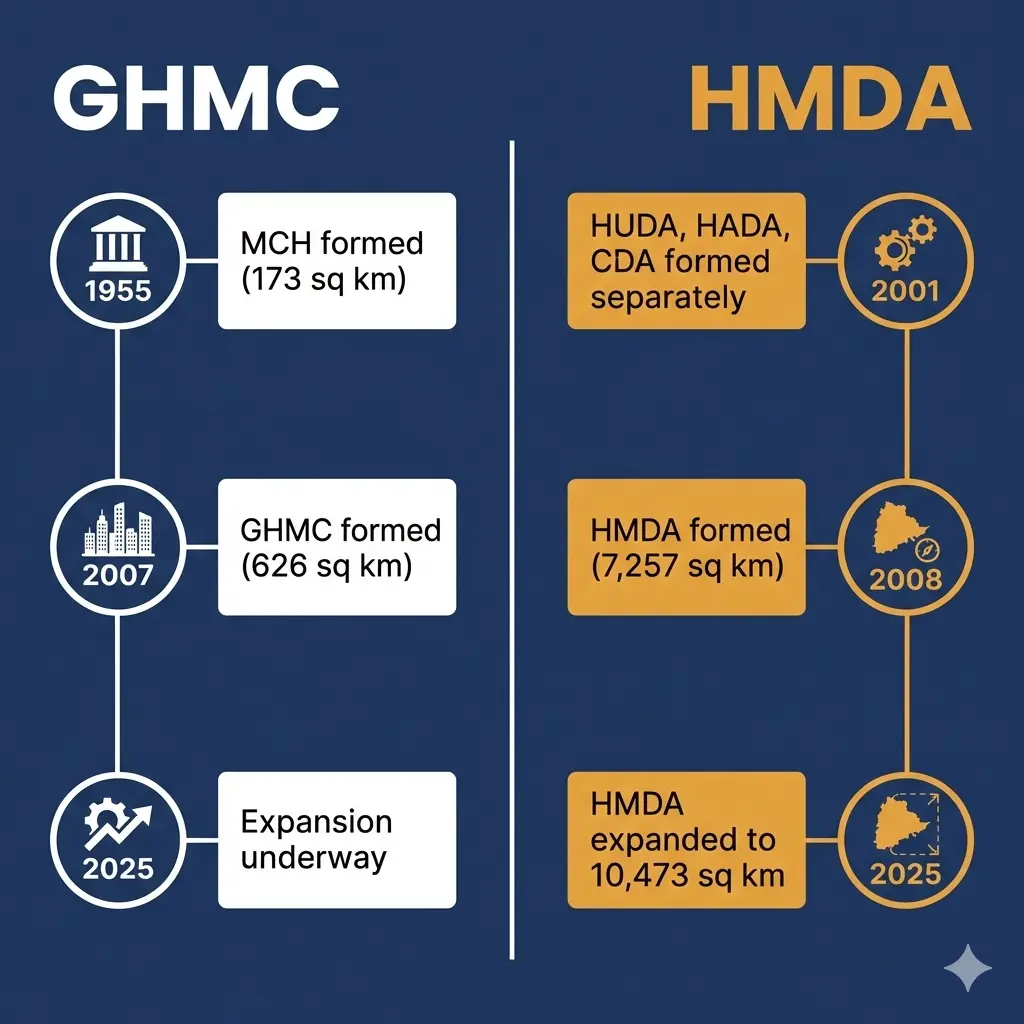
Flashback: GHMC was formed in 2007 from MCH megalopolises. HMDA was formed in 2008 from HUDA, HADA, CDA, and BPPA. One governs the municipality. The other plans the entire metropolitan region.
What GHMC Actually Does: The City's Caretaker
To understand the difference between GHMC and HMDA, know the Greater Hyderabad Municipal Corporation—were it a person, it would be the one who fixes your road potholes, collects your garbage, maintains the park where you walk your dog, and sends you a property tax bill that somehow always arrives on the most inconvenient day of the year. GHMC is fundamentally a civic services body. It keeps the city running at the local level.
Core Functions
Roads and Infrastructure:
It’s is responsible for building, maintaining, and repairing roads, footpaths, flyovers, and street lighting across its 626 sq km jurisdiction. Every pothole you’ve ever swerved around—that’s GHMC’s department.
Sanitation and Waste Management:
Solid waste collection, stormwater drains, and public toilets — all under GHMC. The corporation manages waste from over a million households across Hyderabad and Secunderabad daily.
Building Permissions (within its core jurisdiction):
It’s is the authority for approving residential and commercial building plans within its core 626 sq km. In 2024-25 alone, GHMC issued 13,421 building and layout permissions, generating ₹1,138 crore in revenue — a number that tells you exactly how busy Hyderabad’s development scene really is.
Trade Licenses and Revenue:
Parks and Public Spaces:
It maintains parks, playgrounds, and community spaces across Hyderabad. It also manages heritage structures within city limits.
One important thing to know: in the areas that have recently merged into GHMC from surrounding municipalities, it can only approve buildings up to seven floors on plots measuring up to 1,000 square meters. Anything bigger—high-rises, large layouts, gated communities, or townships—remains under HMDA’s jurisdiction even in those merged areas. This is a frequently misunderstood nuance of the difference between GHMC and HMDA that catches buyers off guard. This is a frequently misunderstood nuance of the difference between GHMC and HMDA that catches buyers off guard.
For individual homes on plots up to 500 sq yards and up to 10 meters in height, GHMC offers an instant self-certification system online. No queue, no wait—permissions generated on the spot. Technology, when it works, is wonderful. The difference between GHMC and HMDA. The difference between GHMC and HMDA.
What HMDA Actually Does: The Metropolitan Mastermind
The difference between GHMC and HMDA: To explain the difference between GHMC and HMDA, know that if GHMC is the city’s caretaker, HMDA is its long-range strategist. While GHMC worries about whether the storm drains are clear before the monsoon, HMDA is drawing the boundaries of where the next township will go, how wide the future ring road must be, and which green belts must be preserved so that Hyderabad doesn’t choke itself to death on its own growth. The Hyderabad Metropolitan Development Authority thinks in decades, not quarterly reports. Also If you’re interested Check out things to check before buying real estate in Hyderabad. and the 6 best places to invest in real estate Hyd.
Core Functions
Master Planning:
HMDA prepares and enforces the Metropolitan Development Plan — the overarching blueprint that governs how land is used, zoned, and developed across the entire Hyderabad Metropolitan Region (HMR). The HMDA Master Plan 2031 is the current governing document, specifying land use across every district under its jurisdiction. If you want to know what development is legally permitted on any plot in the metro region, the answer lives in that master plan.
Layout Approvals:
All residential layouts — including plots in Hyderabad’s peripheral areas — require HMDA approval. The difference between GHMC and HMDA. When a developer carves up agricultural land into a residential plotted development in areas like Shamshabad, Tellapur, Mokila, or Kompally, HMDA must sanction the layout plan before a single plot can be legally sold. This is why HMDA-approved layout status is the first thing a serious buyer checks.
High-Rise and Township Approvals:
For large-scale development — buildings above seven floors in extended GHMC areas, gated communities, integrated townships, and group housing projects — the approval authority is HMDA, regardless of whether the project technically sits within GHMC’s merged municipality boundaries. This was formally clarified as recently as January 2026, when HMDA confirmed it retains all high-rise and layout approval powers even in newly merged GHMC areas. The approval deadline is 10 days.
Infrastructure Projects:
The difference between GHMC and HMDA is that HMDA oversees regional infrastructure that goes beyond individual buildings — expressways, the Regional Ring Road alignment, regional parks, and coordination between Telangana’s state utility boards (water, sewerage, power transmission) within the metropolitan region.
HMDA Regulations and Zoning:
HMDA Regulations govern everything from floor space index (FSI) limits to setback requirements, green area mandates, and height restrictions in different zones across the HMR. Violating HMDA Regulations — building without approval, exceeding permitted heights, or selling unapproved layouts — can result in demolition notices, a reality that buyers in Shamshabad learned painfully in 2022 when layouts without HMDA approval were razed near the ORR.
Online Development Permissions:
The difference between GHMC and HMDA is that HMDA has moved most processes to TG-bPASS, Telangana’s unified online building permission portal. All layout permissions, building permissions in gram panchayats under HMDA’s jurisdiction, and Occupancy Certificates must now be applied through TG-bPASS. The HMDA portal (hmda.gov.in) also provides the Master Plan viewer, layout permission reports, and TDR (Transferable Development Rights) processing.
HMDA is chaired by the Chief Minister of Telangana — which tells you everything about how much political and strategic weight it carries in shaping Hyderabad’s long-term development. This isn’t a department. It’s the state’s urban development policy made institutional. The difference between GHMC and HMDA.
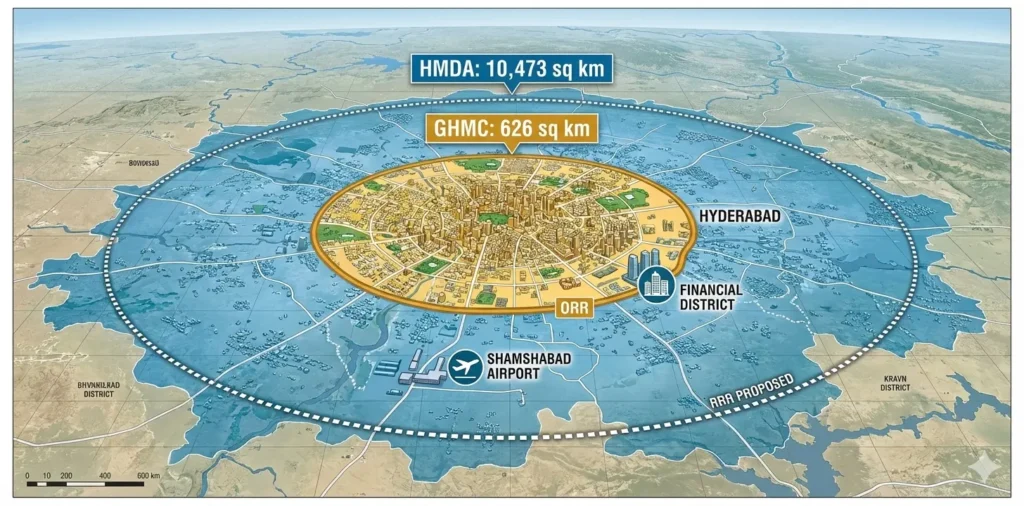
The Full Comparison: GHMC vs HMDA at a Glance
Here’s the side-by-side breakdown that answers the difference between GHMC and HMDA in every dimension that matters for a buyer, builder, or investor in Hyderabad: difference between GHMC and HMDA
Parameter | GHMC | HMDA |
Full Name | Greater Hyderabad Municipal Corporation | Hyderabad Metropolitan Development Authority |
Year Formed | 2007 (from MCH + 12 municipalities) | 2008 (merged HUDA, HADA, CDA, BPPA) |
Area Covered | ~626 sq km (core city) | ~10,473 sq km (11 districts) |
Role | Civic services & local administration | Regional planning & development |
Reports To | Municipal Commissioner (IAS) | Chaired by Chief Minister of Telangana |
Builds Approvals | Up to G+7 / plots ≤1,000 sq m (extended zones) | High-rises, layouts, townships, gated communities |
Zones | 5 zones, 18 circles, 150 wards | Covers 7–11 districts, per master plan |
Master Plan | Implements within city limits | Formulates & enforces metropolitan master plan |
Plots in Hyderabad | Approves within 626 sq km core | Approves all layouts in extended metro region |
Portal | ghmc.gov.in / DPMS | hmda.gov.in / TG-bPASS |
Why the Difference Between GHMC and HMDA Matters When Buying Property
Here’s where the difference between GHMC and HMDA stops being civic trivia and becomes something that affects your money, your legal standing, and potentially your ability to live in or sell the property you’ve paid for. difference between GHMC and HMDA.
For Buyers of Plots in Hyderabad
If your flat is in the core Hyderabad city limits — Banjara Hills, Jubilee Hills, Begumpet, Ameerpet, Madhapur, Gachibowli, or Kondapur — it falls under GHMC jurisdiction. The difference between GHMC and HMDA. The building approval from GHMC is what you need to verify. Check the GHMC DPMS portal or request the building permission order number from the developer and verify it independently.
The Overlap Zone — Where Things Get Interesting
Here’s where the difference between GHMC and HMDA gets genuinely complex. GHMC has been expanding its jurisdiction by absorbing surrounding municipalities and gram panchayats. But HMDA has made it clear that absorbing these areas into GHMC does not automatically transfer planning and approval powers to GHMC. High-rises and large layouts in those newly absorbed zones continue to require HMDA approval, not GHMC approval.
What this means practically: if a developer in a recently merged municipality tells you they have GHMC approval for a large gated community with 15-story towers, ask to see the HMDA approval as well. Both may be required. If only one exists, dig deeper before committing. The difference between GHMC and HMDA.
HMDA Regulations vs GHMC Bylaws — Who Rules Your Building?
HMDA Regulations govern the metropolitan region, while GHMC operates under its own building bylaws (most recently updated as GHMC Bylaws 2020). Within GHMC’s core 626 sq km, GHMC bylaws apply. Outside that zone but within the HMDA metropolitan region (which is most of the area investors are currently eyeing for development), HMDA Regulations apply — including FSI rules, permissible heights relative to road widths, setback requirements, and green area mandates. The difference between GHMC and HMDA.
For Apartment Buyers in the Core City
If your flat is in the core Hyderabad city limits — Banjara Hills, Jubilee Hills, Begumpet, Ameerpet, Madhapur, Gachibowli, or Kondapur — it falls under GHMC jurisdiction. The building approval from GHMC is what you need to verify. Check the GHMC DPMS portal or request the building permission order number from the developer and verify it independently.
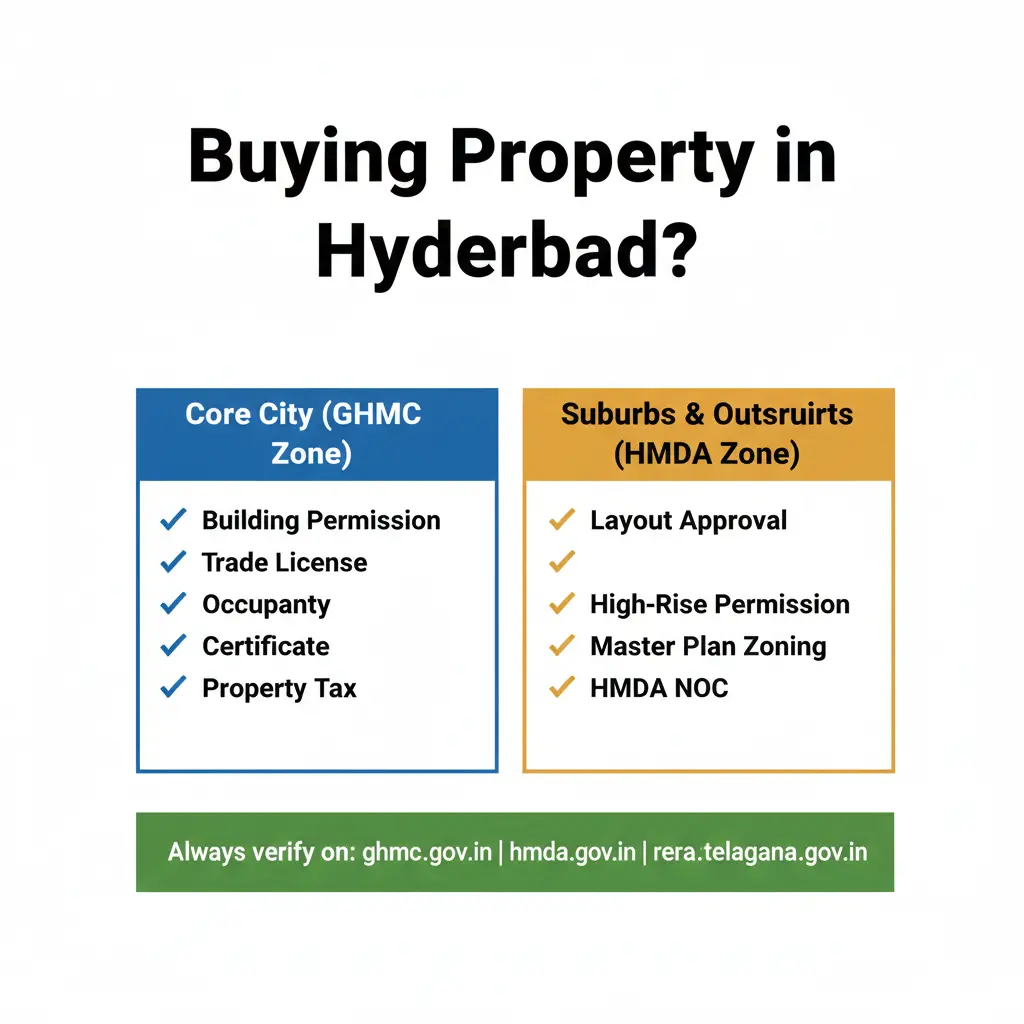
The rule of thumb: if it’s inside the core GHMC zone, check GHMC. If it’s outside — any suburb, township, or plotted development on the city’s outskirts — HMDA is your primary authority. When in doubt, check both portals.
How to Actually Verify GHMC or HMDA Approval (The Practical Guide)
Step 1: Determine Which Authority Governs Your Property
Visit hmda.gov.in → Master Planning 2031 → Map viewer. Enter the location or survey number of the property. The map will show you which zone the land falls under — GHMC, HMDA, DTCP, or another authority. This is your starting point. The difference between GHMC and HMDA.
Step 2: Verify the Approval on the Relevant Portal
Here is the difference between GHMC and HMDA.
For GHMC: Visit ghmc.gov.in or the TS-bPASS portal. Use the ‘Building Permissions’ search with the file or application number provided by the developer. The approval order, approved plans, and Occupancy Certificate (OC) status are all verifiable online.
For HMDA: Visit hmda.gov.in → Layout Permissions → Layout Permission Report. Enter the layout name or file number. HMDA will show the approval status, sanctioned layout plan, and development conditions attached to the approval.
Step 3: Cross-Check TGRERA Registration
For any under-construction project — whether under GHMC or HMDA — verify RERA registration at rera.telangana.gov.in. RERA registration does not replace GHMC or HMDA approval — it’s additional verification that the developer has disclosed the project legally and is accountable under the Real Estate Regulatory Act.
Step 4: Engage a Property Lawyer
For any purchase above ₹25–30 lakh, spend ₹5,000–₹15,000 on a registered property lawyer to conduct title verification, confirm the approval chain, and check for any encumbrances. The cost is trivial. The protection is substantial.
Quick shortcut: Search ‘[project name] GHMC approval’ or ‘[layout name] HMDA approved’ on Google. If no credible result appears, or if the developer can’t provide the approval number immediately, treat that as a red flag before you treat it as a home.
The Bottom Line: Two Bodies, One City, Your Peace of Mind
The difference between GHMC and HMDA is ultimately the difference between local governance and regional planning. GHMC keeps Hyderabad functioning day to day. HMDA shapes where Hyderabad is headed decade to decade. Both are essential. Both have real power over your property. And both need to be checked before you invest.
For buyers in the core city, GHMC approval is your primary verification. For buyers of plots in Hyderabad’s growing suburban corridors—the places where most of today’s investment action is happening—HMDA approval is non-negotiable. For large projects anywhere in the metropolitan region, you likely need both, and you should check both without exception.
The HMDA regulations and GHMC bylaws that govern development in Hyderabad exist not to confuse you, but to protect you—and every other buyer—from illegal development, unauthorized layouts, and unsafe buildings. Learning to navigate them isn’t optional if you’re serious about investing in this market. Consider this guide your orientation.
FAQs
Q1. What is the main difference between GHMC and HMDA?
The difference between GHMC and HMDA is that GHMC (Greater Hyderabad Municipal Corporation) is the local urban body that delivers civic services—roads, sanitation, water, building permissions—within core Hyderabad (≈626 sq km). HMDA (Hyderabad Metropolitan Development Authority) is the regional planning authority that governs land use, layout approvals, and high-rise permissions across the entire Hyderabad Metropolitan Region (≈10,473 sq km). The difference between GHMC and HMDA in simplest terms: GHMC runs the city day-to-day; HMDA plans where and how it grows.
Q2. When was GHMC formed, and what areas does it cover?
GHMC—the GHMC Lesser Hyderabad external pot was formed in April 2007 by incorporating the Municipal Corporation of Hyderabad (MCH) with 12 cosmopolises and 8 gram panchayats from Ranga Reddy and Medak sections. It covers roughly 626 sq km divided into 5 zones, 18 circles, and 150 wards. It’s headed by a municipal commissioner (IAS rank).
Q3. What is HMDA and how large is its jurisdiction?
The Hyderabad Metropolitan Development Authority (HMDA) was formed in 2008 by merging HUDA, HADA, CDA, and BPPA. Initially covering 7,257 sq km across 7 districts, HMDA’s jurisdiction expanded in March 2025 to approximately 10,473 sq km across 11 districts, covering 1,355 revenue villages. It is chaired by the Chief Minister of Telangana. The difference between GHMC and HMDA.
Q4. Do I need GHMC or HMDA approval for plots in Hyderabad?
The difference between GHMC and HMDA is that It depends on location. Plots in Hyderabad’s core city (within ≈626 sq km) require GHMC approval. Plots in suburban and peripheral areas — Shamshabad, Tellapur, Mokila, Kompally, Adibatla, Narsingi — require HMDA layout approval. For any plotted development outside the GHMC core, always verify HMDA approval first. Unapproved layouts in HMDA zones can be demolished.
Q5. Can GHMC approve high-rise buildings in extended municipal areas?
No. In areas recently merged into GHMC from surrounding municipalities, GHMC can only approve buildings up to 7 floors on plots up to 1,000 sq m. High-rise buildings, large layouts, gated communities, and townships — even in those merged zones — remain under HMDA jurisdiction. HMDA formally confirmed this as recently as January 2026.
Q6. What are HMDA Regulations and why do they matter?
HMDA Regulations are the legal framework governing land use, zoning, permissible FSI, building heights, setbacks, and development conditions across the Hyderabad Metropolitan Region. They are derived from the HMDA Act 2008 and implemented through the HMDA Master Plan 2031. Any construction, layout, or development in the HMDA zone that violates these regulations is illegal and can face demolition. Understanding HMDA Regulations is essential before investing in any property outside GHMC’s core limits.
Q7. How do I check whether a property is in GHMC or HMDA limits?
Visit hmda.gov.in → Master Planning 2031 → Map Viewer and search the location or survey number. The map will show the governing authority. For GHMC verification, use ghmc.gov.in or the TS-bPASS portal. For HMDA layout verification, use hmda.gov.in → Planning → Layout Permission Report. Always cross-reference with TGRERA at rera.telangana.gov.in for under-construction projects.
Q8. Is HMDA approval enough to buy a plot, or do I need GHMC approval too?
HMDA layout approval is the primary requirement for plots in Hyderabad’s suburban and extended zones. However, for the actual construction of a building on that plot, you will also need a building permission — either from GHMC (if the plot is in the merged GHMC area) or from HMDA (if it’s in a gram panchayat under HMDA jurisdiction). Layout approval and building approval are two separate permissions.
Q9. What is the TG-bPASS portal and how does it relate to GHMC and HMDA?
TG-bPASS (Telangana State Building Permission Approval and Self-Certification System) is the Telangana government’s unified online portal for processing building permissions across the state. Both GHMC and HMDA have migrated their permission processes to TG-bPASS. All new building applications in plots above 2,000 sq m, all layout permissions, and all Occupancy Certificates under HMDA jurisdiction must now be submitted through TG-bPASS only.
Q10. What happened to layouts near the ORR that didn't have HMDA approval?
In 2022, several unapproved layouts near the Outer Ring Road in Shamshabad and surrounding areas were demolished by authorities for lacking HMDA approval. This was a stark reminder that buying plots in Hyderabad’s growth corridors without verified HMDA layout approval is a serious legal and financial risk. HMDA regulations require all layouts in the metropolitan region to be sanctioned before any plot sale. No approval = no legal standing.