
Introduction: Panic, Headlines, and the Truth Behind the Noise
In recent months, the phrase “real estate crash in Hyderabad” has been circulating widely across social media, WhatsApp groups, YouTube channels, and even casual conversations among investors. With skyrocketing prices over the past few years followed by a noticeable slowdown in transactions, many are questioning whether Hyderabad’s once-booming property market is now heading toward a downturn.
But is Hyderabad truly facing a real estate crash—or is the market simply undergoing a natural correction?
To answer this, we need to move beyond speculation and examine the data, economic fundamentals, supply-demand dynamics, and long-term growth drivers of the city. This article provides a comprehensive, professional analysis of Hyderabad’s real estate market, helping buyers, investors, and industry professionals make informed decisions, Real Estate Crash in Hyderabad.
Understanding What a Real Estate “Crash” Really Means
Before labeling any market condition as a “crash,” it’s important to understand what the term actually implies.
A real estate crash is typically characterized by:
- A sharp and sustained drop in property prices (often 20%–40% or more)
- A significant mismatch between supply and demand
- High inventory levels with unsold units
- Declining transaction volumes
- Financial distress among developers
- External economic shocks (recession, job losses, banking crisis)
Historically, real estate crashes are rare and usually triggered by systemic economic failures. More commonly, markets experience corrections or slowdowns, which are part of a healthy economic cycle.
Market Cycle Overview:
- Growth Phase
- Peak Phase
- Correction Phase
- Stabilization Phase
- Recovery Phase
Hyderabad is currently transitioning between the peak and correction phase, not a crash, Real Estate Crash in Hyderabad.
Hyderabad’s Real Estate Boom: A Decade of Growth
To understand the present, we must first understand the past.
Over the last decade, Hyderabad has emerged as one of India’s most attractive real estate markets. Unlike cities such as Mumbai or Delhi NCR, Hyderabad offered a combination of affordability, infrastructure, and economic growth.
Key Growth Drivers (2015–2024)
1. IT and Corporate Expansion
The development of major IT corridors such as:
HITEC City
Gachibowli
Financial District
Attracted global companies including Microsoft, Google, Amazon, and Facebook, creating massive employment opportunities.
2. Infrastructure Development
Major projects like:
Outer Ring Road (ORR)
Hyderabad Metro Rail
Upcoming Regional Ring Road (RRR)
Improved connectivity and expanded urban boundaries.
3. Government Policies
The Telangana government introduced investor-friendly policies such as:
TS-iPASS (fast-track approvals)
RERA implementation (transparency)
Ease of doing business reforms
4. Affordable Pricing Advantage
Compared to Bengaluru, Mumbai, and Gurgaon, Hyderabad offered relatively affordable property prices, attracting both end-users and investors.
5. NRI Investment Surge
NRIs viewed Hyderabad as a stable and high-return investment destination, contributing to increased demand.
Real Estate Crash in Hyderabad.
What Triggered the “Crash” Narrative?
Despite strong fundamentals, several recent developments have fueled speculation about a possible crash.
1. Rapid Price Appreciation
Property prices in key areas like Gachibowli, Kokapet, and Financial District have doubled in the last 5–7 years. This rapid increase has raised concerns about overvaluation.
2. Inventory Build-Up
Certain micro-markets are witnessing:
Increased unsold inventory
Large-scale high-rise projects nearing completion
Oversupply in luxury housing segments
3. Rising Interest Rates
Higher home loan interest rates have:
Increased EMIs
Reduced affordability for middle-class buyers
Slowed down new bookings
4. Investor Pullback
Speculative investors who entered the market during the boom phase are now:
Holding off new investments
Waiting for price corrections
Avoiding bulk purchases
5. Global Economic Uncertainty
IT layoffs and hiring slowdowns
Inflation concerns
Global recession fears
These factors have impacted buyer sentiment, Real Estate Crash in Hyderabad.
Reality Check: Is Hyderabad Facing a Crash?
The short answer is: No, Hyderabad is not experiencing a real estate crash.
What Is Actually Happening?
- Price growth has slowed significantly
- Developers are offering discounts and flexible payment plans
- Buyers have more negotiation power
- Transaction volumes have stabilized
What Is NOT Happening?
- No widespread price collapse across the city
- No major developer bankruptcies
- No large-scale project cancellations
- No panic selling
Expert Interpretation:
Hyderabad is undergoing a market correction, which is a normal and healthy phase after a period of rapid growth.
Real Estate Crash in Hyderabad.
Area-Wise Market Analysis
Hyderabad is not a uniform market. Different areas behave differently based on demand, supply, and infrastructure.
High-Demand Stable Areas
- Gachibowli
- Financial District
- Madhapur
- Kondapur
These areas continue to see strong demand due to proximity to IT hubs and employment centers. Rental demand is also high, ensuring price stability, Real Estate Crash in Hyderabad.
Overheated or Risk-Prone Areas
- Kokapet
- Tellapur
- Narsingi
These locations experienced rapid price hikes and large-scale developments, leading to potential oversupply, Real Estate Crash in Hyderabad.
Emerging Growth Corridors
- Patancheru
- Adibatla
- Shamshabad
These areas offer:
- Lower entry prices
- Future infrastructure development.
- Long-term appreciation potential
Real Estate Crash in Hyderabad
Supply vs Demand Dynamics
Supply Side
- Surge in residential construction
- Increase in luxury and high-rise projects
- Expansion into peripheral areas
Demand Side
- End-users still active
- Investors becoming cautious
- Strong rental demand in IT corridors
Key Insight
Oversupply is primarily concentrated in the premium and luxury segment, while mid-range housing remains relatively stable.
Real Estate Crash in Hyderabad.
The Role of the IT Industry
Hyderabad’s real estate market is closely tied to the IT sector.
Positive Factors
- Continued expansion of global tech companies
- Strong long-term employment outlook
- Competitive advantage over other cities
Concerns
- Temporary hiring slowdowns
- Layoffs affecting buyer confidence
Conclusion
While short-term fluctuations exist, the IT sector remains a strong long-term growth driver, Real Estate Crash in Hyderabad.
Rental Market: A Strong Indicator
Interestingly, Hyderabad’s rental market tells a different story.
Current Trends
- Rising rental demand
- Increased rental yields
- Low vacancy rates in prime areas
This indicates that actual housing demand remains strong, contradicting the crash narrative.
Real Estate Crash in Hyderabad.
Government Policies and Their Impact
Government initiatives continue to support the market.
Key Policies
- RERA: Increased transparency
- Infrastructure investments
- Business-friendly environment
Impact
- Boosted buyer confidence
- Encouraged organized development
- Reduced fraudulent practices
Real Estate Crash in Hyderabad.
Comparison with Other Indian Cities
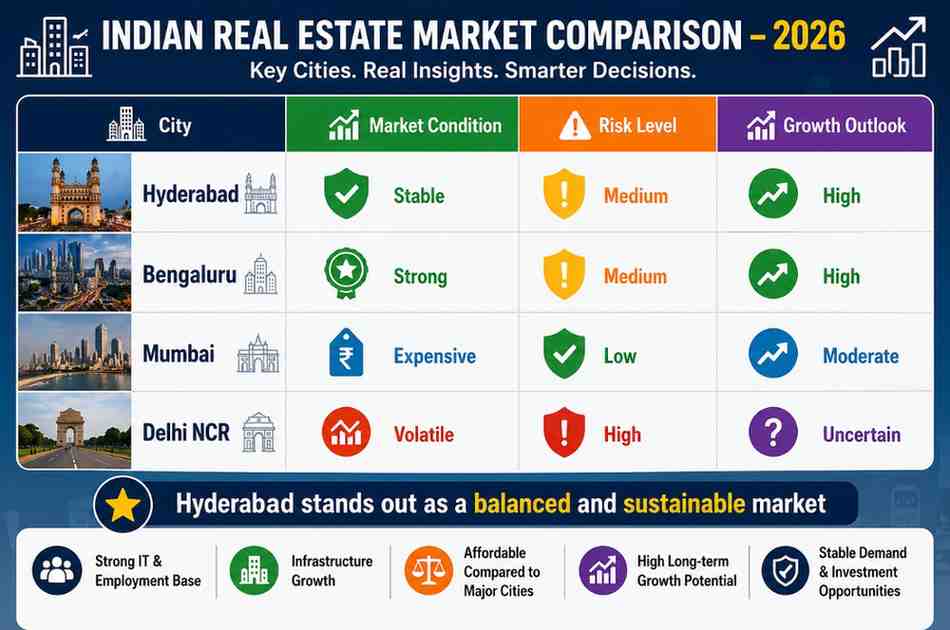
Developers Are Still Investing (Strong Confidence Signal)
Recent news shows continued investment:
A major developer acquired 5.72 acres for new residential projects
👉 If a crash was coming:
Builders would stop buying land ❌
Projects would be cancelled ❌
👉 Instead:
Expansion is still happening ✅
💡 Developers invest only when they expect future demand.
Real Estate Crash in Hyderabad.
Government Is Increasing Property Values (Not Reducing Them)
Real Estate Crash in Hyderabad, One of the strongest signals:
Telangana government is planning 30–50% increase in land values
Registration values being revised upward
👉 In a crash scenario:
Government reduces values ❌
👉 In Hyderabad:
Government is raising values ✅
💡 This reflects confidence in long-term market strength.
Real Estate Crash in Hyderabad.
Policy Changes Are Affecting the Market (Short-Term Disruption)
Real Estate Crash in Hyderabad, Recent regulatory shifts:
New policies like TDR increased project costs
Developers facing planning challenges
👉 Impact:
Temporary slowdown
Delayed launches
Higher construction costs
💡 This is a policy-driven adjustment, not a crash.
Construction Activity Is Still Strong
High-rise approvals have nearly doubled
Hyderabad now has ~1,800 high-rise buildings
👉 This indicates:
Long-term urban expansion
Strong developer pipeline
💡 A crashing market does NOT build aggressively.
Real Estate Crash in Hyderabad.
Market Is Shifting, Not Collapsing
A key trend emerging:
Shift from luxury → mid-range housing
Smaller deals replacing large investments
👉 Meaning:
Market is rebalancing
Demand is changing, not disappearing.
Real Estate Crash in Hyderabad.
Expansion Beyond Hyderabad (Hidden Growth Signal)
Real estate activity spreading to Tier-2 cities in Telangana
👉 Interpretation:
Growth is diversifying
Pressure on Hyderabad core market reducing
💡 This is a maturity sign, not a collapse.
Real Estate Crash in Hyderabad.
⚖️ Final Reality Check (Data vs Rumors)
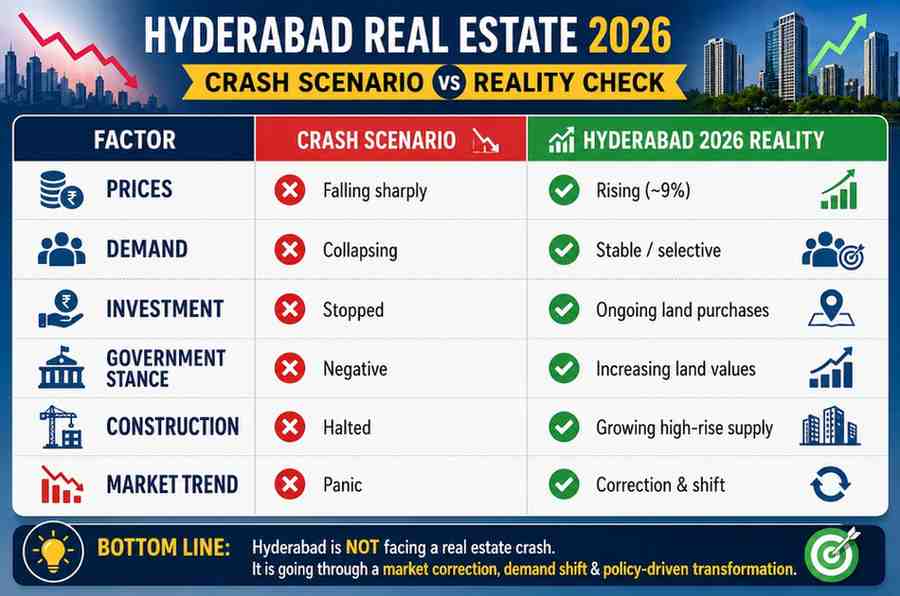
🧠 Final Verdict (Based on Latest News)
👉 Hyderabad is NOT facing a real estate crash
👉 It is going through a:
✔ Market Correction
✔ Demand Shift
✔ Policy Adjustment Phase
🎯 Simple Explanation
- 2020–2023 → Boom phase
- 2024–2026 → Cooling / correction phase
- 2026+ → Stable growth expected
💡 Bottom Line
The “real estate crash in Hyderabad” is:
👉 A myth driven by slowdown + fear
👉 Not supported by actual data