
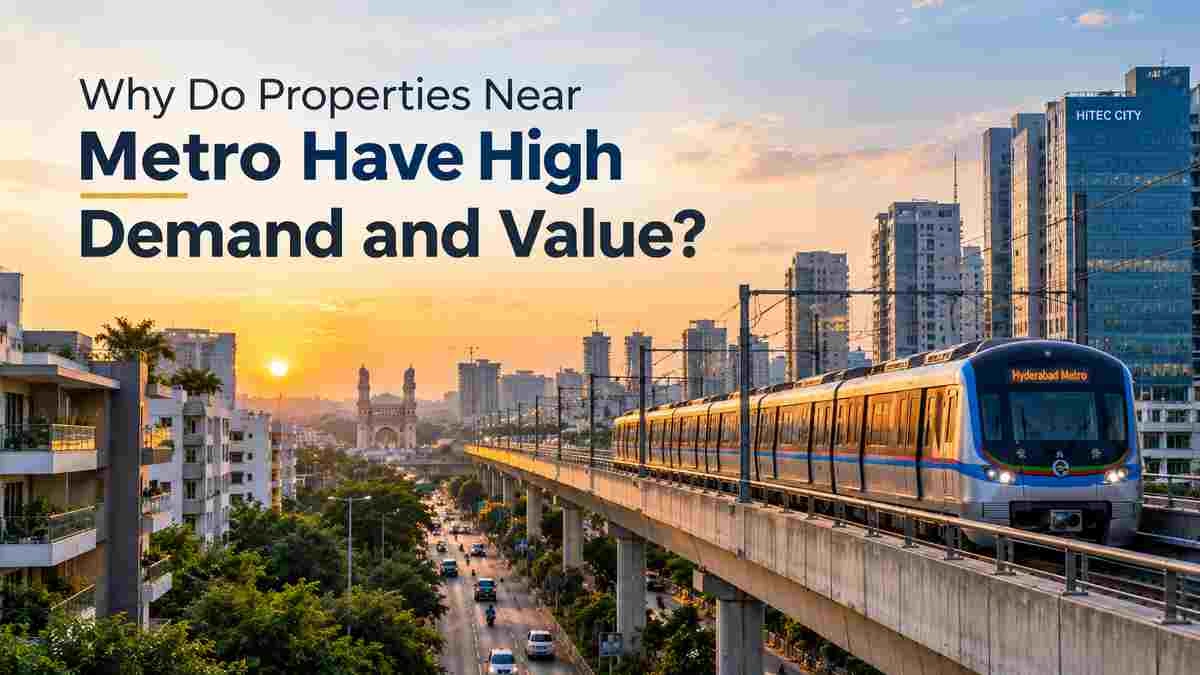
Introduction: Why Metro Connectivity Matters in Real Estate
For many people, the daily commute is one of the biggest factors when choosing where to live or work. An apartment can look luxurious, be equipped with the best facilities and come with a decent price tag but eventually if it takes too long for you to reach office or school and the other usual places. This can also influence property value because accessibility often affects how buyers and tenants perceive a location.
A metro station can change the entire perception of a location among real estate investors The hitherto neglected/remote peripheral areas now have access to IT and commercial nerve centers and thus attract much attention from builders and real estate developers.
The benefits of an ideal metro connectivity For Homebuyers: An easier and consistent daily commute to work and other places. Reduces reliance on private vehicles, Saves time and reduces stress during your commute. For Investors greater access to potential tenants, higher rental demand, and increased potential for capital appreciation on your investment.
To put it in simplest terms, access can affect the demand for property. If you make the place more accessible for more people you make them more likely to want to come to place to live, play, shop or do business, hence this increases the rental demand and property value near metro stations
This is not just restricted to residential properties though. Commercial spaces like shops, offices and also rental properties can do well with increased metro access to their location. Companies would tend to favor areas easily accessible to both staff and clients, while shops may find good footfall in well-linked locations.
Therefore a metro station is not merely just about a mode of transit. It could be that one element that contributes to the destination as a whole and it’s ability for development and also a major factor in increasing rental demand and property value around it. If you’re a prospective purchaser or a seller for property right now knowing how transportation is correlated with property values will help you.
1. How Metro Connectivity Influences Property Demand
1.1 Improved Accessibility Attracts More Homebuyers
It is often accessibility that determines when a buyer begins to look at another property if both homes are comparable. A buyer might love the many amenities of a property, its contemporary design and its favorable price, but if going into work every morning is an inconvenient feat, the homes attractiveness might swiftly diminish.
Properties near metro stations that have a certain appeal to buyers. Metro accessibility gives owners the convenience of traversing through certain parts of a city without needing the private transportation on hand for an accessible daily trip to any desired city locale. Metro stations can serve as access points that, depending on the city and its connectivity and stations, can take buyers to:
- Major employment and business hubs
- Educational institutions and colleges
- Shopping and entertainment areas
- Hospitals and healthcare facilities
- Railway stations and other transport hubs
- Important residential and commercial districts
For someone in the workforce, finding a way to cut time from their daily travel would go a long way to improve their quality of life, Similarly a family or a student might place emphasis on finding a home within easy access to multiple crucial services via public transport. Thus properties near metro stations could attract a wider range of buyers than otherwise comparable properties in a poorly serviced area.
1.2 Reduced Dependence on Private Vehicles
You buy a car or bike, the day-to-day life becomes convenient. Nevertheless owning a car also includes costs such as money to be spent on fuel, parking, insurance, maintenance as well as stress caused by traffic. But, if you get metro connectivity, then you, as a resident, who happens to live near a station, also get an alternative. This can be a huge draw for young professionals, young families and college students. So, for some homeowners, metro connectivity is about more than the real estate value of the location.
1.3 Better Connectivity Expands the Property’s Catchment Area
Metro connectivity can link up localities considered too far away from key business or commercial centers For a decade, maybe it wasn’t a comfortable travel option – decades away from a main business district in a remote corner of town that took hours of bus rides. If a metro line is laid connecting these areas, suddenly, travelling to that part of town may become feasible. What it does is extend the catchment area – potential tenants or buyers would now be more than happy to consider the property, knowing the access has drastically improved. The extended demand might even encourage retailers, companies, and real estate developers in the region, Hence increasing the property value.
2. Why Properties Near Metro Stations Command Higher Prices
2.1 The Accessibility Premium
Another factor that contributes to high real estate values around metro stations is the so-called ‘accessibility premium.’ Basically, they will pay a premium to live closer to and be more accessible from their place of work. They pay not just for the land but for the accessibility to public transportation that it affords. However, the actual values of the premium vary. A property on the metro a kilometer from a station could be very different value to a property that is at the same distance from the metro station but at the bottom of a street with a terrible road base, drainage and pedestrian pathways.
Some of the factors contributing to this accessibility premium include:
- Distance from the station
- Quality of pedestrian access
- Neighborhood infrastructure
- Metro network connectivity
- Nearby employment hubs
- Availability of schools and hospitals
- Overall demand in the locality
- Quality of the property itself
Therefore, real estate values around metro stations do not depend only on proximity to the station.
2.2 Higher Demand Creates Upward Price Pressure
Here also, the law of supply and demand takes effect. An increased number of people wanting to buy property in an area can make listed available properties increasingly competitive. Should the supply of these properties remain stationary while demand grows, property owners can have an increasing leverage over property prices.
Existing metro corridors attract this effect, as they continue to benefit from a ready developed transport infrastructure in the neighborhood and surround themselves with both developed as well as growing areas for both residential and commercial use.
Properties near metro stations cost higher than otherwise equal properties lying away from this access point. Buyers must however research their prospects keenly, such prices might be justified only if it brings adequate additional advantages with regard to transport, amenities, utilities or future expectations.
2.3 Location Becomes a Stronger Selling Point
Location has long driven real estate – but with metro connectivity, sellers have yet another valuable advantage.
Terms like “within walking distance of metro station” or “good metro connectivity” can tell potential buyers or tenants at a glance that the building is convenient and well connected. Developers can also leverage connectivity to the metro as a key element in their promotion campaigns, while private sellers have yet another factor to help differentiate their apartment or house from others. Such little extra things can really trim a buyer’s list in this busy marketplace.
3. The Impact of Walking Distance From a Metro Station
3.1 What Is Considered “Near” a Metro Station?
“Close” to a metro station does not necessarily mean that the property must be adjacent to the station. A property can still be well-connected by people being able to access the station at ease without too long a walk. However, what this actually is can differ greatly from person to person, depending heavily on the surrounding environment.
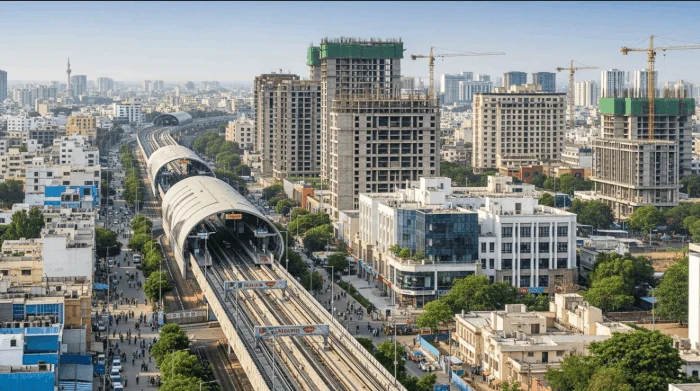
A 10 minutes’ walk down a shady path with smooth pavements can really feel a much easier distance compared to a mere 5 minutes’ across a road that sees very heavy traffic and with no adequate pedestrian infrastructure. Weather conditions too would surely have to be considered. With unbearable summers or torrential monsoon weather, the walk to the metro station can appear a lot shorter than it actually is according to any map distance calculation. So, would-be owners of a property should have actual walk-arounds as opposed to checking the linear distance as suggested on the maps
3.2 Why Walkable Metro Access Matters
Proximity to a metro station and easy accessibility is fundamentally different to having said proximity.
Accessible routes may contain the following:
- Proper sidewalks
- Safe road crossings
- Street lighting
- Clear pedestrian routes
- Reasonable traffic conditions
- Safety during different hours
- Last-mile transportation options
The walking time from a station may be a key factor affecting the demand of the property along with pedestrian safety. A plot that is only marginally closer to a station but has access over a busy and hazardous road should not automatically deliver equivalent value, especially for families with young children, the elderly or those travelling daily in and out of a town or city center.
3.3 The “Walk-to-Metro” Advantage
Walking to an station is a lifestyle benefit The commute, for most, isn’t just the time spent at the metro. Office workers use private vehicles a bit less. Students can move about more easily. Tenants without own transport can access the rest of town better. Consequently homes with functional walking distances to a metro station often fetch better rental demand and premiums than homes requiring one to even reach the metro station. That means metro convenience is only as good as a hassle free, total-journey solution.
4. Metro Stations and Rental Property Demand
4.1 Why Tenants Prefer Metro-Connected Properties
A common preference from tenants arises due to reasons of convenience, possibly owing to the fact that they might not be occupying the same rental property for decades: A working professional may agree to a smaller dwelling, if considerable traveling time is saved each day traveling to his or her workplace. Similarly, for students, values of properties near metro stations would be preferably higher in the list as it offers access to colleges, institutes of higher learning, workplaces and leisure centers alike. Hence, rental properties near metro stations have tenants falling in all types of categories.
4.2 Potential for Better Rental Demand
A well connected area can perhaps attract a wide customer segment, Larger the market segment a property can attract, greater is the prospect of landing up a suitable tenant immediately upon vacancy. That may not directly mean high occupancy every time a property is in a metro station area, but connectivity can assist well.
Rental market segment for properties at metro stations:
- Young professionals
- Students
- Corporate employees
- Frequent commuters
- People without private vehicles
- Tenants working in nearby commercial hubs
The surrounding neighborhood still matters. A poorly maintained building or overpriced apartment may struggle even if it is close to a station.
4.3 Metro Connectivity and Rental Income
High rental demand can have the ability to strengthen rental income; however an investor cannot assume that the largest monthly rent guarantees better overall investment returns. The real rental computation should include : Rental Income + Property appreciation potential – Property expenses = Overall Investment Returns
An investor’s study of property costs must take into account purchase price, potential rental income, maintenance charges, taxes, vacancy issues and other related costs of ownership. A property that has only marginally more, for example, at a far greater price will never be better the investment yield compared to a lesser expensive but at greater distances from the station, for that reason metro link should be used as component of the entire computation not the actual computation on its own.
4.4 Who Benefits Most From Metro-Connected Rentals?
This type of rent, being linked to the metro, can be really advantageous to people whose life relies mostly on this mode of transport in their day to day lives. Young professionals are sure to want shorter travel times to their offices while students can avail great mobility. Easy commuting for business employees even though their workplace isn’t necessarily right behind their house. The Landlord can advertise his home to a much larger customer base.
5. How Metro Connectivity Benefits Real Estate Investors
5.1 Stronger Resale Potential
Usually investors prefer to own an asset that will appeal to new buyers by the time they wish to part ways with it. A property that is easily accessible might attract a larger pool of interested parties as well, because if one interested party did not attach value for excellent metro station proximity, perhaps another buyer will seek it. Hence it can enhance marketability of property and thereby liquidity. Nevertheless, depends on the condition of the property , its market price and the up-coming neighborhood projects along with overall market scenario.
5.2 Long-Term Appreciation Potential
Access to the urban center is a service that Metro infrastructure can be used to support neighborhood development and as connectivity grows so does residential developments, shops, service industries and shops who may wish to invest in a neighborhood, promoting greater vitality and possible property value appreciation for properties near metro stations. Not to be considered as part of metro development potential as an investor must first analyze local business/job growth, local population flow patterns, current infrastructure and development plans, current market supply/demand and general economic health of the region.
5.3 Greater Investment Visibility
Since these properties were located by a metro station therefore they have desirability value for. Businesses, retailers, housing developments, prospective consumers, developers etc. May compete for a site in that area.
The following may initiate a regenerative process cycle Connectivity of the property makes it more desirable. The high density of people will draw local users of local services and local businesses. This will give rise to draw businesses to the location since there is increased activity and hence increased commercial activity. The more service businesses and the more firms located in that position, and the more development and success will follow.
6. How Metro Stations Drive Commercial Real Estate Growth
6.1 Increased Foot Traffic
With the metro bringing commuters to an area on an ongoing basis during the day there are clear benefits for both retailers and services which benefit from this pedestrian flow. Restaurants, cafes, shops like a convenience store, a pharmacy and small stores are a couple of examples where the flow of commuters could mean valuable business. Nevertheless the best spots are unlikely to be right by the entrance to the metro station itself – there is also the question of visibility, access to the site, rent and type of stores adjacent to each other in the area.
6.2 Demand for Offices and Commercial Spaces
Businesses prefer places with employees and customers that are accessible. If an office location has easy access to a metro station, it might appeal to those who use public transport as their means of commuting to work, or who would like their client meetings or visits to occur in an easily accessible area, thus enhancing interest for commercial properties near metro stations, especially if that station has a direct link to employment areas.
6.3 Growth of Retail and Mixed-Use Developments
The infrastructure along metro corridors can stimulate the growth of multi use neighborhoods in which activities from housing, commercial services and retailing can take place in close proximity. This concept has strong links to transit oriented development, commonly known as TOD or Transit Oriented Development which considers that development should not take place around separate transportation networks and the real estate, but rather developing vibrant neighborhoods around transit stops
7. The Role of Transit-Oriented Development in Property Values
7.1 What Is Transit-Oriented Development?
Transit-oriented development is about bringing together residential, commercial and public spaces in close proximity to transit. It’s about making things close to people instead of having people travel a long way from their homes to their offices or shops and the transit system. An area with TOD uses might contain:
- Residential buildings
- Offices
- Retail stores
- Restaurants
- Public spaces
- Pedestrian-friendly streets
- Access to public transportation
This can make an area more convenient and active.
7.2 Why TOD Can Increase Neighborhood Attractiveness
Good transit oriented development has the potential to upgrade many dimensions of a neighborhood simultaneously. Easier travel is achieved through the improved connectivity. Residents rely less on cars with increased walkability. Proximity to services through mixed-use development makes it more convenient for inhabitants. Retail brings business to the neighborhood encouraging visits. These collectively bring down the livability of the neighborhood along with its investment profile.
7.3 How TOD Can Influence Real Estate Demand
Transport & development considered together would seem to produce a lively, and integrated area. This may also have effects on the demand, not only for residential uses (on properties that lie near metro stops), but also for offices, retail outlets and other uses as well. A successful plan should; A building dropped above a metro station does not itself imply TOD; only if roads, footpaths, parking provisions, open areas and utility installation are evaluated.
8. Other Factors That Determine Property Value Near Metro Stations
Metro connectivity is important, but it should never be treated as the only factor determining property value.
8.1 Neighborhood Infrastructure
A metro station cannot compensate for poor basic infrastructure.
Before buying a property, investors should examine:
- Road quality
- Drainage
- Electricity supply
- Water availability
- Internet connectivity
- Public facilities
- Waste management
A well-connected property in a poorly maintained neighborhood may not offer the same long-term value as a slightly farther property in a better-developed locality.
8.2 Proximity to Employment and Business Hubs
A metro connectivity becomes even more important when it enables access within minimum duration to the major business hubs. In the event that a suburban development is connected by the means of the metro transit to a key IT park, the main business district, and/or an industrial/commercial district; it would undoubtedly be beneficial for every single individual who earns a livelihood in that area. The vital mistake that most prospective buyers tend to overlook is that only the nearest Metro connectivity should be verified when reviewing connectivity of a location.
8.3 Schools, Hospitals, and Essential Services
Schools, hospitals, shops and other services influence a family’s decision to purchase a home. A home may not seem appealing if it has the benefit of a metro station but a distant access to the local services. Generally, a desirable area to live in will have many amenities reachable within a short range.
8.4 Safety and Walkability
Safety can have a great deal of influence over the true utility of metro connectivity. Though the station may be in physical proximity of a property, the walk to the station might have poor lighting, unsafe crossings or a high volume of traffic which deters from the walk itself. This is the reason why potential buyers must physically visit the route to know its true accessibility, and not rely on the mapping entirely
8.5 Quality and Reliability of Metro Services
Not all metro connectivity provides the same value.
Investors should consider:
- Train frequency
- Network coverage
- Service reliability
- Interchange connections
- Operating hours
- Access to other transport modes
A station connected to several important corridors may provide more value than a station with limited network coverage.
9. Are Properties Right Next to Metro Stations Always Better?
9.1 Noise and Congestion Concerns
However, being too close to the metro station has some cons of its own as well Depending on the actual area, residents could be subject to more noise, traffic and pedestrian activity. Those properties immediately next to an operational station could also “have more transient activity”. Consequently, buyers may not want to be immediately next to the station and will be looking for the next one over.
9.2 Privacy and Crowding
High-footfall areas can sometimes reduce privacy. A busy station can bring commuters, shops, restaurants, vehicles and other activities into the neighborhood. Which is the best for a commercial space like cafe, restaurant, office etc. but completely opposite for a buyer seeking a calm area.
9.3 Commercial Activity Can Have Both Benefits and Drawbacks
Super markets, medical stores, restaurants and other such commercial spaces make life easier while on other hand too much of these spaces also causes more traffic and foot fall which is good for commercial spaces but for residential spaces this can become a problem.
9.4 The Importance of Finding the Right Distance
The best property might not always be the one right near the entrance of the metro station. An ideal situation for most buyer will possibly be near but yet far, where it’s within reach to catch for transit conveniently and not that far that your comfort are jeopardized. Walking distance accessibility, road network, lesser noise level and tranquil surrounding to an abode might make a good decision better overall for most home buyer.
10. Metro Expansion and Emerging Real Estate Markets
10.1 How New Metro Lines Can Transform Neighborhoods
New metro lines can have quite an impact on possible real estate market value within these emerging neighborhood(s). A proposed or under construction line encourages investors whom would otherwise not be interested in the neighborhood to start investing time and energy in it as access becomes more widely available. Easier access can lure more investors, a buyer, or a commercial company, and thus, it will be easier for the value of the market to grow. Nevertheless, an investor should be careful; there is no real investment, only its perception in marketing.
10.2 Investing Before Metro Completion
Buying property before a metro line becomes operational can offer an opportunity, but it also comes with additional risk.
Potential benefits include getting into an emerging location before demand increases. However, infrastructure projects can experience:
- Construction delays
- Route changes
- Cost increases
- Regulatory issues
- Changes in development patterns
- Delayed commercial growth
Therefore, investors should not purchase a property solely because a broker or developer claims that a metro station is “coming soon.”
10.3 Why Investors Should Verify Metro Projects
Before making a property investment based on future connectivity, verify the actual status of the project.
There is a major difference between:
- A proposed metro line
- An officially approved project
- An under-construction corridor
- An operational metro line
Investors should rely on official project information wherever possible and check the latest status before considering future metro connectivity as part of the property’s value.
11. How Metro Connectivity Affects Different Types of Properties
11.1 Apartments and Residential Properties
Convenience to buyers as well as tenants for properties closer to the metro line would be a positive. These attributes may seem more attractive to working professionals, students and families with their shorter and assured travel time. This would be good for the demand of apartments in strategically located residential neighborhoods. Also important would be building quality, amenities, maintenance, security and surroundings.
11.2 Commercial Properties
Commercial properties benefit from an array of features including accessibility, visibility and the convenience for employees. When employee’s are in the proximity to a metro corridor then there is a relatively increased ease of reach from both employee’s and client’s view. It is then understandable why connectivity is often considered when looking for new premises.
11.3 Retail Properties
The success of Retail businesses is in many ways driven by the flow of customers. Therefore properties sited along a high level of pedestrian movement would also be attractive due to increased metro-based footfall, while at the same time the level of visibility, frontage, level of existing competition and rent must also be taken into account. Even high footfall for a rental that is not financially viable would not always be an advantage.
11.4 Plots and Land
The infrastructure plans can also impact on a plot of land or an area. Better infrastructure is expected to develop people’s interest in a particular area and the land may be considered suitable for commercial and residential purposes in future. Investors need to be cautious of the planning permissions and zoning regulations, road access and the development projects planned around the land. Just the introduction of a Metro station won’t guarantee high investment value for every plot.
12. What Buyers Should Check Before Purchasing Property Near a Metro Station
12.1 Actual Walking Distance
Don’t trust the distance quoted on an advertisement. Bring up a map, view the ped route and if possible walk from the flat to the station; beware road crossings, footpaths, traffic and general safety.
12.2 Current and Future Connectivity
Examine both current metro lines, and planned additional ones confirmed to open. Know what the destinations reachable from the station are, and check if interchange stations on the way also connect to important areas of the city.
12.3 Property Price Premium
Compare the property with similar homes farther from the station. Ask yourself: How much extra am I paying for metro connectivity?
It may be worth it if the premium is reasonable and the location is genuinely convenient but consumers should not purchase a ‘nearly a metro’ property which has been genuinely over-inflated as a result.
12.4 Noise, Traffic, and Environmental Factors
Visit the property at different times of the day. A neighborhood that appears peaceful at noon may become extremely busy during office hours.
Check:
- Peak-hour traffic
- Noise levels
- Parking conditions
- Air quality
- Pedestrian movement
- Commercial activity
This gives buyers a much more realistic picture of the location.
12.5 Developer and Property Quality
Metro connectivity should never compensate for poor construction quality or serious property issues.
Before purchasing, buyers should evaluate:
- Construction quality
- Legal documentation
- Maintenance
- Amenities
- Security
- Water and electricity
- Developer reputation
- Overall condition of the property
A well-connected bad property is still a bad property.
13. Why Metro-Connected Properties Are Likely to Remain Attractive
Considering our increasingly dense populations, a strongly rising group of commuters-one more significant trend that should have a dramatic effect on real estate market trends for the next few years and possibly decade or so. Residents will demand neighborhoods that are easily accessible without their journey to and from the city being an absolute burden. They demand accessible business sites where all potential employees and consumers will have access to the property they desire-whether it’s by their automobile or the light-rail system.
Residents and consumers alike want to reside within walkable/easily accessible areas. Where there are accessible convenient shops and businesses. And although it should seem self-evident, the linkage between our metro systems and real estate development cannot be exaggerated; access to a metro stop can significantly increase demand, buyer interest, lease potential, retail shops/office spaces, and long-term growth and appreciation of the property values of land and/or housing-depending on the current situation of the property.
There is one thing that people buying property near and even with proximity to metro access should always remember, however; the metro system is only one of the contributing factors.
Economical status; number of available lots of land/residences on the market; labor market strength in your neighborhood, town and city; existing neighborhood and city infrastructure; desired appeal of an neighborhood; and parcel of land’s current price are but several other factors that can determine a property’s worth. This will make an purchase much more informed than simply buying property to ‘gain profit on real estate’ by means of purchase next to the light rail system.
Conclusion: Is Buying Properties Near Metro Stations a Good Investment?
Buying properties near metro stations can be a good investment when the connectivity provides genuine value and the property itself meets the buyer’s requirements.
The major advantages include:
- Better connectivity
- Higher potential buyer demand
- Stronger rental demand
- Potential property appreciation
- Commercial development
- Better resale prospects
- Reduced dependence on private vehicles
However, the closest property is not automatically the best investment. A buyer would assess walking distance to actual stations and neighborhoods, the quality of the property, the metro lines connected to it, the employment centers around them, rental yield, and price premiums. This would be similar for an investor assessing property for future metro infrastructure projects.
The new infrastructure represents opportunities but this new infrastructure is also uncertain, and it has to be verified to be confirmed through official source before taking investment decisions based upon. Properties on or around metro stations will perform well due to an element that cannot be manufactured later on, the quality of access to the transport hub.
However this cannot be true in isolation without good infrastructure and quality of living and also a rational pricing strategy and future growth prospects; thus to apply on metro connected properties a buying decision should not only focus on how close the property is but what package it offers with respect to accessibility, quality of living, pricing and growth.
Frequently Asked Questions About Properties Near Metro Stations
Does property value increase near metro stations?
Metro connectivity, can cause a surge in rental demand and can raise property values by increasing buyers and tenants motivation to pay more for convenient transport. However, its effect depends on place and property and can differ between the infrastructure characteristics, metro network, and development.
Is it good to buy a property near a metro station?
Commuters that are looking for apartment rentals located close to the metro will want to buy an apartment near a metro station. Renters often favor these apartments and resale value will be high. However an apartment buyer may also need to take into consideration a property’s condition, price and neighbors in addition to an appropriate walkability and availability level.
How far should a property be from a metro station?
There is no fixed distance from the metro station to be the best, it depends on the factors like difficulty of the walk from the property to the metro station. The property with a larger distance from the metro station with proper pedestrian infrastructure is better than the property with less distance but no pedestrian infrastructure.
Do metro stations increase rental demand?
Yes, metro stations can increase rental demand as it makes it more convenient for corporate employees, students and people who prefer properties near public transport. However rental demand also depends on various factors like quality of the property, infrastructure connecting it to the metro station and distance from commercial hubs.
Are properties near metro stations more expensive?
Yes, properties near metro stations are more expensive as compared to other properties as these properties have high demand due to the connectivity and convenience to the future buyers who are corporate employees, students etc. however the pricing of these properties also depends on the quality of the neighborhood, quality of the property itself and many mother factors.
Does metro connectivity guarantee property appreciation?
No, metro connectivity does not always guarantee property appreciation as this proximity is just one of the several factors that determine the appreciation of the property.
What are the disadvantages of buying property near a metro station?
Properties near metro stations have high foot fall which is the most important thing for commercial properties however this same thing can become a problem for residential properties as high foot fall means less privacy, more crowd and noise which is a huge deal breaker for buyers who prefer peace, privacy and quiet neigborhood.
Is it better to buy property near an existing or upcoming metro station?
An existing metro station makes buying the property a good deal because it is already operational, however a proposed metro station or metro line also makes it a good deal but comes with risks of delays, change in routes etc. However it is advised to conduct a thorough research about the metro plan, route and time taken to make it operational before investing in the property.