

A home purchase is about more than the house. Where you live can have a huge impact on how convenient and comfortable your day-to-day life is. A home may have a great layout, attractive interiors and a reasonable price, but being far from basic services can make simple things time-consuming.
That’s why many homebuyers are looking for homes close to daily essentials. Grocery stores, schools, hospitals, public transport, banks, pharmacies and other services can make a neighbourhood more convenient for everyday life.
A place like this is especially appealing to those with busy schedules, families with children and those who like to travel less. But proximity to everything doesn’t necessarily mean it’s the right property. Other things to consider are price, traffic, noise, safety, and future development.
Why Are Homes Close to Daily Essentials Becoming More Popular?

There are many small trips in everyday life. People have to buy groceries, take kids to school, go to doctors, go to work, withdraw money, pick up household items. Even routine errands can take a lot of time and planning when these places are far away.
Living near to the necessities can help make these routines easier. Residents may be able to complete several tasks within the same neighbourhood instead of travelling across the city.
Some of the main reasons buyers prefer such locations include:
- Less time spent travelling for basic needs
- Easier access to public transport
- Convenient grocery and shopping options
- Quick access to healthcare facilities
- Better connectivity to important parts of the city
- Less dependence on a private vehicle for short trips
Convenience is particularly valuable when it becomes part of everyday life. Saving ten or fifteen minutes on several regular journeys can add up to a significant amount of time over the course of a month.
What Daily Essentials Do Homebuyers Look For?

A family with children who go to school may focus on schools and educational institutions. A working professional might care more about transport options. How close the home is to the workplace.
For people comparing different neighbourhoods, homes close to daily essentials can offer an important advantage because regular needs can often be handled without long trips.
There are some things that most people should think about when looking at a neighbourhood.
Schools and Educational Institutions
For families having a school nearby can be very important. Being close to the school means less time spent driving or traveling each day for drop-offs and pickups. This is one reason homes close to daily essentials can be especially attractive to families who want to simplify their daily routines.
This shorter trip can make mornings easier and less stressful. It also leaves time for kids to do other things like playing, studying or spending time with family.
However, buyers should look beyond the distance shown on a map. They should consider:
- Actual travel time during school hours
- Traffic around the school
- Road safety
- School transport options
- Availability of other educational institutions nearby
A school may be only a few kilometres away but still take much longer to reach during busy hours.
Grocery Stores and Shopping Facilities
Grocery shopping is one of the most frequent household activities. When supermarkets, local shops, vegetable markets and convenience stores are closed, these regular trips become a lot easier.
For many households, homes close to daily essentials make regular shopping quicker and more convenient.
Residents can buy what residents need away instead of having to plan a longer trip.
When checking the area, buyers can look for:
- Supermarkets and local grocery stores
- Fresh fruit and vegetable markets
- Pharmacies
- Household stores
- Restaurants and food outlets
- Delivery services
The availability of different shopping options can also be useful because households do not always need the same type of store.
Hospitals and Healthcare Services
Health care access is another part of a convenient location. A nearby clinic or pharmacy can be very handy for needs while a hospital becomes especially essential during emergencies, for healthcare. I believe buyers should weigh both how far the health care facilities are and how good the health care services are.
Buyers should consider both the distance and the quality of available healthcare services.
It is useful to check whether the neighbourhood provides access to:
- Hospitals
- Clinics
- Pharmacies
- Diagnostic centres
- Emergency medical services
Having healthcare facilities within reasonable reach can provide an added sense of security, particularly for families and older residents.
Public Transport and Major Roads
I think good connectivity can make a property more practical. Homes that are close to bus stops, metro stations, railway stations or major roads can be very attractive to people who travel regularly.
Public transport can also reduce the need to use a car for every journey.
When evaluating connectivity, consider:
- Distance to public transport
- Road conditions
- Peak-hour traffic
- Travel time to major areas
- Availability of different transport options
A property does not need to be directly beside a busy road to have good connectivity. In many cases, a home slightly away from heavy traffic can provide a better combination of accessibility and peace.
For buyers who commute regularly, homes close to daily essentials can make it easier to combine work travel with other everyday errands.
Banks, ATMs, and Other Essential Services
Small services can make a large difference to everyday convenience. Small services can make a large difference, to everyday convenience. Banks, ATMs, courier centres, repair shops, salons, petrol stations and other local businesses can save residents from making trips across the city. Banks, ATMs, courier centres, repair shops, salons, petrol stations and other local businesses can save residents from making trips across the city.
These facilities may not be the things buyers think about during a property visit but their value becomes more noticeable after moving in. These facilities may not be the things buyers think about during a property visit but their value becomes more noticeable after moving in.
How Proximity to Daily Essentials Makes Everyday Life Easier
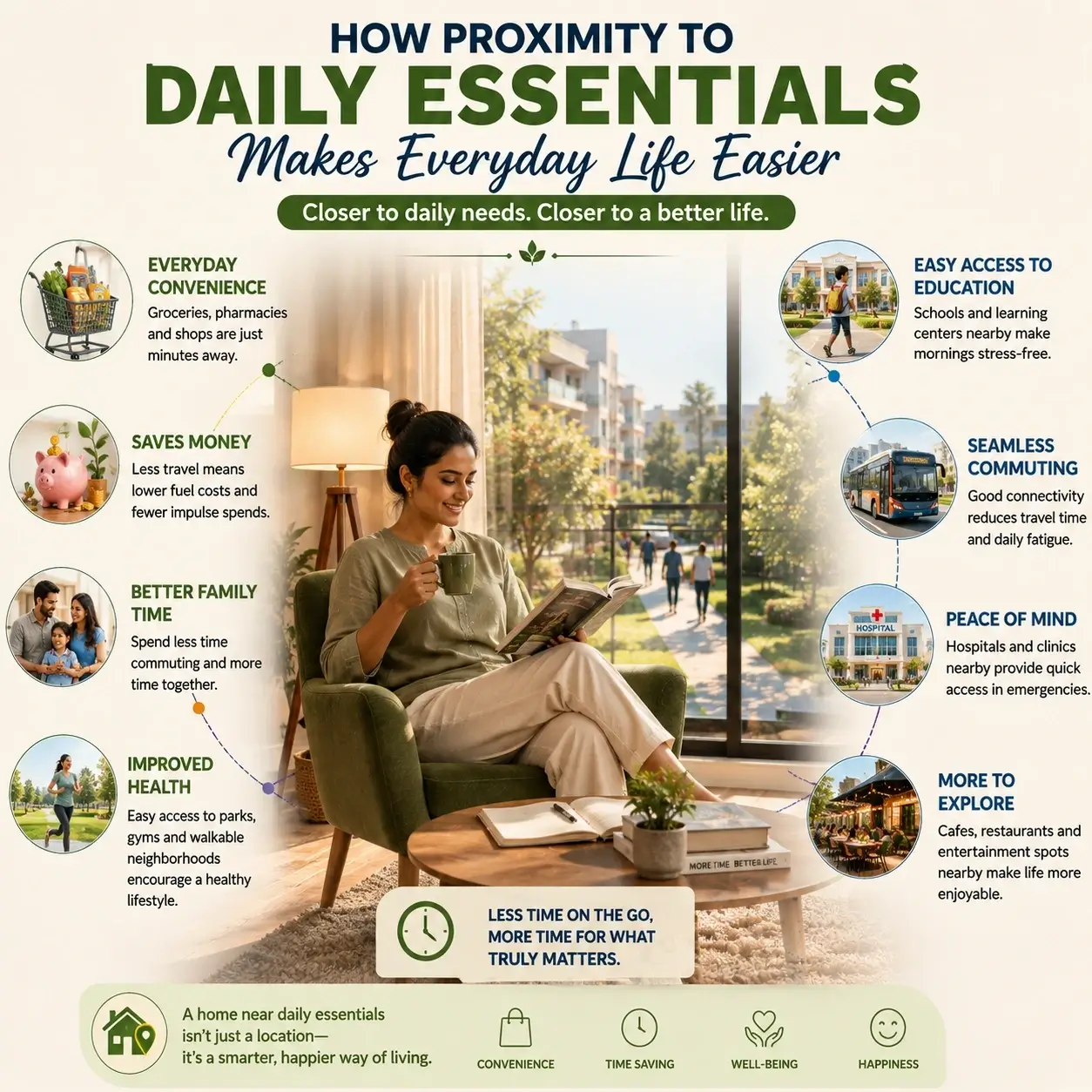
Small services can really help make daily life easier. Banks, ATMs, courier centers, repair shops, salons, petrol stations and other local businesses can help residents avoid having to travel over the city for simple tasks.
These places might not be the things people think about when they look at a house but they become much more important once someone moves in.
Living close to services saves a lot of time. For many buyers, homes close to daily essentials offer a simple way to make regular errands less stressful and easier to manage.
Imagine someone who has to buy groceries after a day at work. If the nearest store is kilometres away that trip can get stuck in traffic, take time to find a parking space and add extra travel time.. If the store is nearby the whole job can be finished in just a few minutes.
The convenience can be useful for everyday activities such as:
- Picking up groceries after work
- Taking children to school
- Visiting a pharmacy
- Attending routine appointments
- Using public transport
- Buying household items
- Visiting a nearby bank or ATM
- Spending time in local parks
This can be very useful, for people who work and have families and already have a lot to do every day.
It can also help people who do not drive. If important places are close enough to walk to or can be reached easily by bus or train the people who live there might feel more free to handle their tasks.
The Impact of Location on Property Value
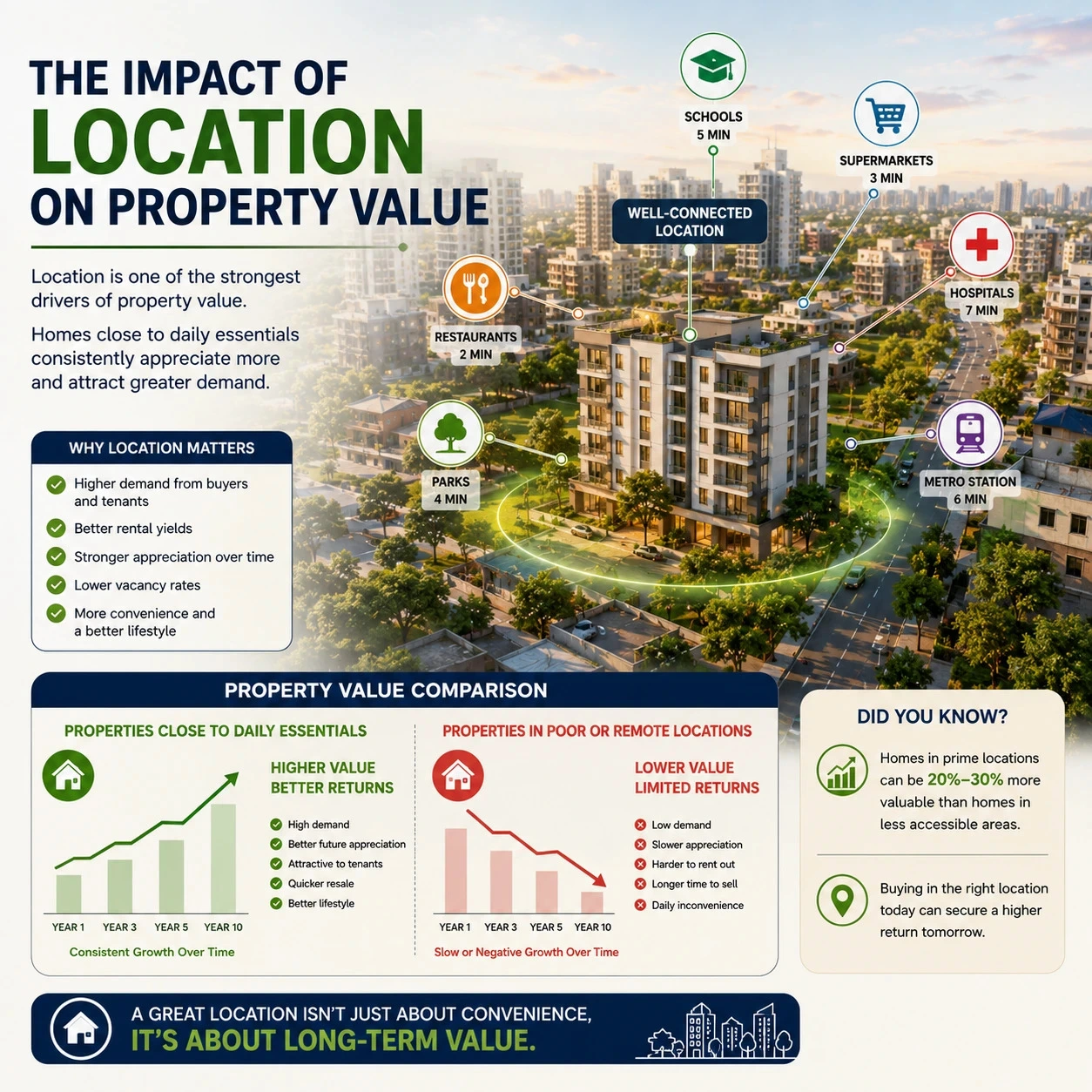
Location has always been an important factor in real estate. A property in an accessible and established neighbourhood may attract more interest because buyers often value convenience.
Being close to essential services can make a home more appealing, but it should not be viewed as the only factor affecting property value. Because of this convenience, homes close to daily essentials may also attract buyers who place a high value on accessibility and an easy daily routine.
Other aspects of the neighbourhood also matter:
| Location Factor | Why It Matters |
| Connectivity | Makes daily travel easier |
| Nearby services | Reduces travel for regular errands |
| Infrastructure | Supports convenient living |
| Safety | Influences comfort and confidence |
| Neighbourhood quality | Affects the overall living experience |
| Future development | May change the area’s appeal over time |
For example two houses might both be close to shops and schools. One might have better roads, quieter areas and better public transport links. These differences can make one house more appealing, to buyers.
So it is better to look at the neighborhood instead of just checking how many shops or schools are nearby.
Benefits of Choosing a Home Near Essential Services

Choosing homes close to daily essentials can bring several practical benefits, especially for people who want to spend less time travelling for everyday tasks.
One of the main reasons homes close to daily essentials appeal to buyers is that they can make ordinary routines simpler without requiring long journeys.
Less Time Spent on Daily Travel
Shorter journeys free up time, for work, family, exercise, hobbies or rest.
Greater Convenience for Families
Families often have several schedules to manage. Parents juggle work, school, shopping, appointments and other responsibilities. A convenient location simplifies these routines.
Easier Access to Important Services
Having healthcare, groceries, transport and other basic services nearby means residents can reach them without trips. Residents find this useful when something is needed unexpectedly.
Potential Resale and Rental Appeal
A convenient location can also attract buyers and tenants. People looking for homes often think about what’s around the property not only the inside features.
However strong resale or rental demand relies on factors, such as the property itself pricing, neighbourhood quality and overall market conditions.
Are Homes Near Daily Essentials Always the Better Choice?

Not always. A convenient location can also bring disadvantages. Although homes close to daily essentials offer convenience, buyers should also consider whether the surrounding environment suits their lifestyle.
Higher Property Prices
Homes in well‑connected and established neighbourhoods can sometimes cost more. Buyers must decide whether the convenience is worth the price.
Before deciding, compare similar properties in nearby areas. A neighbourhood a little away can offer many of the same facilities for a lower price.
Traffic and Noise Concerns
Being close, to schools shopping areas, major roads or commercial centres can mean traffic and noise.
A location may be convenient during the day but much busier during morning and evening rush hours.
It is therefore a good idea to visit the property at different times before buying.
Less Privacy in Busy Areas
Busy neighbourhoods usually have movement throughout the day. Some buyers may prefer a residential environment even if certain services are slightly farther away.
The ideal choice depends on what matters most to the buyer.
How to Choose the Right Location for Your Home
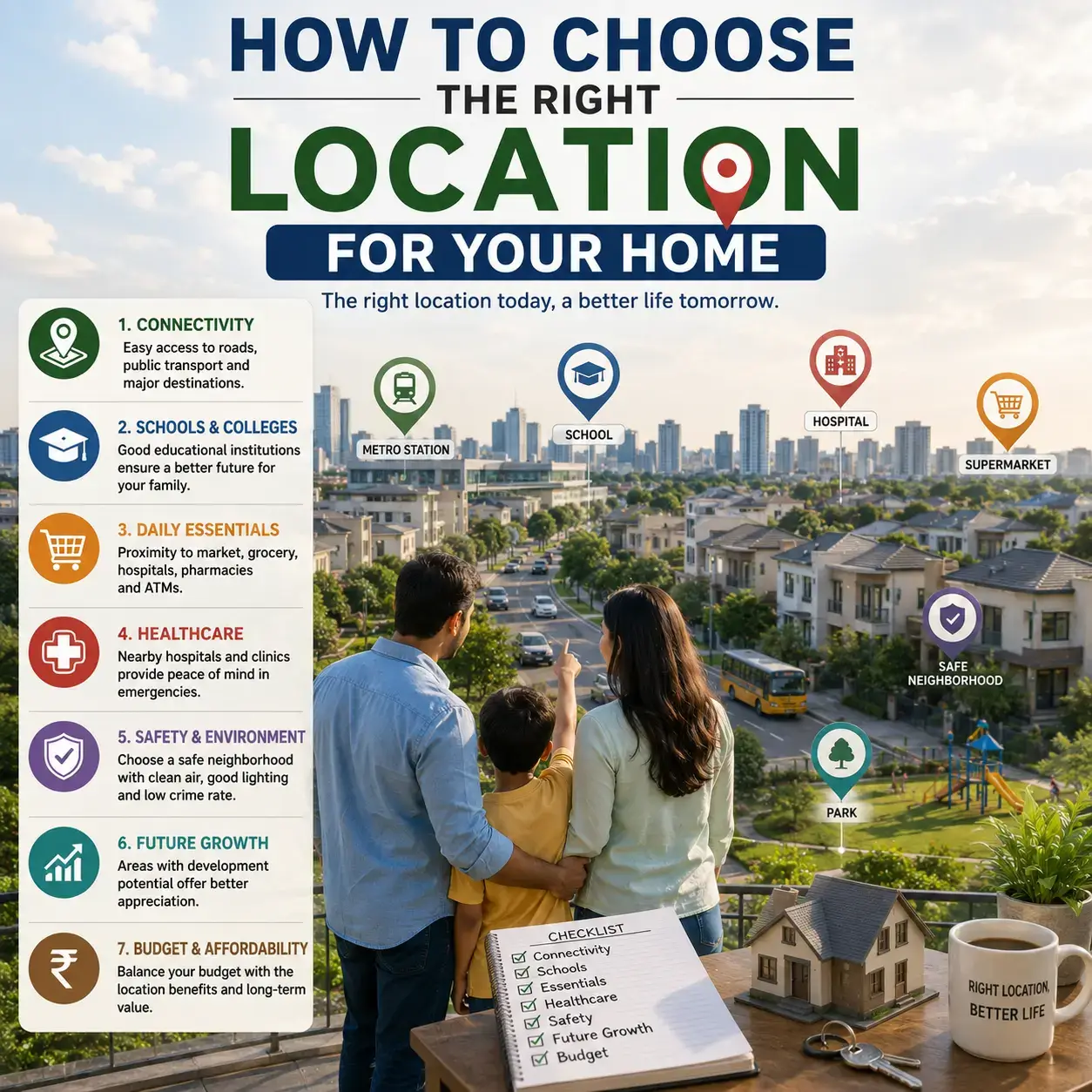
Choosing a location should involve more than looking at a property advertisement. Spend some time exploring the neighbourhood and thinking about your normal routine.
When comparing homes close to daily essentials, look beyond the number of nearby facilities and consider how easily you can actually reach and use them.
Check the Actual Distance to Essential Services
Do not rely only on the distance shown online. Visit locations yourself and check how long the journey actually takes.
Your checklist can include:
- Grocery stores
- Schools
- Hospitals and pharmacies
- Public transport
- Banks and ATMs
- Parks
- Restaurants and local shops
Also check these routes during busy hours. Travel time can be very different when roads are crowded.
Consider Accessibility and Connectivity
A nearby facility is only useful if it is easy to reach. Poor roads, traffic, limited public transport or difficult walking routes can reduce the practical benefit of being close to a facility.
Look at the movement within the neighbourhood, not just the distance between two points.
Think About Your Future Lifestyle
Your needs can change after buying a home. A location that works perfectly today may not be as suitable several years later.
Before making a decision, think about whether the area can support your plans.
Consider:
- Possible changes in your workplace
- Future family needs
- Access to schools
- Healthcare requirements
- Public transport needs
- New infrastructure planned nearby
Thinking ahead can help you choose a home that remains practical for longer.
Compare Convenience With Property Cost
Convenience has value. It should still fit your budget. By focusing only on the purchase price, think about the overall cost of living in the location.
A home away may have a lower price but involve higher transportation costs and longer daily journeys.
On the other hand paying more for a convenient location may make sense if it significantly reduces travel and fits comfortably within your budget.
Is Living Close to Daily Essentials Worth It?

For homebuyers living near daily essentials can be a worthwhile choice. It can reduce travel, simplify everyday tasks and make the neighbourhood easier to live in.. The closest property is not always the best property. A home should offer a balance, between convenience, price, comfort, connectivity and the quality of the surrounding area.
The right choice ultimately depends on your lifestyle and priorities.
Conclusion
Choosing homes close to daily essentials can make everyday life easier by reducing travel time and providing convenient access to important services.
Easy access to schools grocery stores, healthcare, public transport, banks and other services can cut travel time. Simplify daily routines.
At the time buyers should look beyond convenience. Property prices, traffic, noise, safety, connectivity and future needs should all be part of the decision.
Before buying visit the neighbourhood check travel times compare nearby properties and think about how the location will fit your daily routine.
A good home is not simply one that looks attractive from the inside. A good location should also make life outside the home easier.
Frequently Asked Questions (FAQs)
1.Why location matters when purchasing a home?
Location determines how easily you can reach schools, workplaces, healthcare, shopping, public transport and other everyday services. A convenient location can cut travel time. Make daily routines easier.
2.What items should I look for near a home?
When comparing homes close to daily essentials, homebuyers can look for grocery stores, schools, hospitals, pharmacies, public transport, banks, ATMs, parks and other services they use regularly.
3.Should I Buy a Home Near Public Transportation?
For people who travel regularly, living close to transport can be very convenient. It may reduce dependence on a vehicle and make it easier to reach workplaces, schools, shopping areas, and other parts of the city.
4.Do homes near services cost more?
They can especially when they are located in established and well-connected neighbourhoods. Prices vary by location and property type however. Buyers should compare homes in nearby areas before deciding whether the added convenience is worth the extra cost.
5.Does being close to essentials add resale value to a property?
Homes close to daily essentials can be attractive to future buyers and tenants because many people value easy access to schools, grocery stores, healthcare, public transport, and other everyday services. However, resale demand also depends on factors such as property condition, pricing, connectivity, neighbourhood quality, and overall market conditions.
6.What should I check before buying a home near daily essentials?
Do not look only at the distance on a map. Visit the neighbourhood and check actual travel times, traffic, noise, road conditions, public transport, safety, and the quality of nearby facilities. It is also useful to consider whether the location will meet your needs in the future.
1 thought on “Preferring Homes Close to Daily Essentials”