
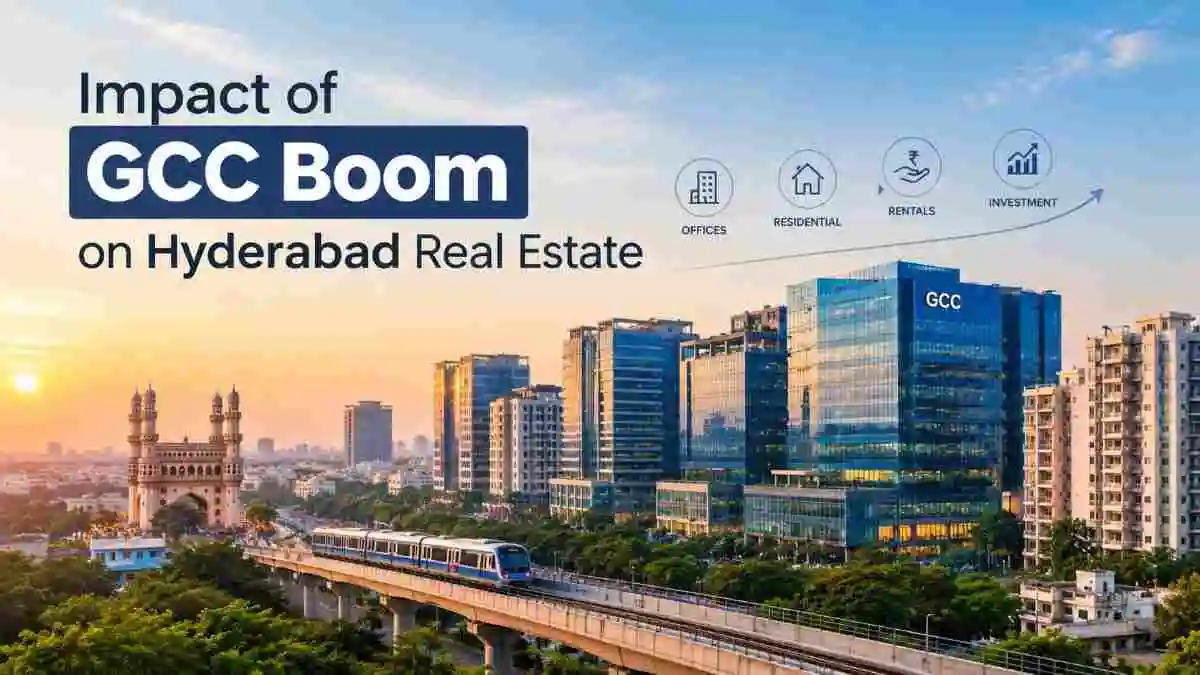
Impact of GCC Boom on Hyderabad Real Estate
Hyderabad has emerged as one of India’s most important destinations for technology, finance, healthcare, pharmaceuticals, and other global business operations. One of the biggest forces behind this transformation is the rapid expansion of Global Capability Centers (GCCs). As multinational companies establish new centers and expand existing operations, the city is experiencing increasing employment, business activity and demand for commercial infrastructure.
The impact of GCC boom on Hyderabad real estate is becoming increasingly visible across office spaces, residential properties in hyderabad, rental housing and supporting infrastructure. GCCs do not simply occupy office buildings. They bring skilled professionals, attract talent from other cities, increase demand for housing and rentals, and create a larger customer base for restaurants, retail stores, healthcare facilities, entertainment and other services.
The relationship can be understood through a simple chain:
GCC expansion → employment growth → population movement → housing demand → rental demand → commercial demand → infrastructure development → real estate growth
This article explores the GCC growth in Hyderabad, why multinational companies are choosing the city, how the expansion is influencing different property segments, which locations are benefiting, and what the trend could mean for investors and the future of Hyderabad real estate.
What Is a GCC?
A Global Capability Centre, commonly called a GCC, is a specialized unit established by a multinational company to perform important functions for its global operations.
In the past, companies often established offshore centers primarily to reduce operating costs or handle routine support functions. Modern GCCs have evolved considerably. They can now be responsible for technology, artificial intelligence, research and development, engineering, cybersecurity, finance, analytics, product development and other strategic activities.
India has become a major destination for these centers because companies can access a large skilled workforce while building capabilities that support their global businesses.
What Does GCC Stand For?
GCC stands for Global Capability Centre.
The three words explain the basic concept:
- Global refers to the international operations supported by the center.
- Capability highlights the specialized skills and expertise available at the center.
- Center refers to the dedicated business operation established by a multinational company.
For example, a multinational financial-services company may establish a GCC in Hyderabad to manage data analytics, software development, cybersecurity, finance operations and technology research for its global business. The employees working in the center may support customers, products or business teams located in different countries. Therefore, a GCC can become an important part of the parent company’s global operating structure rather than simply functioning as a support office.
What Do Global Capability Centers Do?
Modern GCCs can handle a wide variety of specialized functions, including:
- IT and software development
- Artificial intelligence
- Data analytics
- Research and development
- Finance and accounting
- Engineering
- Cybersecurity
- Product development
- Human resources
- Business operations
- Digital transformation
- Cloud technology
- Risk management
This shift toward higher-value activities is important for cities such as Hyderabad because these operations can create demand for specialized professionals and larger corporate workplaces. GCCs can also become long-term business operations rather than temporary outsourcing facilities. As companies become more comfortable with their Indian operations, they may expand teams, add new functions and move additional responsibilities into their centers.
How Are GCCs Different From Traditional IT Companies?
An IT services company generally provides technology or business services to external clients. A GCC, on the other hand, is usually established by a multinational company to support its own global operations. For example, an IT services company may develop software for several different clients. A technology company’s GCC may develop and maintain products specifically for its parent organization.
The distinction matters because GCCs can create highly specialized employment tied directly to the parent company’s products, technology, research or business operations. For real estate, both models can create demand for office space. However, the GCC growth in hyderabad can be particularly significant because multinational companies may establish large, long-term operations and continue adding functions as their centers mature.
Why Are GCCs Growing in Hyderabad?
The GCC Hyderabad ecosystem has developed around several advantages that make the city attractive to multinational companies. Talent availability, infrastructure, existing business networks, operating costs and government support all play a role. Hyderabad is not competing only on the basis of inexpensive operations. Its growing appeal increasingly comes from its ability to provide specialized talent and support more sophisticated global functions.
Availability of Skilled Talent
One of Hyderabad’s biggest advantages is its large technology and engineering talent pool. The city has a long-established IT ecosystem supported by universities, educational institutions, technology companies and a large professional workforce. This gives multinational companies access to employees across different technical and business disciplines.
Talent availability can be particularly important for GCCs because companies often need specialized professionals in areas such as:
- Software engineering
- Data science
- Artificial intelligence
- Cybersecurity
- Finance
- Engineering
- Healthcare
- Pharmaceuticals
- Product management
A strong talent pool also makes expansion easier. Once a company establishes a successful operation, it can potentially add new teams without completely rebuilding its workforce ecosystem.
Hyderabad’s IT and Business Ecosystem
Hyderabad already has a mature technology and corporate ecosystem. The city has established business districts, office parks, residential communities, restaurants, retail centers, educational institutions, healthcare facilities and other services that support a large professional workforce.
The western part of Hyderabad has become particularly important for technology and corporate activity. Areas such as Gachibowli, Madhapur, Kondapur, the Financial District and surrounding corridors have developed into major employment centers.
This existing ecosystem reduces the friction involved in establishing a new operation. Companies can find office buildings, service providers, talent and supporting infrastructure within an established business environment.
Competitive Operating Costs
Operating costs are another factor influencing the location decisions of multinational companies.
A company establishing a GCC considers several expenses, including:
- Employee costs
- Office rentals
- Infrastructure
- Utilities
- Business services
- Recruitment
- Administration
Hyderabad can offer cost advantages compared with some major global business markets while still providing access to a significant skilled workforce. Cost efficiency can therefore allow companies to expand their operations while maintaining competitive operating structures. However, as demand for premium office space increases, the cost advantage can change at the micro-market level. Prime business districts may experience rising rents as more companies compete for high-quality office space.
Infrastructure and Connectivity
Infrastructure is closely connected to both GCC expansion and real estate development. Hyderabad benefits from major transportation and business infrastructure, including:
- Outer Ring Road
- Rajiv Gandhi International Airport connectivity
- Major arterial roads
- Metro connectivity
- IT and business corridors
- Expanding residential infrastructure
- New and proposed infrastructure projects
Good connectivity matters because companies need their employees to reach workplaces efficiently. It also influences where employees choose to live.
When a business corridor becomes easier to access, surrounding residential and commercial areas can become more attractive.
This creates one of the strongest links between GCC growth and real estate: business infrastructure can influence residential demand, while residential growth can encourage additional commercial development.
Government Support for GCCs
Government policies can also influence corporate location decisions.
The Telangana government has been working to strengthen the state’s technology, innovation and business ecosystem. Its long-term GCC strategy focuses on areas including policy and governance, talent development, infrastructure, incentives and ecosystem development.
A supportive business environment can make it easier for multinational companies to establish or expand operations.
For Hyderabad, continued government support could be particularly important as GCCs move beyond traditional IT functions into areas such as artificial intelligence, life sciences, pharmaceuticals, engineering and advanced research.
Understanding the GCC Growth in Hyderabad
The scale of GCC activity provides a clearer picture of why the trend matters for real estate.
According to the India GCC Guide 2026 published by JLL, Hyderabad has obtained about 20 to 23 per cent of India’s total GCC market and has thus confirmed its position as a major GCC hub. The city has built up a particularly strong presence in the fields of healthcare and biotechnology and at the same time attracts GCC activity in the areas of life sciences, pharmaceuticals, technology, BFSI and engineering and R&D.
The latest office market data further highlights the importance of GCCs to Hyderabad’s commercial real estate market. JLL reported that Hyderabad’s gross office leasing reached 6.27 million square feet in H1 2026, representing a 10.5% year-on-year increase from 5.68 million square feet in H1 2025. JLL also found that GCCs accounted for 42% of Hyderabad’s office leasing activity during the 2024 to mid-2026 period, demonstrating their growing role in driving demand for commercial space.
Knight Frank found that the GCC’s contribution had risen even further in the first six months of 2026. In H1 2026, Hyderabad saw office transactions amount to 7.5 million square feet, a year-on-year increase of 29 per cent, which was the best first-half leasing result the city has ever achieved. The GCC accounted for 45 per cent of total office leasing, up from 40 per cent in H1 2025, and during that period GCC tenants leased about 3.4 million square feet.
The most recent data therefore indicates that the GCC story does not consist merely of announcements concerning new companies. GCC expansion is already giving rise to strong and measurable demand for commercial office space in Hyderabad, and this increasing demand for office space also reinforces the broader link between GCC expansion, employment growth and Hyderabad’s wider real estate market.
Growth of GCC Companies in Hyderabad
GCC growth in hyderabad can happen in two ways. The first is the arrival of new multinational companies establishing their first major center in the city.
The second is the expansion of existing GCCs. The second category is particularly important because an established center may gradually take on more responsibilities. A company may begin with a relatively small team and later add engineering, analytics, finance, research, cybersecurity or product functions. This creates repeated demand for office space and skilled professionals.
JLL reported that GCCs accounted for 42% of all office leasing activity in Hyderabad during the 2024 to mid-2026 period. Hyderabad also recorded 6.27 million square feet of gross office leasing in H1 2026, up 10.5% year over year from 5.68 million square feet in H1 2025. GCCs represented the largest share of this leasing activity, highlighting their growing contribution to Hyderabad’s commercial real estate demand.
Major Industries Driving GCC Growth
The GCC growth in Hyderabad is becoming increasingly diversified.
Major sectors include:
- Technology and IT
- Banking, financial services and insurance
- Healthcare
- Pharmaceuticals
- Biotechnology
- Engineering
- Manufacturing
- Artificial intelligence
- Data analytics
- Research and development
This diversification is important for the long-term strength of the market.
A city dependent on one industry can face significant risks if that industry slows down. A broader GCC ecosystem can distribute demand across multiple sectors.
Hyderabad’s growing strength in healthcare and biotechnology is especially notable. JLL’s 2026 GCC analysis identified the city as India’s leading healthcare-biotech GCC destination, while also highlighting its capabilities in technology, semiconductors, pharmaceuticals, life sciences and BFSI.
Future Growth Potential of GCCs in Hyderabad
A growing number of companies are treating Indian GCCs as strategic capability centers rather than simply lower-cost support offices. This can increase the amount of high-value work performed in cities such as Hyderabad.
More GCC operations could mean:
- Greater demand for Grade A office space
- More skilled employment
- Increased housing demand
- Greater rental demand
- More retail and service businesses
- Additional infrastructure requirements
- Expansion into emerging business corridors
JLL’s recent Hyderabad analysis also points toward continued office demand, with industry estimates indicating that GCC expansion could generate roughly 8–12 million square feet of additional office-space demand over the next three to five years.
How Is GCC Growth Affecting Hyderabad Real Estate?
More GCCs → more jobs → more professionals → more households → higher housing demand → higher rental demand → more retail demand → more infrastructure → stronger real estate activity
This is why the GCC growth effect on property values can extend beyond the immediate office location.
Increase in Commercial Real Estate Demand
The most direct impact is on commercial property. GCCs typically require high-quality office environments with modern technology, security, amenities, parking and reliable connectivity.
This increases demand for:
- Grade A office buildings
- Corporate campuses
- Business parks
- Managed offices
- Flexible workspaces
- Premium commercial developments
Recent market data reflects this trend. Hyderabad’s office market recorded strong leasing activity in 2025, while GCCs became the largest demand driver in the second half of the year. As demand increases, landlords may gain stronger negotiating power, particularly when the availability of high-quality office space is limited
Increase in Residential Property Demand
GCC employees need housing, and many professionals moving to Hyderabad initially prefer living close to their workplace. This creates demand for apartments, gated communities and other residential properties.
Young professionals may initially choose:
- Shared apartments
- PG accommodation
- Co-living spaces
- Furnished rentals
- Compact apartments
As their income and family requirements change, they may move toward larger apartments or purchase homes. Therefore, GCC employment can influence residential demand over several stages rather than producing only one-time demand.
Growth in Rental Demand
Rental properties in Hyderabad can benefit significantly from employment growth. Employees relocating from other cities often rent before deciding whether to purchase a property. New employees may also prefer flexibility during the early years of their careers.
This creates demand for:
- 1 BHK and 2 BHK apartments
- Furnished apartments
- PG accommodation
- Co-living
- Shared housing
- Premium rental homes
Rental demand tends to be particularly strong in areas that provide convenient access to major employment centers. For investors, this can make rental properties in well-connected locations attractive. However, rental returns depend on the purchase price, maintenance costs, vacancy, property quality and local supply.
Development of New Real Estate Projects
Developers respond to demand. If a particular corridor experiences sustained employment growth, developers may introduce additional residential and commercial projects.
These can include:
- Apartment communities
- Luxury residential projects
- Commercial buildings
- Mixed-use developments
- Retail centers
- Managed office projects
The result can be outward expansion from established business districts into emerging areas. However, development does not automatically guarantee successful investment. Actual employment growth, infrastructure and absorption must support the new supply.
Growth in Retail and Commercial Infrastructure
A large professional population creates demand for more than housing.
Employees need:
- Restaurants
- Cafes
- Supermarkets
- Gyms
- Healthcare facilities
- Shopping centers
- Entertainment
- Convenience stores
This creates a secondary layer of real estate demand. A residential neighborhood near a large employment center may become more commercially active as its population grows.
Impact of GCC Growth on Different Types of Properties
The impact of GCC boom on Hyderabad real estate varies significantly depending on the property type and location. Some segments experience direct demand, while others benefit indirectly through population growth and infrastructure.
Impact on Residential Apartments
Residential properties in Hyderabad located near major employment hubs can experience stronger demand as professionals look for convenient places to live.
Professionals working in GCCs often prefer properties that provide reasonable commuting times and access to daily conveniences.
Popular requirements can include:
- 2 BHK apartments
- 3 BHK apartments
- Gated communities
- Security
- Parking
- Fitness facilities
- Nearby schools and healthcare
- Convenient road connectivity
Properties close to employment hubs may experience stronger demand than similar properties located farther away. However, proximity alone is not enough. A poorly connected property can still struggle if commuting becomes difficult.
Impact on Luxury Homes and Villas
GCC growth in hyderabad can also support premium residential demand. Senior executives, experienced technology professionals and high-income specialists may have greater purchasing power and may seek:
- Luxury apartments
- Premium gated communities
- Villas
- Larger homes
- High-end amenities
This segment is more sensitive to income levels, location, amenities and the overall quality of the development. Not every GCC employee will create demand for luxury housing, so this segment should not be treated as a direct one-to-one result of GCC expansion.
Impact on Rental Properties in Hyderabad
The connection between GCC employment and rental properties in Hyderabad can be particularly strong. New employees may not immediately purchase homes. Renting provides flexibility while they understand the city, workplace location and long-term career plans.
This can support demand for:
- Furnished apartments
- Unfurnished apartments
- PGs
- Co-living spaces
- Serviced apartments
- Shared accommodation
Properties located within practical commuting distance of major employment centers can potentially command rental premiums when demand is strong.
Impact on Commercial Office Spaces
Commercial office space receives the most direct impact. GCCs need workplaces, and expansion can require substantial additional space.
The strongest demand is generally focused on modern office buildings with:
- Good connectivity
- Reliable infrastructure
- Security
- Parking
- Employee amenities
- Sustainability features
- Flexible floor plans
The increasing preference for high-quality office environments can also create competition between developers and landlords for large corporate tenants.
Impact on Retail Properties
Retail can benefit from the growing population around employment centers. A large workforce creates demand for food, shopping and everyday services.
This can support:
- Restaurants
- Cafes
- Convenience stores
- Fitness centers
- Salons
- Supermarkets
- High-street retail
- Entertainment facilities
Mixed-use developments can particularly benefit because they combine residential, commercial and retail activity within the same ecosystem.
Impact on Plots and Land
GCC expansion can increase investor interest in land around developing employment corridors. However, this is one area where investors should be especially careful. A plot located near a GCC hub may appear attractive, but future appreciation depends on actual development.
Investors should distinguish between:
Actual development: companies, roads, housing, infrastructure and services are genuinely being built.
Speculation: prices are rising mainly because investors expect something to happen in the future.
Not every plot near an employment corridor will appreciate at the same rate.
Impact on Co-Working and Flexible Office Spaces
GCC expansion can also increase demand for flexible workspace. Companies may require temporary space while establishing a new center, additional space during expansion or smaller satellite locations.
Flexible workspace can provide:
- Managed offices
- Shorter lease commitments
- Plug-and-play infrastructure
- Project offices
- Satellite offices
- Temporary expansion space
This makes flexible commercial real estate another potential beneficiary of GCC expansion.
Hyderabad Locations Benefiting From GCC Growth
The GCC growth in Hyderabad is closely connected to the city’s established western business corridor. Employment concentration matters because residential and commercial demand is often strongest where workers can access workplaces conveniently.
Gachibowli
Gachibowli is one of Hyderabad’s established technology and corporate hubs. Its existing office ecosystem, residential developments, restaurants and connectivity make it an important location for professionals. GCC expansion can reinforce demand in the area by increasing the number of employees seeking nearby housing and services. The established ecosystem also provides an advantage because employees do not have to wait for basic infrastructure and amenities to develop.
Madhapur
Madhapur is another major technology and corporate center. Its established office market and surrounding residential ecosystem have already created a strong live-work environment. As GCCs compete for premium office space, established areas such as Madhapur can continue to benefit from corporate demand. However, the maturity of the area also means that property prices and rents can be relatively high compared with emerging locations.
Kondapur
Kondapur benefits from its proximity to major employment centers. The area has a strong residential presence and is attractive to professionals who want access to the western business corridor. This makes Kondapur particularly relevant to rental properties in Hyderabad, as employees may prefer to rent in the area while maintaining convenient access to workplaces.
Financial District
The Financial District has become one of Hyderabad’s most important corporate locations. It has attracted major Grade A office developments and multinational companies. For example, JLL Business Services signed a 120,000-square-foot facility in Hyderabad’s Financial District, with plans to create more than 1,600 highly skilled positions.
Such developments demonstrate how employment creation and commercial real estate can develop together. The surrounding residential market can also benefit as employees look for homes near their workplaces.
Nanakramguda
Nanakramguda forms part of the wider western business corridor. Its connection to major commercial districts, residential developments and infrastructure makes it relevant to future GCC-driven expansion. As established locations become more expensive, companies and developers may look toward nearby corridors where additional space is available.
Kokapet and Other Emerging Areas
Kokapet and other western Hyderabad locations have experienced substantial development as the city expands. These areas are attracting new residential and commercial projects and could potentially benefit from spillover demand from established employment hubs.
However, it is important to distinguish potential future benefit from proven GCC-driven appreciation. An emerging location needs actual employment, infrastructure, connectivity and sustained housing demand to support long-term property growth.
GCC Growth Effect on Property Values in Hyderabad
The GCC growth effect on property values can be explained through supply and demand. When a growing number of employees require housing in a particular location, demand increases. If the supply of suitable housing cannot keep pace, prices and rents may face upward pressure. The economic chain is straightforward:
More GCC jobs → more employees → more households → higher housing demand → stronger demand for nearby properties
However, this does not mean all the properties in hyderabad will automatically become more valuable.
How Increased Employment Drives Property Demand
Employment is one of the strongest drivers of residential demand. When a new GCC creates hundreds or thousands of jobs, employees need accommodation.
Some workers may move from other cities, while others may relocate within Hyderabad. Both situations increase demand. Over time, employment centers can become anchors around which residential and commercial ecosystems develop.
Effect on Residential Property Prices
Higher demand can put upward pressure on residential prices, particularly when supply is limited. Properties with strong connectivity to employment hubs may benefit because buyers and tenants place value on shorter and more convenient commutes.
However, the effect varies based on:
- Location
- Property quality
- Supply
- Connectivity
- Infrastructure
- Developer reputation
- Local employment concentration
- Buyer affordability
A GCC announcement alone should therefore not be considered sufficient evidence that property prices will rise.
Effect on Commercial Property Values
Commercial properties in hyderabad can benefit directly from increased office demand. When companies compete for quality office space, occupancy can improve and rents may increase.
Premium Grade A buildings may benefit particularly when large multinational tenants seek modern workplaces. Recent Hyderabad office-market data already reflects this pressure. Economic Times reported that premium Grade A+ office rents in Madhapur had risen to approximately ₹130–180 per square foot per month amid strong GCC demand.
Effect on Rental Property Values
Rental demand can rise as employees relocate to Hyderabad. This can make rental properties in Hyderabad particularly relevant to investors. A property near a major employment hub may attract tenants who are willing to pay more for:
- Shorter commute
- Better connectivity
- Furnished interiors
- Security
- Amenities
- Access to restaurants and retail
Strong rental demand can improve rental income, although investors must calculate the actual rental yield rather than assuming that high rent automatically means a good investment.
Will GCC Growth Increase Property Values Across Hyderabad?
No. This is one of the most important points for property buyers and investors. The effect of GCC growth in hyderabad on property values is likely to be stronger in areas that combine employment, infrastructure and housing demand.
Property performance depends on:
- Location
- Connectivity
- Infrastructure
- Supply
- Property quality
- Employment concentration
- Developer reputation
- Actual demand
A property far from employment hubs may experience a much weaker effect than one located within a well-connected business corridor.
Positive Impact of GCC Growth on Hyderabad Real Estate
The impact of GCC boom on Hyderabad real estate can create several long-term benefits.
Increased Property Demand
More employment can increase the number of people searching for homes. This supports residential absorption and can encourage developers to launch new projects.
Rising Rental Opportunities
Employees moving into the city often rent before purchasing. This can support demand for apartments, furnished homes, PGs and co-living spaces. For investors, areas with sustained employment growth can offer potential rental opportunities.
Growth in New Developments
Strong demand encourages developers to introduce new residential and commercial projects. This can accelerate the development of emerging corridors.
Improved Infrastructure
Large business investments can increase the need for roads, transportation, utilities and other infrastructure. Better infrastructure can subsequently increase the attractiveness of surrounding real estate.
Increased Investment Opportunities
The combination of employment, commercial demand, housing demand and infrastructure can create opportunities across residential, rental and commercial property. However, investment decisions should always be based on actual market fundamentals rather than the GCC label alone.
Negative Impact and Challenges of GCC Growth
The GCC growth in hyderabad also causes some challenges to the city . A strong real estate market is not automatically beneficial for every resident.
Rising Property Prices
Increasing demand can make housing less affordable. First-time buyers may face higher entry prices, particularly in premium business corridors. If property prices increase faster than incomes, affordability can become a concern.
Increasing Rental Costs
Strong demand for housing can also push rents upward.
This can affect:
- Middle-income households
- Students
- Young professionals
- Families
- Workers in lower-paying sectors
A city needs sufficient rental housing across different price categories to accommodate a growing workforce.
Traffic and Infrastructure Pressure
More employees mean more daily travel. If infrastructure does not expand at the same pace as employment, the result can be:
- Traffic congestion
- Longer commutes
- Parking pressure
- Higher transport demand
- Greater pressure on public infrastructure
This is why connectivity will remain an important factor in determining how sustainable GCC-driven development becomes.
Risk of Overdevelopment
Developers may build aggressively when they expect continued demand. If actual employment growth falls below expectations, certain micro-markets could experience excess supply.
This can create:
- Higher vacancy
- Slower price growth
- Greater competition between projects
- Lower rental yields
Investors should therefore examine actual absorption instead of relying only on future projections.
Uneven Real Estate Growth Across Hyderabad
The benefits of GCC growth will not be distributed equally. Employment hubs are likely to experience stronger effects than areas with weak connectivity or limited economic activity. This makes micro-market analysis extremely important.
GCC Growth and the Future of Hyderabad Real Estate
The future relationship between GCC Hyderabad and property markets will depend on whether the city can continue attracting companies while expanding infrastructure and housing supply.
Future Demand for Office Spaces
GCC growth in hyderabad is expected to remain an important source of office demand.
Companies may increasingly seek:
- Grade A office buildings
- Large corporate campuses
- Sustainable workplaces
- Technology-enabled offices
- Flexible expansion space
The continued preference for high-quality office space could support commercial real estate in established business districts.
Future Demand for Residential Properties
Continued employment growth should support housing demand. Professionals will require homes near employment corridors, while families may seek larger gated communities with schools, healthcare and other amenities. As established areas become more expensive, demand may gradually spread toward emerging corridors.
Growth of Rental Properties in Hyderabad
Rental properties in Hyderabad are likely to remain important because employees do not necessarily purchase homes immediately after relocating.
Demand could continue for:
- Furnished apartments
- 1 and 2 BHK homes
- Gated-community rentals
- Co-living
- PG accommodation
- Premium rental properties
This could make rental housing an important component of Hyderabad’s broader real estate ecosystem.
Emerging Real Estate Corridors
As established business districts become more expensive, companies and developers may look toward newer areas.
This can encourage development in western and other emerging corridors.
However, the success of these areas will depend on the combination of:
Employment + infrastructure + connectivity + housing + amenities
Without these components, development may remain speculative.
Role of Infrastructure in Future Growth
Infrastructure will determine how effectively GCC-driven growth spreads across Hyderabad.
Important factors include:
- Roads
- Metro connectivity
- Airport access
- Public transportation
- Business corridors
- Residential infrastructure
- Civic services
If infrastructure improves alongside employment growth, businesses and residents can spread into a wider geographical area. This can reduce pressure on established hubs and create new real estate opportunities.
What Does GCC Growth Mean for Real Estate Investors?
The GCC growth in hyderabad creates opportunities, but investors need to separate genuine demand from market hype.
Opportunities in Residential Properties
Residential properties near major employment hubs can benefit from sustained demand. Potential advantages include:
- Large pool of working professionals
- Strong tenant demand
- Long-term housing requirements
- Potential appreciation
- Established social infrastructure
However, investors should evaluate the purchase price carefully.
Opportunities in Rental Properties
Rental properties in Hyderabad can be attractive when located near strong employment corridors.
Potential tenant segments include:
- GCC employees
- Young professionals
- Managers
- Families
- Relocating employees
- Students and early-career workers
Investors should calculate rental yield, vacancy and maintenance costs before purchasing.
Opportunities in Commercial Real Estate
Commercial opportunities may include:
- Office spaces
- Retail properties
- Restaurants
- Flexible workspaces
- Managed offices
- Commercial buildings
GCC-driven employment can support these properties by creating a larger customer and tenant base.
Factors to Consider Before Investing
Before purchasing a property because of the GCC trend, investors should examine:
- Location
- Connectivity
- Distance from employment hubs
- Existing infrastructure
- Upcoming infrastructure
- Rental demand
- Existing property supply
- Purchase price
- Developer reputation
- Rental yield
- Long-term employment demand
- Quality of the surrounding ecosystem
The most important question is not simply, “Is there a GCC nearby?”
A better question is:
“Is there sustainable economic activity that will continue generating real housing and commercial demand?”
That distinction can help investors avoid buying purely on speculation.
Conclusion: The Long-Term Impact of GCC Growth on Hyderabad Real Estate
The impact of GCC boom on Hyderabad real estate is becoming increasingly significant as multinational companies expand their operations across the city. GCCs create employment, and employment creates demand for housing. Employees relocating to Hyderabad increase demand for apartments, rental homes, PGs and co-living spaces. At the same time, companies require offices, while the growing workforce creates demand for restaurants, retail, healthcare, entertainment and other services.
The result is a broader economic cycle:
GCC growth → employment → population movement → housing demand → rental demand → commercial development → infrastructure → real estate growth
Recent office-market data supports the importance of this relationship. GCCs accounted for 45% of Hyderabad’s total office leasing in H1 2026, up from 40% in H1 2025. During the same period, the city’s office transactions reached 7.5 million square feet, representing a 29% year-on-year increase and the highest leasing volume recorded by Hyderabad in a first-half period.
However, the effect of GCC growth in hyderabad on property values should not be interpreted as a guarantee that every property in Hyderabad will appreciate.
Location, connectivity, infrastructure, supply, property quality, employment concentration and actual demand will continue to determine performance. Established employment hubs such as Gachibowli, Madhapur, Kondapur and the Financial District are likely to remain important, while emerging areas such as Kokapet and surrounding western corridors could benefit from future expansion if employment and infrastructure continue to develop.
Ultimately, the strength of Hyderabad real estate will depend not just on how many GCCs enter the city, but on how effectively employment growth translates into sustainable communities, infrastructure and economic activity. If the current trend continues, GCC growth in Hyderabad could remain one of the important drivers of the city’s commercial, residential and rental property markets in the coming years.
Frequently Asked Questions About GCC Hyderabad
What is GCC Hyderabad?
GCC Hyderabad refers to the ecosystem of Global Capability Centers established by multinational companies in Hyderabad. These centers perform functions such as technology, finance, research, engineering, analytics, healthcare, cybersecurity and product development for global organizations. Hyderabad has become an important GCC destination because of its skilled talent, infrastructure, business ecosystem and growing capabilities across multiple industries.
Why are GCCs growing in Hyderabad?
GCC growth in Hyderabad has been supported by talent availability, infrastructure, existing business networks, operating costs and government support. GCCs are growing in Hyderabad because the city offers access to skilled technology and engineering professionals, established IT infrastructure, business ecosystems, competitive operating costs and improving connectivity. Government support and Hyderabad’s strengths in sectors such as technology, healthcare, pharmaceuticals, biotechnology and BFSI are also contributing to its attractiveness as a global business location.
How does GCC growth affect Hyderabad real estate?
GCC growth in hyderabad affects real estate market by increasing demand for office spaces, homes and rental accommodation. New employees require housing, while companies require commercial workplaces. A larger workforce also increases demand for restaurants, retail, healthcare and other services. These combined effects can encourage residential, commercial and infrastructure development around major employment corridors.
Does GCC growth increase property values in Hyderabad?
GCC growth in hyderabad can put upward pressure on property values in locations with strong employment demand, good connectivity and limited supply. However, it does not guarantee appreciation across the entire city. The GCC growth effect on property values depends on factors such as location, infrastructure, property quality, supply, employment concentration, developer reputation and actual demand.
How does GCC growth affect rental properties in Hyderabad?
The growth of GCCs can increase demand for rental properties in Hyderabad because employees relocating to the city often rent before purchasing a home. Demand can include apartments, furnished homes, PG accommodation and co-living spaces. Rental demand is generally more relevant in locations that provide convenient access to major employment hubs and everyday amenities.
Which areas in Hyderabad are benefiting from GCC growth?
Major employment corridors associated with GCC activity include Gachibowli, Madhapur, Kondapur, the Financial District, Nanakramguda and surrounding western Hyderabad areas. These locations benefit from established offices, residential communities and connectivity. Emerging areas can also benefit from future spillover, although investors should distinguish potential future growth from proven GCC-driven appreciation.
Is GCC growth good for Hyderabad real estate investors?
GCC growth in hyderabad can create opportunities for residential, rental and commercial real estate investors. However, investors should not purchase property solely because a GCC or business park is nearby. Location, purchase price, rental demand, infrastructure, supply, developer reputation and expected long-term employment growth should all be considered before investing.
Will GCC growth increase demand for residential properties in Hyderabad?
Yes, sustained GCC employment can increase residential demand because employees need accommodation close to workplaces or within convenient commuting distance. Demand may come from young professionals, relocating employees and families. The effect can be particularly noticeable around major employment hubs, although the strength of demand will vary depending on housing supply, connectivity and affordability.
What is the future of GCC growth in Hyderabad?
The future of GCC growth in Hyderabad appears closely connected to the city’s ability to provide skilled talent, high-quality infrastructure and a supportive business ecosystem. GCC operations are increasingly moving into areas such as AI, analytics, healthcare, pharmaceuticals, engineering and research. Continued expansion could support office demand, employment, housing, rentals and infrastructure over the coming years.