
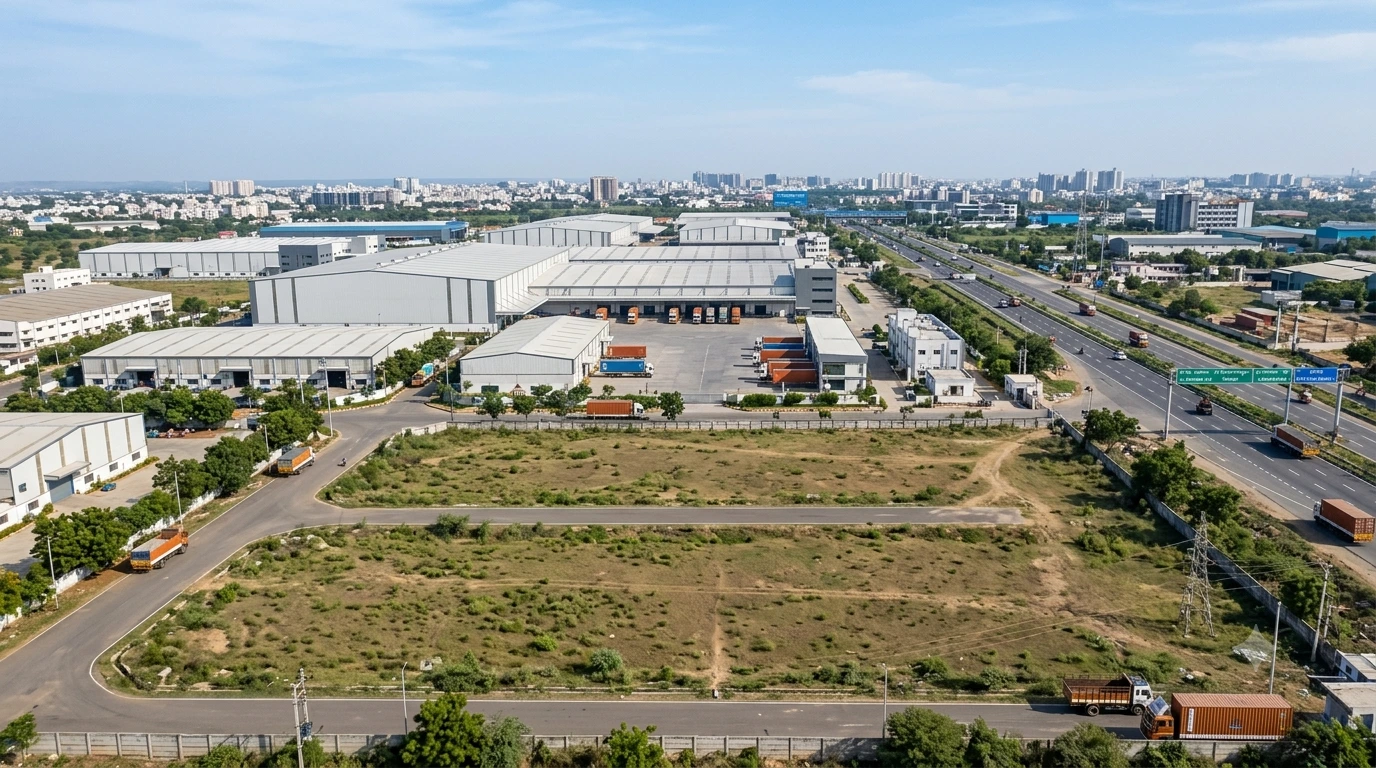
Investing in real estate by acquiring land has traditionally been a common practice. But today, more people have been exploring beyond residential and commercial zones. Today, land near logistics centres, warehouses, industrial zones, and key transport corridors is attracting attention.
With more people doing online shopping and increased manufacturing, there has been an increased need for storage and logistics spaces. In the quest by companies to locate appropriate sites, land close to logistics centres has become interesting to property investors.
The location might prove to be an investment that can earn money through growth in price and/or rent in the future. Nevertheless, it should not be assumed that all land close to logistics centres will be profitable investments. There are several factors that should be considered before buying such land.
What Are Logistics Hubs and Why Are They Important?
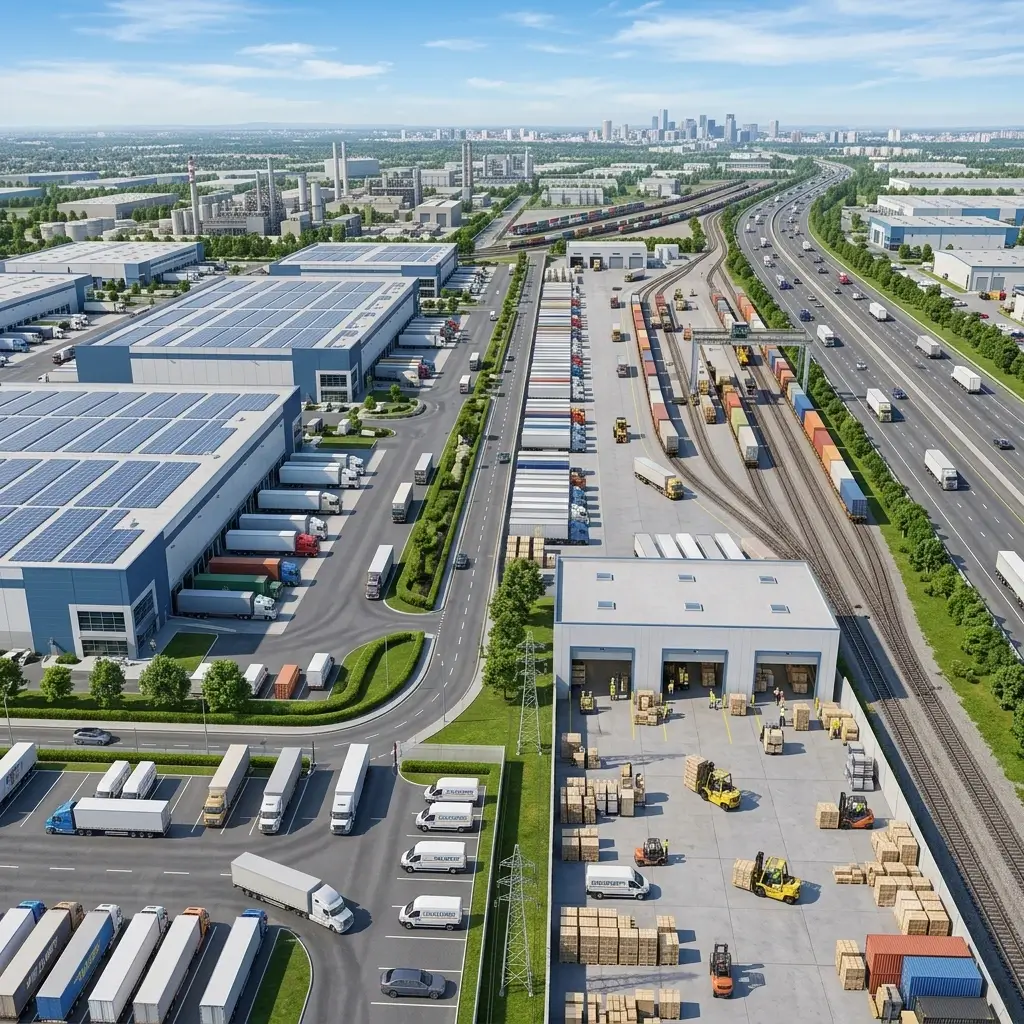
A logistics facility is an area where the goods are held, organized, and sent out to their respective destinations. The logistics facility bridges manufacturers, suppliers, war
Logistics hubs may include:
- Warehouses and distribution centers.
- Storage facilities for online shopping companies.
- Industrial parks and manufacturing zones.
- Truck terminals and freight transport centers.
- Cold storage facilities for food and other temperature-sensitive products.
Such facilities facilitate movement of goods. With increased business activities, companies will require more land for holding, transportation, and other business purposes. This increases the demand for suitable plots in the nearby areas.
Why Land Near Logistics Hubs Is Becoming a Hot Investment
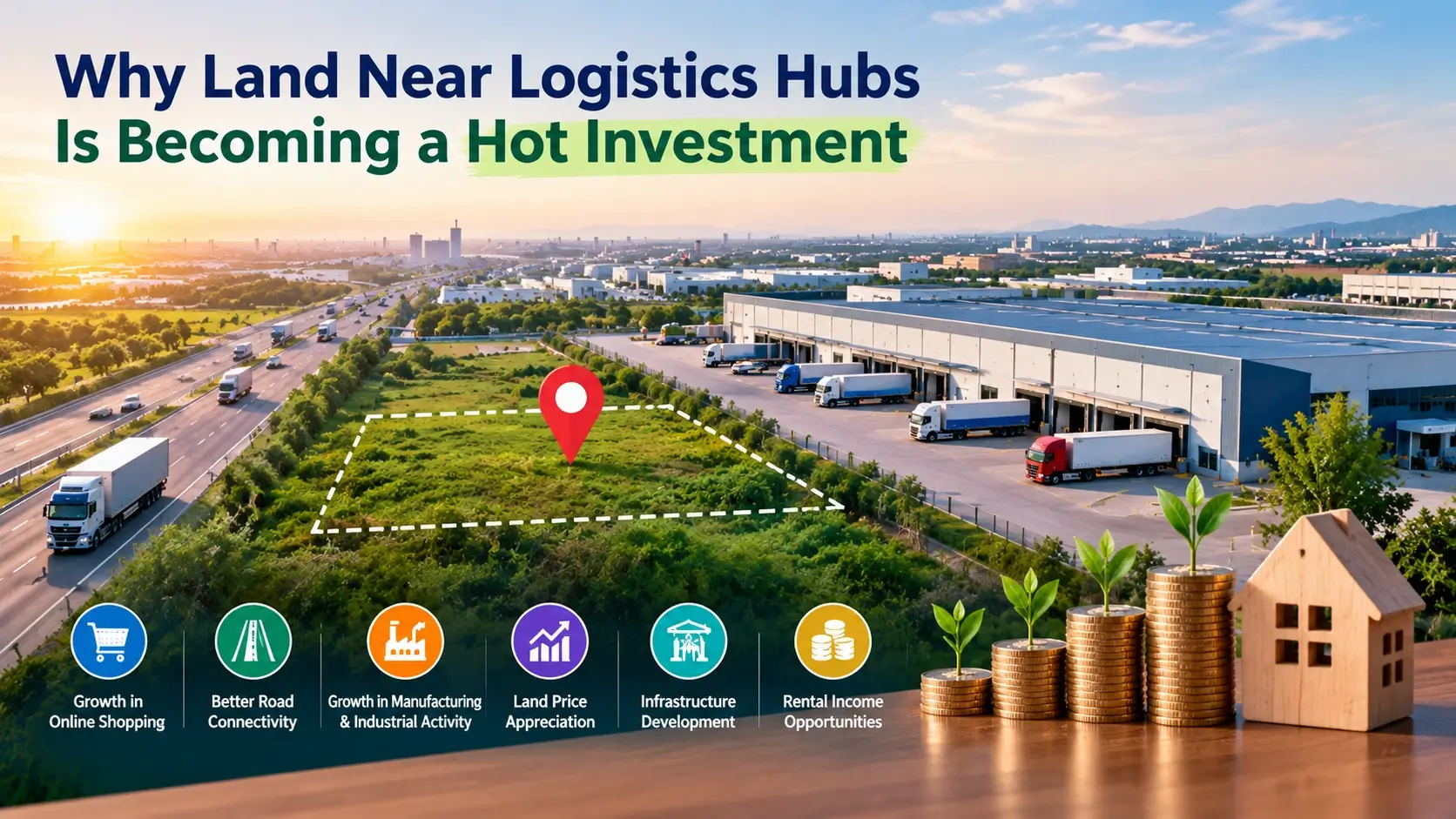
Several factors are making these locations attractive to investors.
1. Growth in Online Shopping
Online shopping has changed how customers acquire goods. The customers want quicker deliveries, hence the need for companies to have warehouses and distribution centers nearer to the markets.
There is need for land that facilitates storage and distribution of the products.
The main reasons include:
- More space is needed to store online orders.
- Delivery companies need convenient locations to reduce travel time.
- Businesses require additional facilities as their customer base grows.
- Well-connected locations help companies manage deliveries more efficiently.
In case there is a growing city and a major highway, such land becomes appealing to the warehouse developers if there is road accessibility and permission for the business.
It is important to note that increase in online business does not necessarily result in high prices of lands in the nearby areas.
2. Better Road Connectivity
It is very important that there are good connections to logistics facilities since the trucks need to ferry the goods from the warehouses, factories, markets, and transport centers without unnecessary delay.
Such land can be near highways, expressways, and other main roads.
Before investing, check:
- Existing highways and major roads.
- Planned road improvements and new connections.
- Access to railway freight terminals, airports, or ports where relevant.
- The quality and width of the road connecting the plot to the main route.
The proximity of a plot to the highway does not necessarily mean that the site is fit for business operations if it is hard for the trucks to access the site or the roads leading to the site are narrow.
Accessibility is more important than the distance of a plot from the highway.
3. Growth in Manufacturing and Industrial Activity
Manufacturing firms require sites where they can erect factories and store their raw materials and manufactured goods. There could be need for transport companies, packagers, and warehouse operators near the site.
With increasing levels of industrialization, there would be need for more support facilities.
This can create opportunities for:
- Industrial land and warehouse sites.
- Storage and distribution facilities.
- Truck parking and transport services.
- Supporting commercial facilities, where permitted.
Plots with existing factories and businesses would be preferable for investment compared to plots where there will be development of industry.
4. Potential for Land Price Appreciation
With increasing numbers of investors within a particular location, there would be increased demand for the sites that suit their needs. Warehouse developers, transport companies, among others could vie for sites that suit their needs.
This would help boost the prices of the land, especially those with good connectivity and limited sites.
Appreciation of land value depends on several fact:
- Actual business demand in the area.
- Availability of suitable plots.
- Infrastructure development.
- Land-use permissions and legal status.
- The purchase price compared with similar properties.
The development of certain properties could already be pricey due to their predicted future appreciation. In case there is delay in development or insufficient business interest, the anticipated rise in price may fail to materialize.
5. Infrastructure Development
The construction of new roads, terminals, corridors, or logistics parks can enhance the transport links and increase the utility value of adjacent lands for commercial purposes.
For instance, the construction of a new freight terminal will enable companies to transport their cargo in an efficient manner, and the improvement of a road will reduce travel times from warehouses to major markets.
Prior to buying lands next to any proposed project, verify:
- Whether the project has official approval.
- Whether construction has started.
- Its expected completion date.
- Whether the project will directly benefit the plot.
- Whether the land is affected by acquisition plans or restrictions.
Never purchase at high prices based on mere assurances of future developments. Verify the existence of the project from credible sources
6. Rental Income Opportunities
Lands that adjoin logistics parks could earn rents if the lands are required by the companies to conduct commercial operations legally.
Based on the local laws and land characteristics, commercial activity could include:
Before estimating rent revenues, take into account:
- The number and type of businesses operating nearby.
- The size and features of plots they require.
- Local rental rates for comparable properties.
- The cost of preparing the land for use.
- Time that may be required to find a tenant
Rental income is not guaranteed. Some lands might lie idle before demand is created by businesses; therefore, investors should estimate return using realistic local numbers.
How Land Near Logistics Hubs Compares With Other Investments
Different property types serve different purposes. This comparison can help investors understand the main differences.
| Factor | Land near logistics hubs | Residential plots | Commercial property |
| Main demand | Warehouses, transport, and industrial businesses | Homebuyers and residential developers | Shops, offices, and service businesses |
| Important location factor | Freight access and industrial connectivity | Livability and neighbourhood growth | Accessibility and customer activity |
| Income potential | Depends on business demand and permitted use | Usually requires development or leasing | May generate rental income |
| Main risk | Weak business demand and land- use restrictions | Slow residential development | Vacancies and changing business demand |
| Investment approach | Often suited to patient investors | Depends on the location and market | Depends on rental demand and property type |
The right investment depends on your budget, financial goals, expected holding period, and willingness to accept risk.
What Should Investors Check Before Buying?
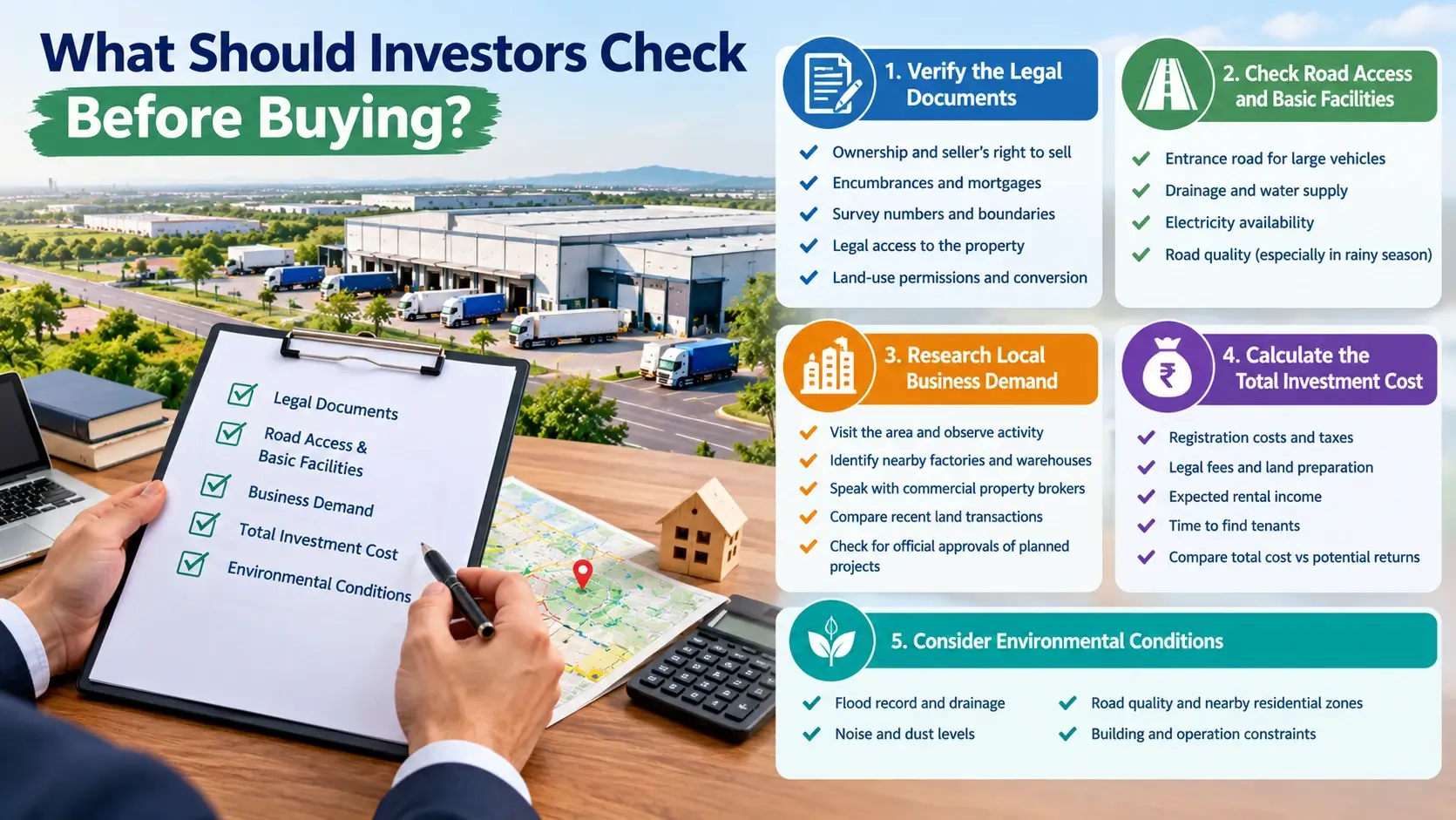
An ideal site location does not necessarily guarantee that all plots are worth investing in. The above factors may help in avoiding any costly mistake.
1. Verify the Legal Documents
Consider the following factors before making a payment:
- The documentation regarding ownership and the right of the seller to sell.
- Encumbrances, mortgages, and other claims.
- Survey numbers and plot boundaries.
- Legal access to the property.
- Land-use permissions and conversion requirements.
- Acquisition notices or other restrictions.
In India, agricultural land may have to undergo conversion and approval to allow it to be used as warehouses or for industrial purposes. This differs from one state to another and varies from one area to another; therefore, it is advisable to seek a lawyer familiar with the property before buying the plot.
2. Check Road Access and Basic Facilities
A plot can be near the logistics center, but it may not be usable due to lack of accessibility.
Find out whether the entrance road can accommodate the required vehicles and whether there is access to a road. Drainage, availability of electricity and water, and road quality during rainy seasons should also be considered.
3. Research Local Business Demand
Do not base your choice of a location only on the proximity of a warehouse or an industrial estate.
Rather:
- Visit the area and observe actual business activity.
- Identify nearby factories, warehouses, and transport companies.
- Speak with local commercial property brokers.
- Compare recent land transactions and asking prices.
- Check whether planned projects have received official approval.
A zone with thriving businesses could give better indications of the demand for the land than one which is marketed solely due to its growth potential.
4. Calculate the Total Investment Cost
The land might be very nice, but too expensive. Add in all costs involved before buying: registration costs, taxes, legal fees, land preparations, among others.
Also, factor in any rentals you could earn from leasing the land and how long it would take you to get tenants.
Compare the total cost against the potential returns and not just the expected future capital gains.
5. Consider Environmental Conditions
Floods, noise, and dust may result from using the site for logistical operations. Some sites may suffer from floods, poor drainage, and environmental constraints.
Be aware of the flood record, road quality, residential zones around the site, and any constraints for building and operation at the site.
The land good for a warehouse might not be the best for residential purposes, so choose a land that suits the use intended.
Common Mistakes to Avoid
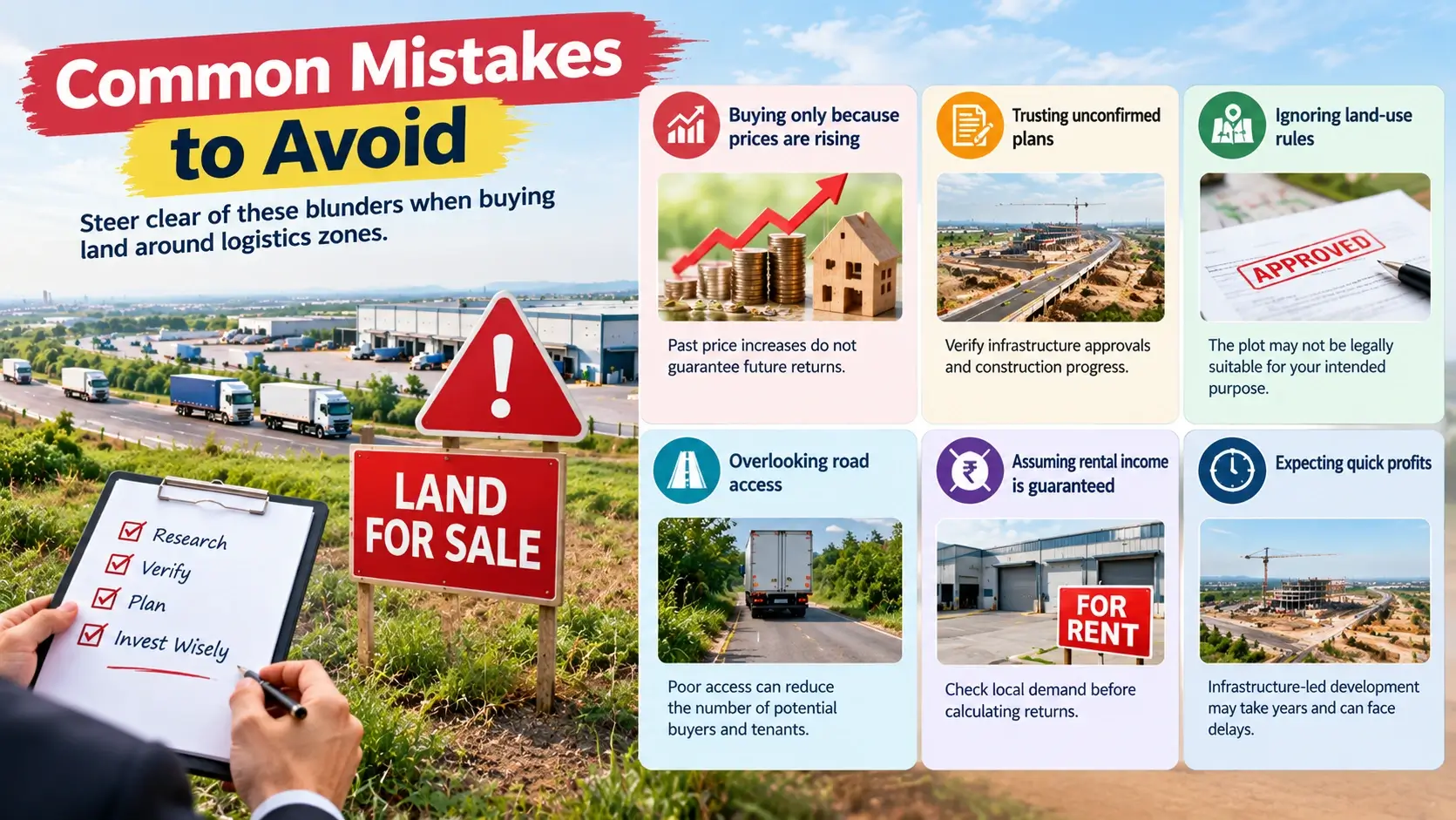
Investors need to steer clear of the following blunders when buying land around logistics zones:
- Buying only because prices are rising: Past price increases do not guarantee future returns.
- Trusting unconfirmed plans: Verify infrastructure approvals and construction progress.
- Ignoring land-use rules: The plot may not be legally suitable for your intended purpose.
- Overlooking road access: Poor access can reduce the number of potential buyers and tenants.
- Assuming rental income is guaranteed: Check local demand before calculating returns.
- Expecting quick profits: Infrastructure-led development may take years and can face delays
Proper research can assist investors in avoiding purely speculative investment decisions.
How to Identify a Promising Location
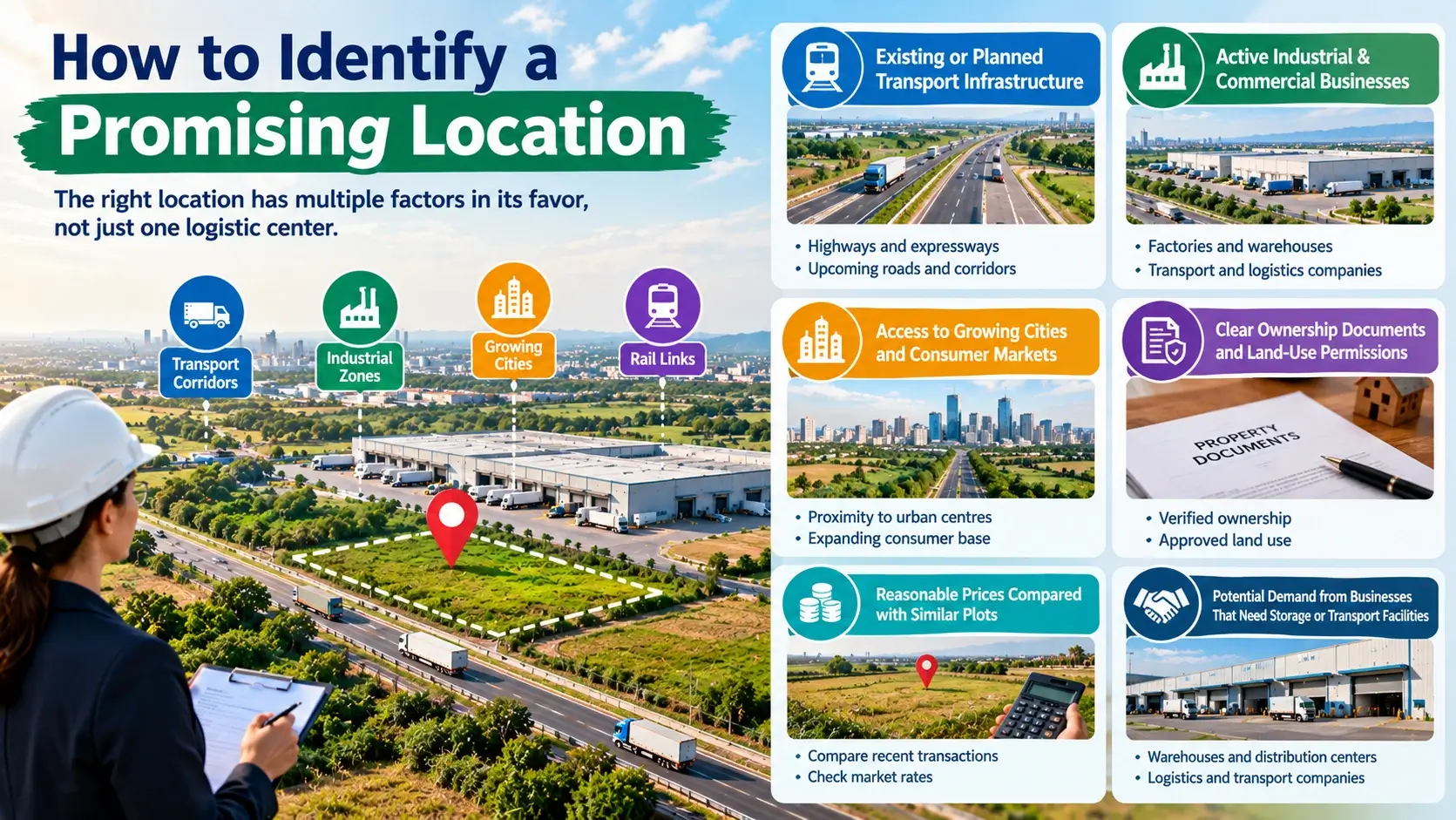
Most promising locations have multiple factors in favor of future demand rather than only one logistic center located in the neighborhood.
Seek plots where there are the following conditions:
- Existing or officially planned transport infrastructure.
- Active industrial and commercial businesses.
- Access to growing cities and consumer markets.
- Clear ownership documents and suitable land-use permissions.
- Reasonable prices compared with similar plots.
- Potential demand from businesses that need storage or transport facilities
Choose between several plots before you make the final decision. The plot that is slightly further from the logistic center may be the most appropriate one due to having a better road network, proper documents and a more attractive price.
The key thing is to find the land that will be needed by businesses and will allow legal ownership, possession, and selling.
Frequently Asked Questions (FAQs)
1. Why do people prefer to buy the land near logistic hubs?
The increased popularity of e-commerce, manufacturing, and transportations causes the increased demand for warehouses and logistic centers. There may be the attraction of companies and investors but the profitability depends on demand and other factors.
2. Is the land near the logistic hub a good long-term investment?
It may be considered a good long-term investment if there is a real business demand, good connectivity, proper documents, and land use permissions. Investors also need to take into account possible delays.
3. Would land close to logistics hubs always be valuable?
No, prices would depend on demand, infrastructure, road links, restrictions, and cost of purchase. The land not properly linked or too expensive may not yield decent returns.
4. Could I earn rentals from the land close to logistics hubs?
Yes, provided that such land can be used for some activity required by businesses, and with the appropriate permissions in place, it could be rented out for storing, warehousing, parking, and other commercial purposes.
5. What kind of land is suitable for investments related to logistics?
That would depend on what use is planned for such land. For warehouse construction large and flat land with truck access could be needed; for transport companies – parking and working areas, etc. You have to check all the requirements.
6. Could agricultural land close to logistics hub be considered a good investment?
Yes, it could potentially be a good investment opportunity in case of development of that region, however agricultural land has certain limitations. You need to check land tenure and other aspects.
7. Which factors impact the value of land around logistics centers?
Some of the factors that influence include road connections, business activity in the vicinity, warehouse demand, infrastructure, plot size, permitted land use, and availability of suitable plots.
8. For how long do I need to hold onto land around logistics centers?
There is no definite holding period which will ensure profits. Infrastructure creation may take several years, and there could be delays. The holding period should be consistent with your financial objectives and your ability to invest in land without getting immediate returns.
9. Which risks should I consider before purchasing land around logistics centers?
The risks you may face include unclear title to the land, restrictions on usage of the land, lack of adequate access, delays in project completion, environmental factors, lack of rental demand, and paying more than what the land is worth.
10. Which methods could I use to find proper land around logistics centers?
You should identify active logistics centers, industrial zones, and well-connected transport corridors. Compare different plots by legal status, road connection, permissible use, business activity, and price.
Conclusion
The increasing importance of storage needs, quick deliveries, and convenient transportation has made land around logistics sites one more critical segment of real estate that deserves attention. Plots of land close to warehouses, industrial zones, and transportation facilities will be in demand due to business expansion.
Yet, the location is not all that matters when choosing where to invest money. Clear legal status, convenient transport communications, land use possibilities, real business demand, and affordable price of the land are as critical as location.
In that way, investors will be able to make the right decisions and find investment opportunities corresponding to their financial expectations. Growth will be achieved; however, patience is needed anyway.