
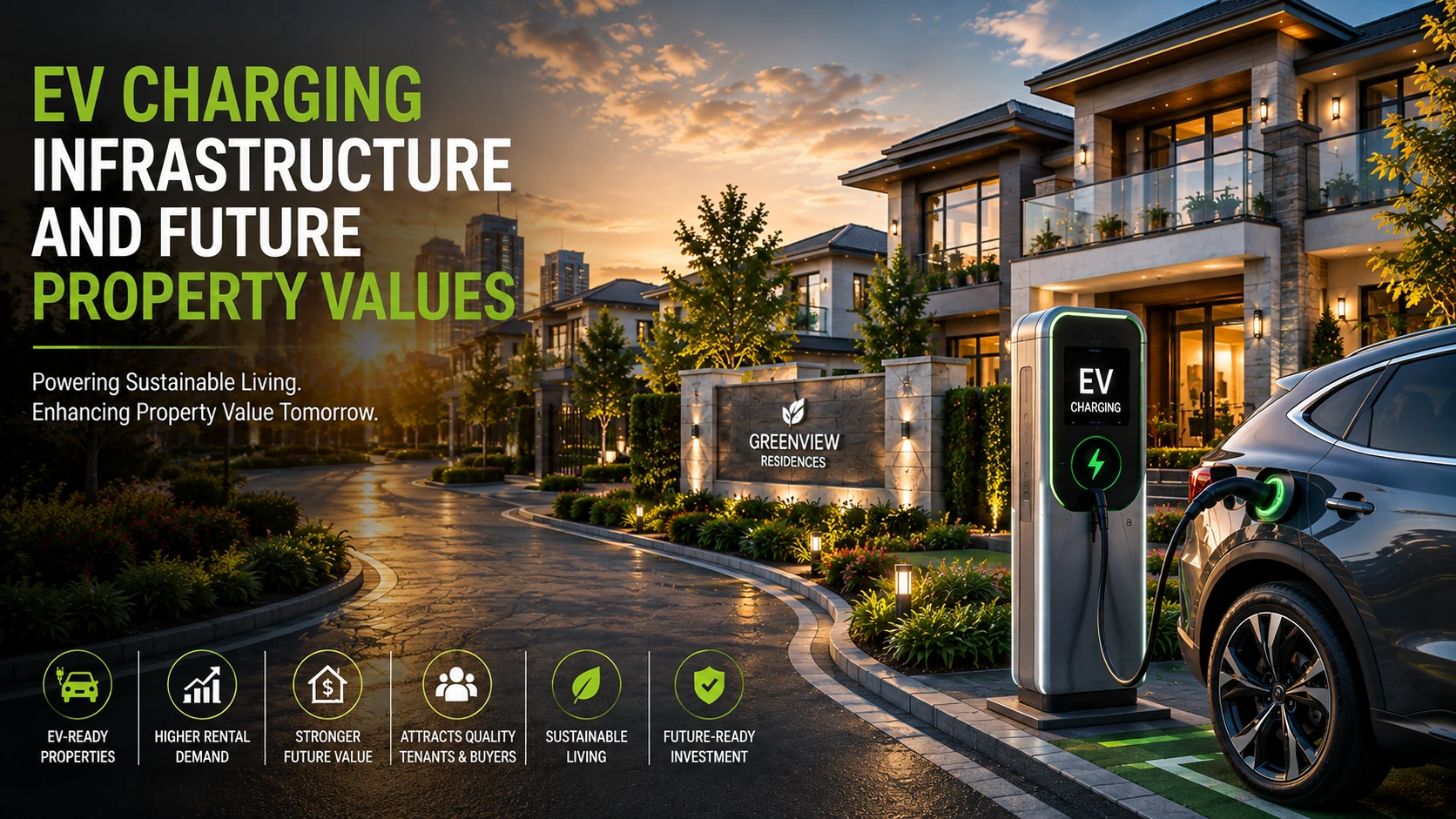
As electric vehicle adoption continues to grow, charging infrastructure is becoming an increasingly important consideration in real estate. From homes and apartments to offices, shopping centers, and hotels, access to convenient EV charging may influence how buyers, tenants, investors, and developers view a property.
EV Charging Infrastructure and Future Property Values: How EVs Are Changing Real Estate
Electric cars are transforming the way people see transportation, yet they influence much more than just roads and streets. With the increasing amount-adoption of electric vehicles, people have started to pay attention to charging stations, thinking of how convenient it will be for them to recharge their vehicle daily. Thus, the issue of electric car charging is becoming an integral part of property management discussions.
For an electric vehicle owner, the charging station could mean far more than just another amenity. Being able to charge a car at home or at work can save time and remove the need to make separate trips to a public charging station. Consequently, the properties that will provide facilities for easy charging will become increasingly appealing to an emerging clientele.
This raises an interesting question for the real estate market: Can EV charging infrastructure influence future property values?
There is no single answer for every property. Location, local EV adoption, charger quality, accessibility, installation costs, and buyer preferences all matter. On the other hand, charging stations can be seen as a growing aspect which one should take into account when looking into the future.
What Is EV Charging Infrastructure?
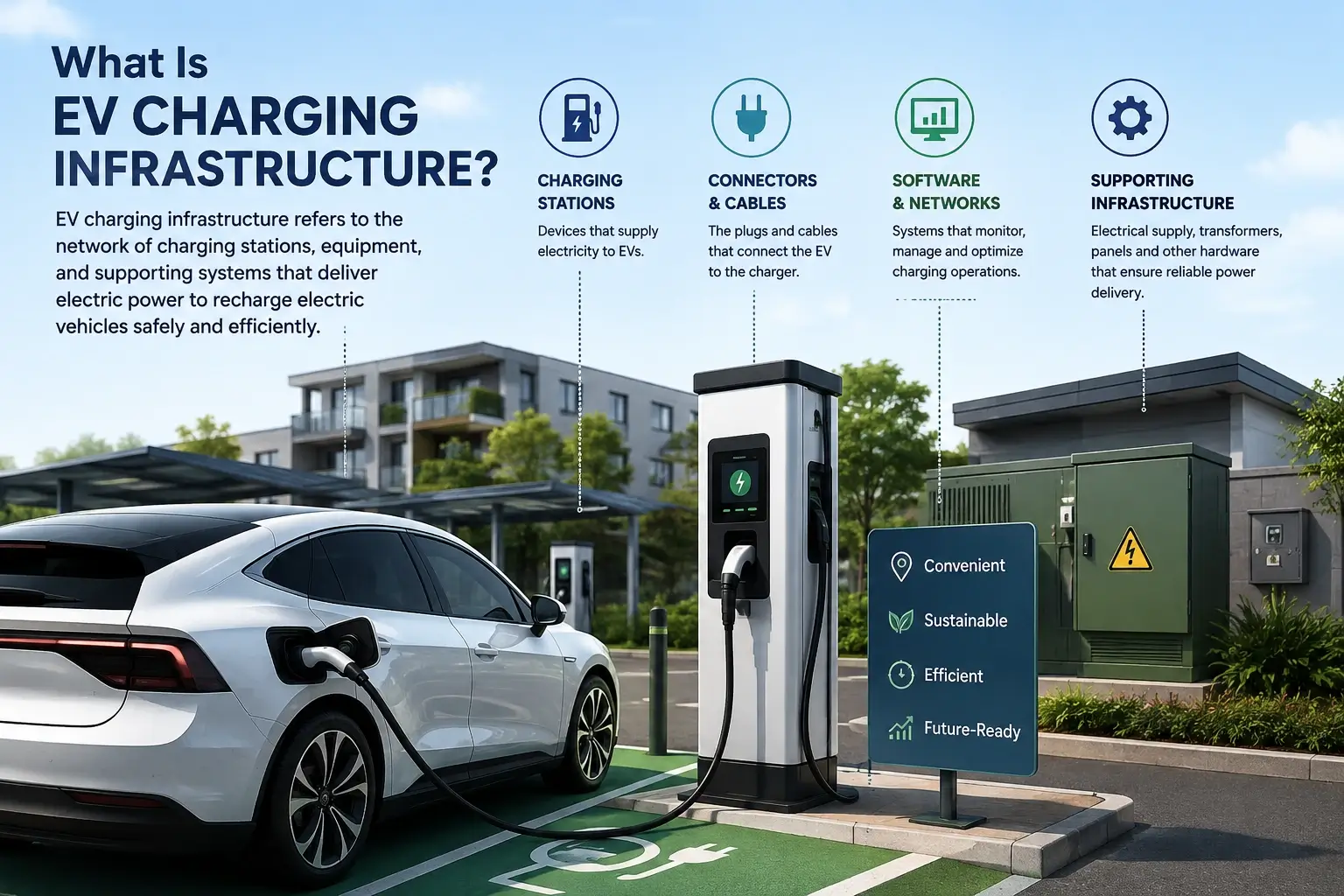
EV charging infrastructure is defined as the technology and system involved in charging of electric vehicles. This could be anything from an EV charging device in a personal garage to a large-scale system providing for the fast charging of hundreds of vehicles.
Charging facilities can be found in many different places, including:
- Private homes
- Apartment complexes
- Gated communities
- Office buildings
- Shopping centers
- Hotels
- Public Parking Areas
- Highway service locations
- Fleet and business facilities
The right charging solution depends on how the property is used. A homeowner may need convenient overnight charging, while a highway location may require a fast charger that can serve drivers within a short period.
Types of EV Charging Stations
Not all chargers provide the same charging speed or serve the same purpose.
| Charger type | Common use | Main benefit |
| Level 1 | Homes | Simple and relatively low-cost charging |
| Level 2 | Homes, apartments, offices | Faster everyday charging |
| DC fast charging | Public and commercial locations | Much faster charging for drivers on the move |
For most residential and workplace situations, Level 2 charging can be particularly useful because vehicles are often parked for several hours.
DC fast charging is different. It is more suitable for places where drivers do not want to wait for a long period, such as highways, busy commercial areas, and travel stops.
Public and Private EV Charging Infrastructure
Private charging is provided to homeowners, businesses, employees, residents, or even particular groups of users. In contrast, public charging is aimed at serving a larger audience of drivers.
Shared charging stations are also possible in apartment blocks or commercial properties. They allow residents or visitors to schedule the charging station usage, pay for it based on the amount of time used, or simply use it as part of a charging network.
What matters here is that the charging infrastructure can be tailored to suit the particular needs of a property.
Why EV Charging Infrastructure Matters to Real Estate
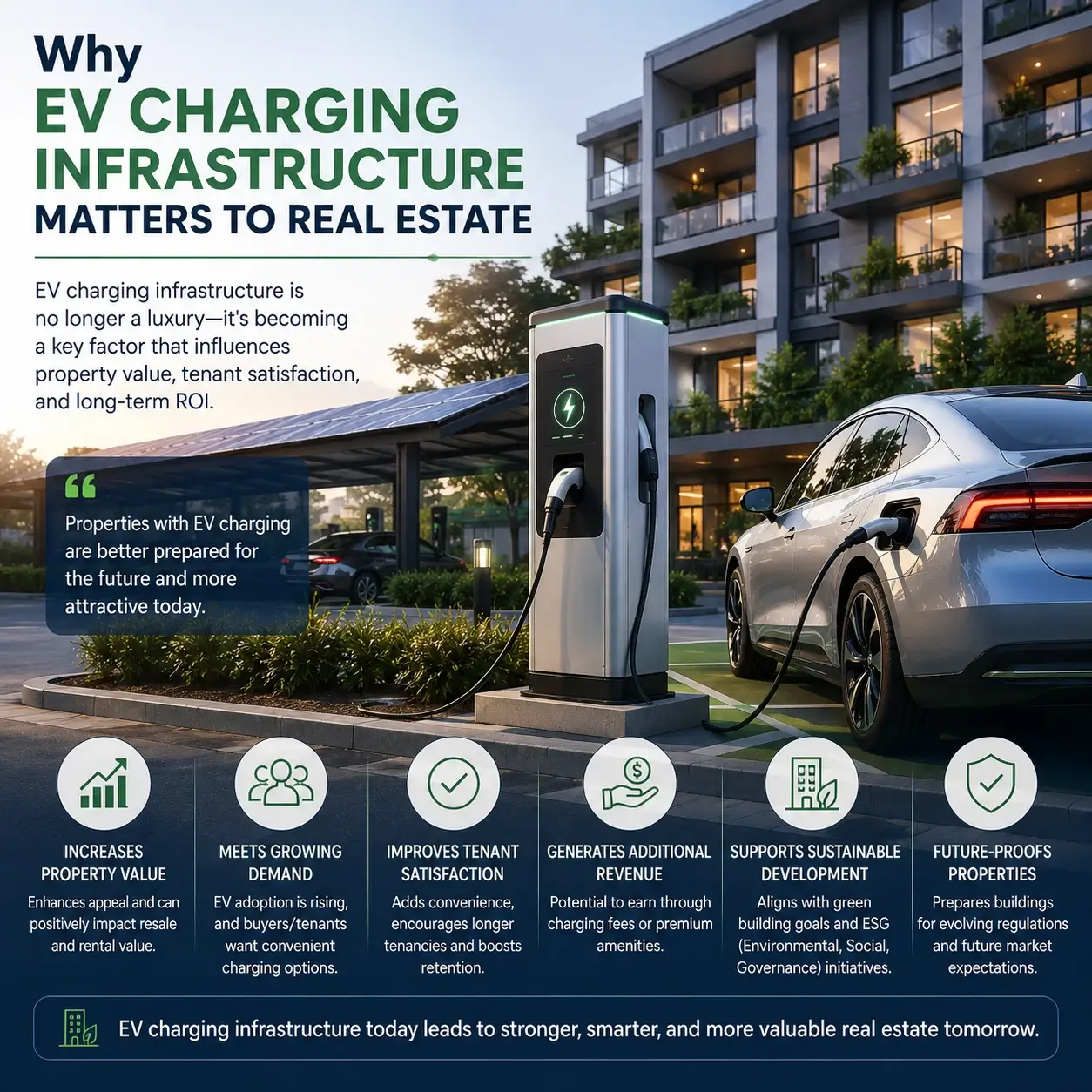
Value in real estate used to be determined by things like location, size, building quality, parking, amenities near by, and neighborhood conditions. However, the needs of today’s consumer have changed.
Technological advances and convenience have become more important when making purchase and lease decisions. Some examples would include high speed internet access, home security systems, energy-efficient equipment, solar panels, and even smart home technology.
One more thing to consider is EV charging.
EV Adoption and Changing Consumer Preferences
Electric vehicle adoption by people is increasing, and so is the act of charging. An EV owner does not simply need a parking space; they also need a practical place to recharge the vehicle.
Consider two otherwise similar apartment buildings. If one has reliable charging facilities in its parking area and the other does not, an EV-owning tenant may naturally prefer the first property. This is similar to the growing demand for modern residential amenities in Hyderabad.
The same idea can apply to houses. A buyer who already owns an electric vehicle may see a professionally installed home charger as a genuine advantage rather than a minor extra.
This does not mean every buyer will pay more for a charger. It means that the number of people who see charging as valuable is likely to grow as EV ownership becomes more common, potentially strengthening the connection between EV charging infrastructure and future property values.
Charging as a Modern Property Amenity
Property amenities often reflect the lifestyle of the people who use them. A swimming pool may appeal to one buyer, while a home office, solar system, or secure parking may be more important to another.
EV charging works in a similar way.
For an EV owner, it can provide:
- Everyday convenience
- Easier overnight charging
- Less dependence on public charging
- A more practical parking experience
- Better preparation for future vehicle needs
This makes charging infrastructure more than an electrical installation and highlights why EV charging infrastructure and future property values may become increasingly connected as property amenities evolve.
How EV Charging Infrastructure Can Influence Future Property Values
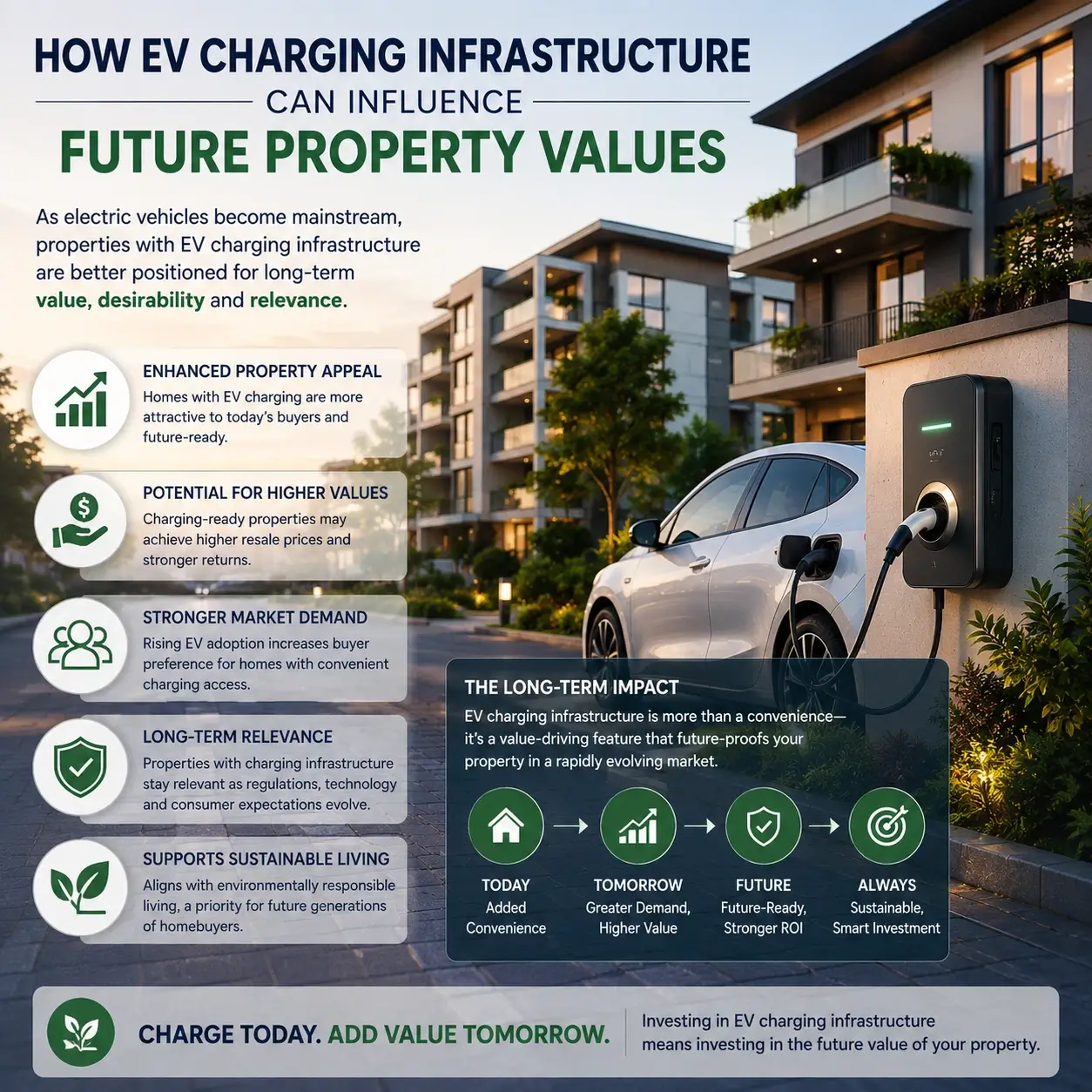
The relationship between EV charging and property value is not as simple as saying, “Install a charger and the property becomes more expensive.” Real estate markets do not work that way.
However, charging infrastructure can potentially contribute to property value by making the asset more useful and attractive to certain buyers and tenants.
Increased Property Attractiveness
Properties with EV charging facilities can stand out from similar properties without charging infrastructure.
Imagine a buyer searching for a new home. Both these houses will be located in the same area, and their prices and amenities are almost similar. While the first house is equipped with an EV charger in its parking lot, the second one will need the installation of the charger by the purchaser after purchasing the property.
The convenience of owning the first property could be significant since the purchasers are evaluating many properties simultaneously.
Greater Convenience for Property Owners and Tenants
Convenience is one of the strongest reasons charging can matter.
A person can plug in their vehicle after arriving home and leave it charging while they sleep. An employee can charge during working hours. A hotel guest can charge overnight. A shopper can connect their vehicle while spending time in a store or restaurant.
In each case, charging becomes part of an activity the person was already doing.
That is why the location of a charger matters just as much as the charger itself. A convenient and reliable charging point can be more useful than a technically powerful charger that is difficult to access.
Potential Rental and Sales Premiums
Charging infrastructure may support stronger demand for some properties, particularly in areas where EV ownership is growing.
Possible benefits include:
- Greater interest from EV-owning buyers
- Better appeal to environmentally conscious tenants
- Stronger property differentiation
- Improved tenant satisfaction
- Potential charging-related income
- Better preparation for future market expectations
However, property owners should be realistic. A charger does not guarantee a higher selling price or rent. Its financial impact depends on the local market and how much buyers or tenants actually value the facility.
The Impact of EV Charging on Residential Properties
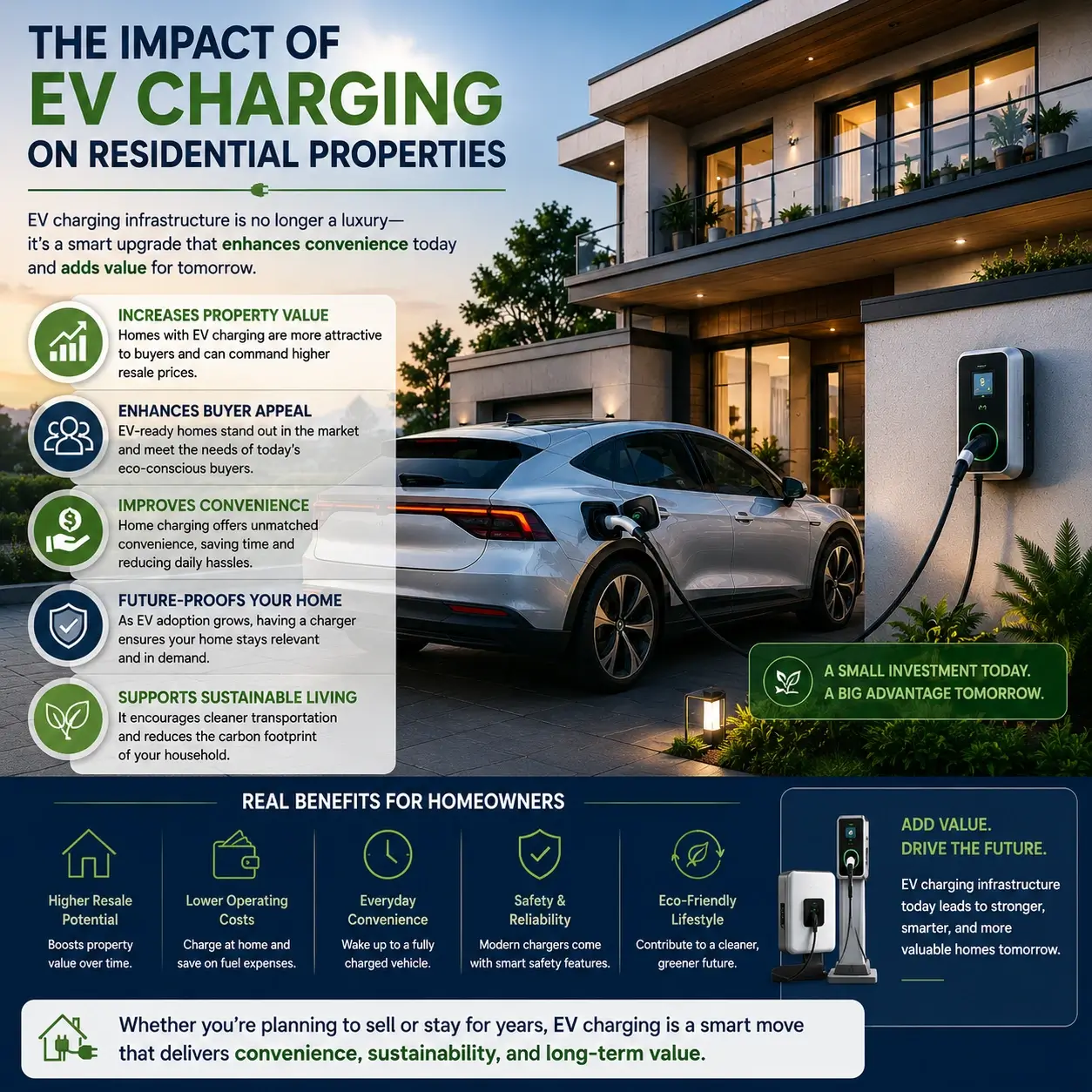
Residential property is likely to gain more from the EV charging stations because the car will be parked there for an extended period of time.
Single-Family Homes
For a car owner, having a dedicated charger for his EV becomes quite easy. There will be no need for a visit to a public charging point because it is possible to charge the car at home.
This can also become a selling point when the property eventually goes on the market, particularly for buyers considering villas in Hyderabad as a long-term investment.
Homeowners considering installation should think about:
- Where the vehicle is normally parked
- Whether the existing electrical system can support the charger
- The appropriate charger type
- Cable length and placement
- Weather protection
- Future charging requirements
A professionally planned installation can be more useful than simply choosing the most powerful charger available.
Apartments and Gated Communities
Apartments create a different challenge because parking and electricity are often shared, especially in gated communities.
A property manager may need to decide:
- Who can use the chargers?
- How are charging costs divided?
- Should charging spaces be reserved?
- Can residents pay according to their electricity use?
- How many chargers are needed today?
- How easily can more chargers be added later?
These questions become particularly important as more residents switch to EVs.
For those building apartments, designing the charging facility while constructing the apartments may also be easier than adding an extra electrical capacity afterward.
New Residential Developments
One of the benefits of new construction is that the developer will be able to incorporate EV charging into the design prior to completion of the buildings and parking lots, supporting the growing connection between EV charging infrastructure and future property values.
Instead of providing a charger in every parking space right away, the developer will prepare certain parking spots for charging and build the electrical infrastructure necessary for expansion in the future.
The Impact on Commercial and Retail Properties
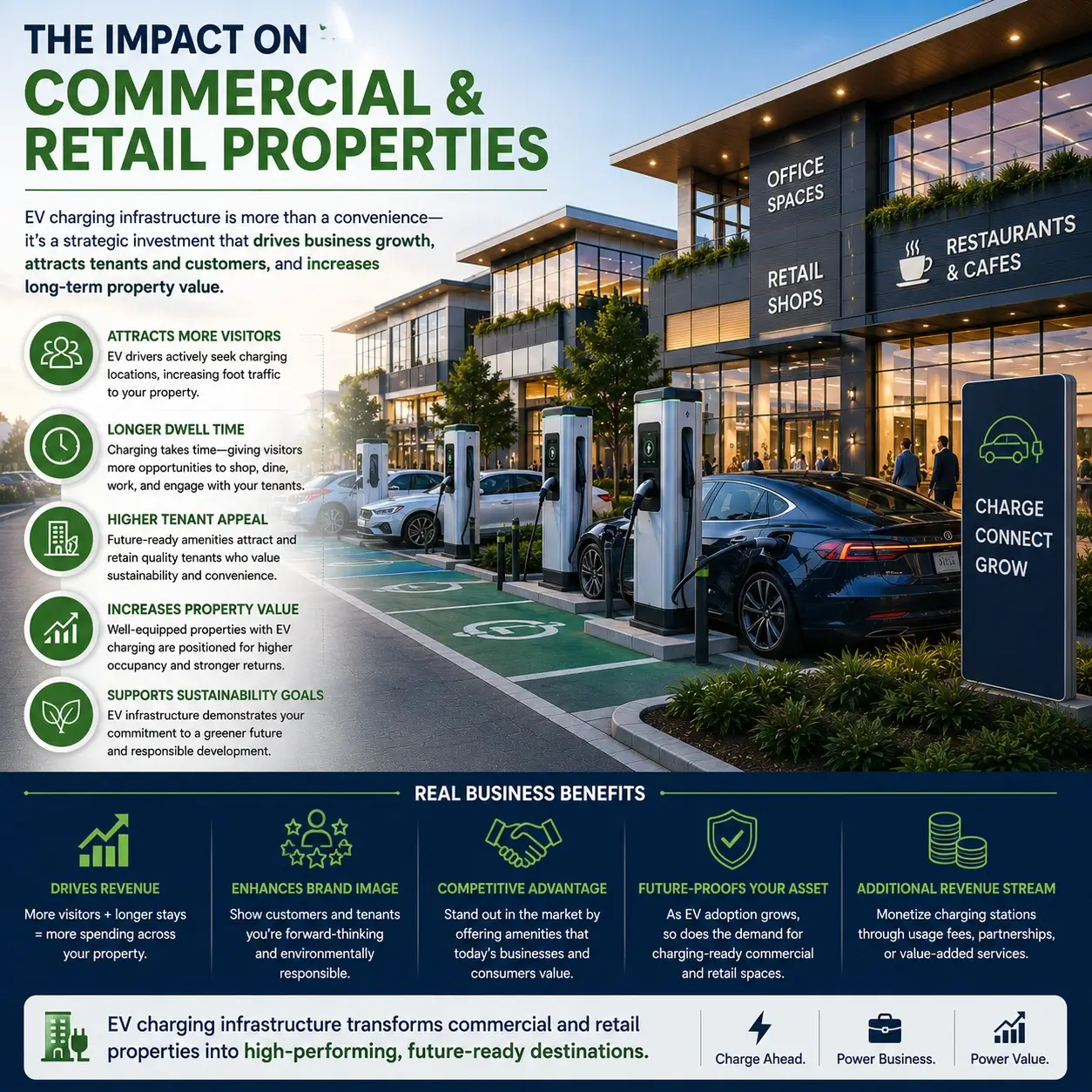
EV charging is not limited to residential real estate. It can also be used by commercial establishments to enhance customer, employee, and tenant experiences.
Office Buildings
Workplace charging can be attractive to employees who drive EVs. A person who spends eight hours at an office has plenty of time for their vehicle to charge.
For office landlords, charging can also become a small but useful feature when companies compare different buildings, particularly as EV charging infrastructure and future property values become more relevant to modern commercial real estate decisions.
A contemporary office building must be much more than just an environment with four walls and parking facilities. Facilities that would serve employee’s needs may help enhance the attractiveness of the building itself.
Shopping Centers and Retail Properties
Retail properties have an interesting opportunity because charging can give customers another reason to stay at a location.
While their vehicle charges, customers may:
- Shop
- Have a meal
- Visit a supermarket
- Watch a movie
- Complete other errands
This makes charging potentially useful for both the driver and the business.
A shopping center does not necessarily need to depend entirely on charging fees. The additional customer activity generated by a convenient charging facility may be equally important.
Hotels and Hospitality Properties
EV charging at hotels is also an ideal choice since the vehicle will be left parked for several hours or overnight.
If the guest’s battery level is low, then he may evaluate the charging facilities available before deciding which of the two hotels to stay in.
Thus for hotels, EV charging may also be an important aspect of the guest experience, along with parking, WiFi, breakfast, etc.
EV Charging Infrastructure and Property Investment
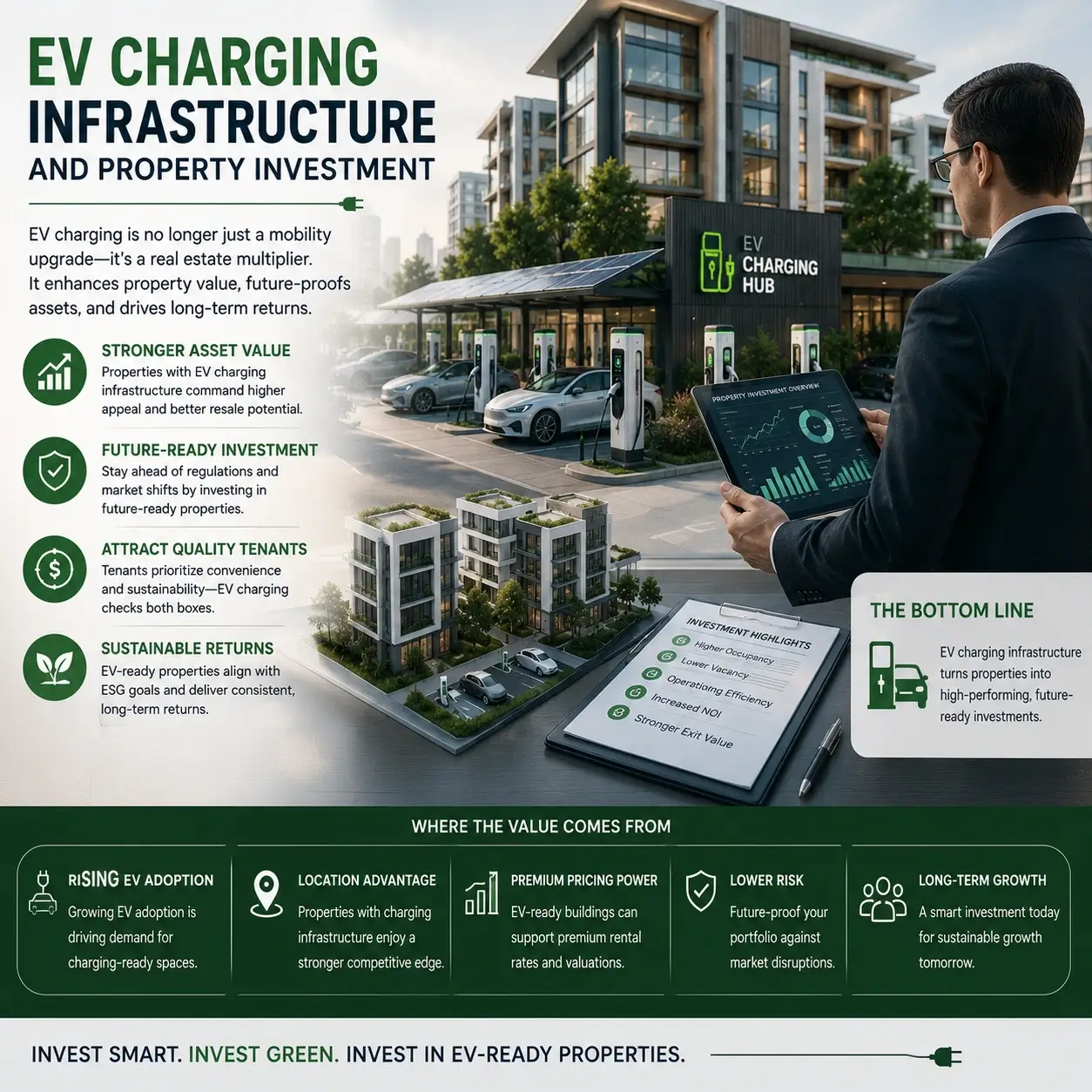
Real estate investors generally think about the long-term performance of an asset. They are not only interested in what attracts tenants today but also in what could keep a property competitive several years from now. Understanding the connection between EV charging infrastructure and future property values can help investors assess whether a property is prepared for changing transportation needs.
EV charging can be considered as part of this longer-term planning.
Why Real Estate Investors Are Paying Attention
Investors may look at EV charging infrastructure and future property values when assessing:
The growing connection between EV charging infrastructure and future property values is encouraging investors to consider charging facilities as part of a property’s long-term potential.
- Future tenant demand
- Property competitiveness
- Parking facilities
- Sustainability features
- Potential additional income
- Long-term upgrade requirements
A property that is difficult to upgrade for EV charging may eventually require more expensive electrical work.
Improving Property Differentiation
Real estate markets can be crowded, particularly when several buildings offer similar rents and facilities.
In this situation, EV charging infrastructure and future property values can become an important consideration because charging facilities may give a property an additional advantage over similar properties.
A reliable charging facility can give a property another point of difference and strengthen the relationship between EV charging infrastructure and future property values.
While it may not be what seals the deal in all cases, for some tenants, it could be just the thing that gives one building the edge over another.
Potential Impact on Rental Income
Property owners have several ways to manage charging costs, while the relationship between EV charging infrastructure and future property values may also influence how they plan long-term property improvements.
As the relationship between EV charging infrastructure and future property values becomes clearer, property owners may also consider charging facilities when planning rental strategies and long-term improvements.
The right model depends on the property.
The aim is to develop a plan which is economically viable and easy to understand by residents, staff members, customers, or visitors.
Factors That Determine Whether EV Charging Adds Property Value
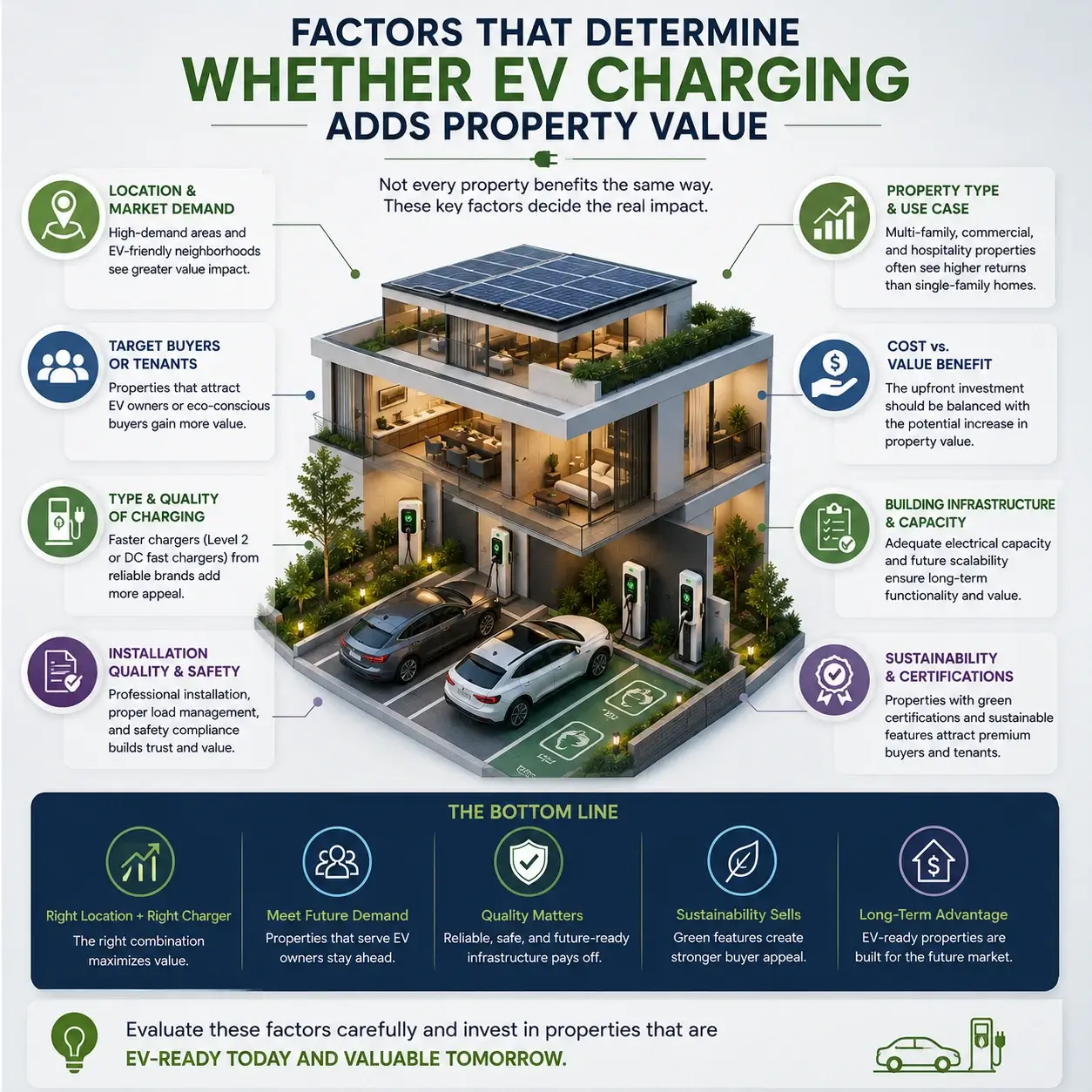
The importance of charging infrastructure depends very much on context. A charger that is highly useful in one location may have little effect in another, which is why the connection between EV charging infrastructure and future property values can vary from one property and market to another.
The connection between EV charging infrastructure and future property values can vary significantly depending on the location, type of property, local EV adoption, and demand for charging facilities.
Location and Accessibility
A charging device ought to be readily available for those who need it. In residential properties, it should be close to designated parking. At commercial properties, drivers should not have to navigate a confusing parking area just to reach it.
Local EV ownership also matters. Greater demand generally creates a stronger reason to invest in charging facilities and may strengthen the relationship between EV charging infrastructure and future property values.
This is one reason why EV charging infrastructure and future property values may have a stronger connection in locations where EV ownership and demand for convenient charging are increasing rapidly.
Type and Speed of Charger
The charger should match the way the property is used.
| Property | Suitable charging approach |
| Individual home | Level 1 or Level 2 |
| Apartment complex | Shared Level 2 charging |
| Office | Level 2 charging |
| Shopping center | Level 2 and/or faster public charging |
| Highway location | DC fast charging |
| Hotel | Level 2 charging for overnight guests |
A more expensive charger is not automatically more valuable. The best system is the one that solves the users’ actual problem.
Reliability and Maintenance
Continuous unavailability will soon diminish the value of a charging station.
The property owner must consider maintenance, software upgrades, payment solutions, repairs, and customer service issues. The reliability issue must be considered at the same time as the infrastructure expense.
Electricity Costs and Charging Fees
Electricity is an endless cost; hence, it is prudent for property owners to think about how this cost shall be sorted out beforehand.
It avoids conflicts between the owner and the user of the property. In case of shared property, charging based on usage becomes easier.
Local EV Adoption
Local demand is perhaps one of the most important considerations.
A property located in an area with growing EV ownership may benefit more quickly from charging infrastructure than a property in an area where very few people drive electric vehicles.
This is precisely why developers should take into account the market situation that exists locally and not blindly follow the methods used in other places.
Challenges of Installing EV Charging Infrastructure
While there is no doubt that there is huge potential in EV chargers, one thing that the owners should be wary of is the problems.
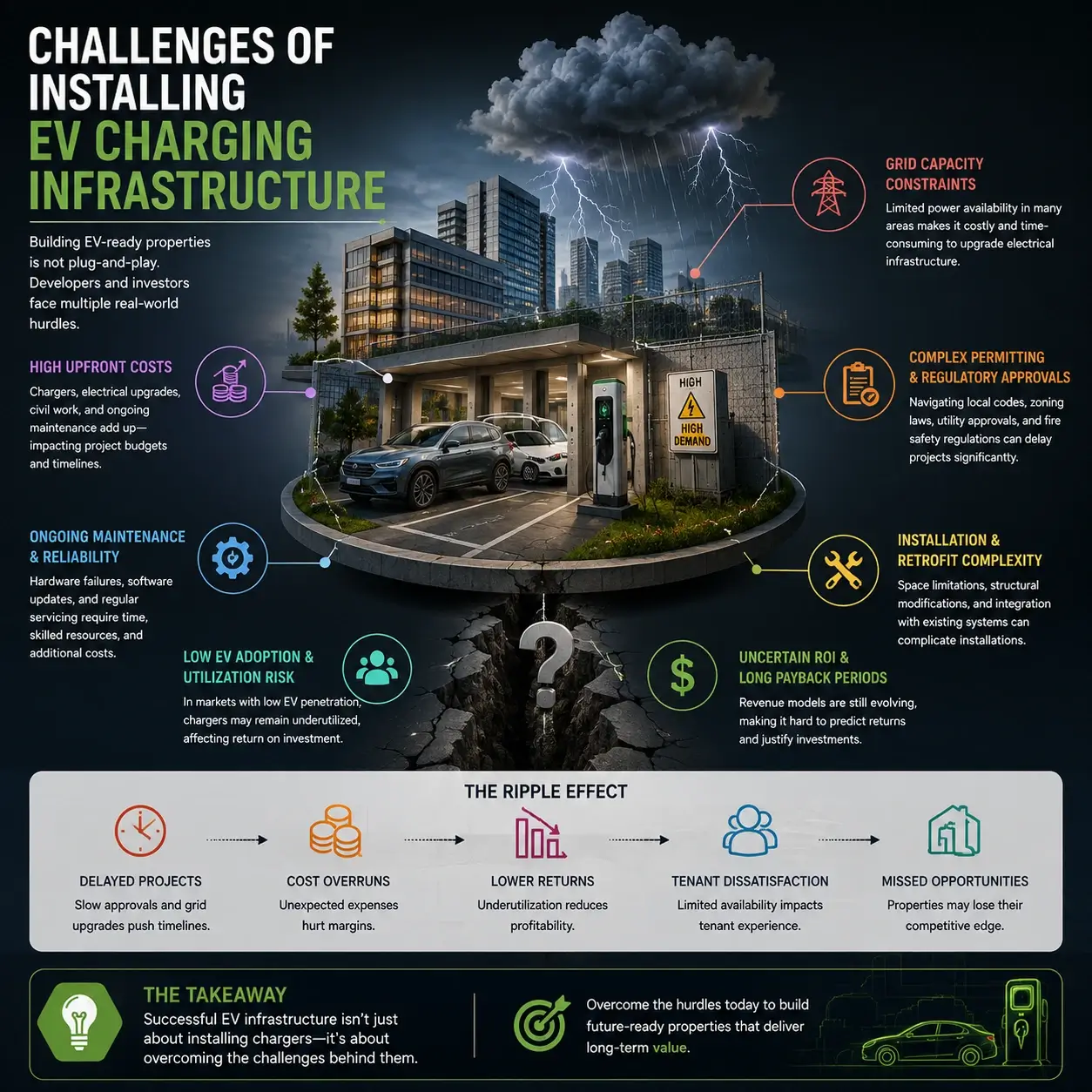
Installation and Infrastructure Costs
The cost goes beyond buying the charger. In case of different properties, the cost can include the upgrading of electricity, wiring, software, permits, maintenance, and parking facilities for electric vehicles.
A larger development will need much more planning compared to a one-family house.
Limited Parking and Space Constraints
An older building of apartments or commercial building will not have sufficient number of parking spaces for electric vehicle charging.
Moreover, access to an electric vehicle charging space and the time period of parking after that will also raise issues.
Good management is therefore just as important as the equipment itself.
Grid Capacity and Electricity Demand
Multiple charger installations may result in increased demand for electricity, especially if done in large properties.
Understanding the electrical capacity of the building and whether there is a need for upgrades should be done before charging stations are installed.
A smart charge would prove useful since it manages the time that vehicles charge and prevents excessive demand for electricity.
Uncertain Return on Investment
The financial return from EV charging can vary considerably.
Before making a major investment, owners should compare:
- Installation expenses
- Expected charging demand
- Electricity costs
- Maintenance expenses
- Possible charging revenue
- Tenant and buyer demand
- Long-term property benefits
The goal should be to make a sensible investment based on real demand rather than simply installing chargers because EVs are becoming popular.
The Future of EV Charging and Real Estate
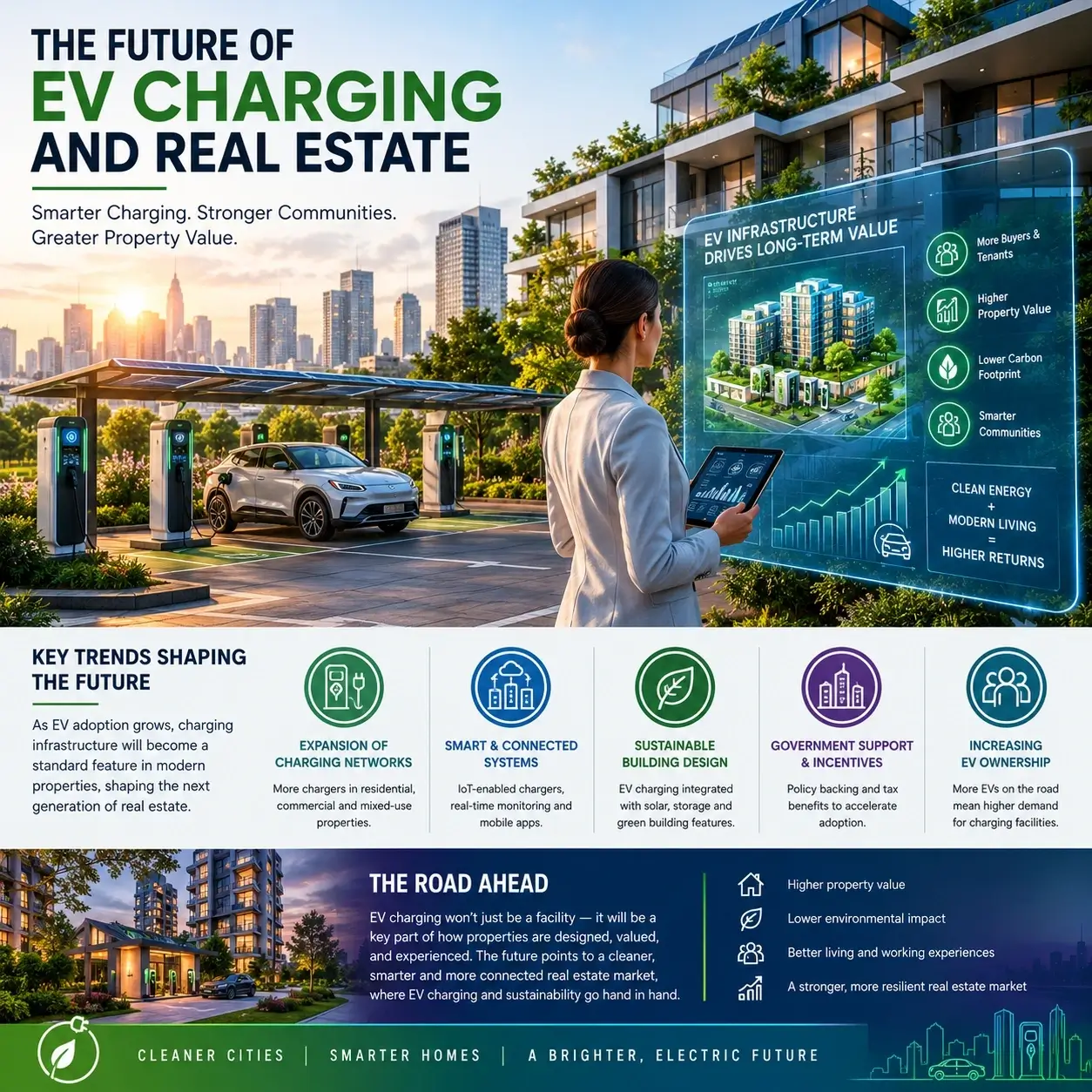
The association of electric cars with real estate is bound to grow as the usage of EVs increases, making EV charging infrastructure and future property values an increasingly relevant consideration for developers, homeowners, and investors.
As this trend continues, EV charging infrastructure and future property values may become increasingly important considerations for developers, investors, homeowners, and property managers.
Charging infrastructure may eventually become something that developers consider during the earliest stages of property design rather than something added after construction.
EV-Ready Buildings Will Become More Common
Future buildings may be designed with charging in mind from the beginning.
This could include:
- EV-ready parking spaces
- Dedicated electrical capacity
- Charging cable routes
- Smart charging systems
- Space for additional chargers
- Charging management software
A building does not necessarily need a charger in every parking space on day one. Preparing for future expansion can be just as important.
Smart Charging and Renewable Energy Integration
There may be much more to consider in the future about vehicle charging besides just plugging into the power grid.
A property may use electric vehicle charging along with solar power and battery storage.
For instance, a commercial property with solar on its roof may be able to use some of the generated electricity to charge its vehicles.
This creates a broader connection between EV infrastructure and energy-efficient real estate.
Charging Infrastructure as a Standard Property Feature
Today, an EV charger may feel like a premium feature in many properties. In the future, that could change.
As EV ownership becomes more widespread, buyers may begin asking a simple question when viewing a property: “Where can I charge my vehicle?”
When that question becomes common, charging may stop being a special feature and become a normal part of property planning.
Growing Importance for Property Developers
Developers who consider future transportation needs during the design stage may be better prepared for changing buyer and tenant expectations.
The important point is not to overbuild.
A developer does not necessarily need to install expensive fast chargers everywhere. Instead, the property can be designed so that charging capacity can grow as demand grows.
Long-Term Property Value Implications
EV charging will not replace the traditional factors that determine real estate value. Location, construction quality, neighborhood conditions, accessibility, and market demand will remain extremely important.
The potential relationship between EV charging infrastructure and future property values should therefore be viewed as one part of a property’s overall long-term market appeal.
However, charging infrastructure could become one of the features that separates future-ready properties from properties that have not kept pace with changing lifestyles. This makes EV charging infrastructure and future property values an important consideration alongside traditional factors such as location, accessibility, and construction quality.
The potential relationship between EV charging infrastructure and future property values is therefore worth considering alongside traditional factors such as location, accessibility, construction quality, and local market demand.
Its greatest value may therefore come from a combination of convenience, competitiveness, and future readiness rather than from the charger alone.
What Property Owners and Developers Should Consider
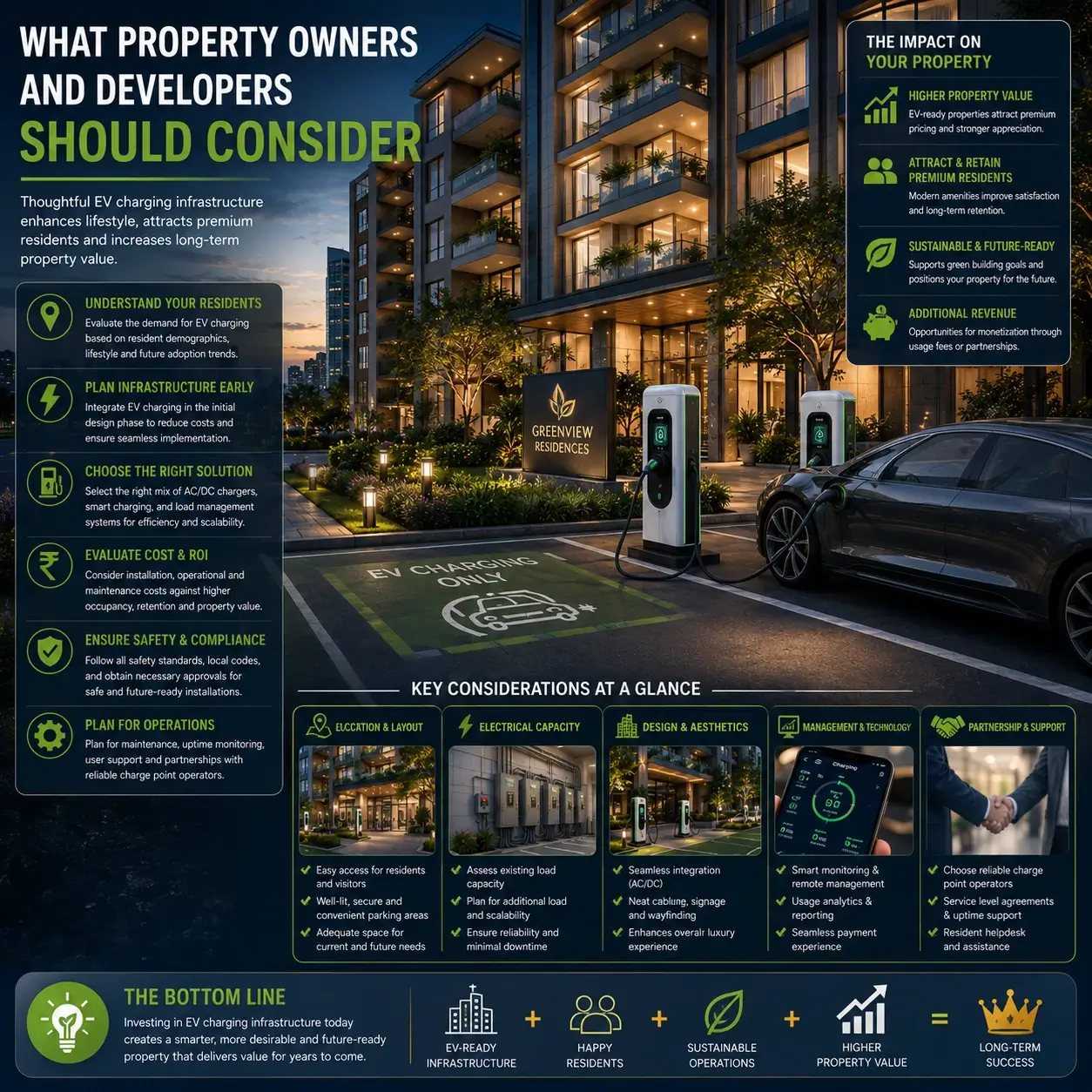
Property owners do not need to rush into installing the most expensive charging system available. A better approach is to understand the property’s current and future needs.
Before investing, consider the following:
- Study local demand: Find out how quickly EV ownership is growing in the area
- Understand the users: Residents, employees, shoppers, and hotel guests have different charging needs.
- Choose the right charger: Match charging speed to how long vehicles normally remain parked.
- Check electrical capacity: Make sure the existing system can support the planned installation.
- Plan for expansion: Leave room for additional chargers if demand increases.
- Think about costs: Include installation, electricity, software, repairs, and maintenance.
- Make access simple: Users should be able to find, use, and pay for charging without unnecessary complications.
- Focus on reliability: A working charger is far more valuable than an impressive-looking charger that is frequently unavailable.
The best EV charging strategy is therefore not simply about installing equipment. It is about creating infrastructure that makes sense for the property and the people who use it.
Conclusion
As electric vehicle adoption continues to grow, EV charging infrastructure and future property values are likely to become increasingly connected in the real estate market.
EV charging infrastructure and future property values are becoming increasingly connected as electric vehicles become more common. Charging facilities may influence how buyers, tenants, developers, and investors view residential and commercial properties.
The impact on the property value cannot be overstated in terms of EV demand, location, quality, accessibility, reliability of the charge points, as well as requirements of the purchasers and tenants.
However, the trend is evident: transport and real estate are becoming more and more connected.
Planning to provide EV charging capacity now will make the property future-proof and competitive for the owners and developers. What is seen now as an additional feature may soon become a requirement.
Frequently Asked Questions About EV Charging Infrastructure and Future Property Values
1. Can EV charging add value to the property?
EV charging may add some value to the property due to its attractiveness to EV owners. But the presence of such an option will not necessarily lead to a higher property price.
2. Can homes with EV charging stations be sold at a premium?
EV charging stations will make the property more attractive to EV buyers as the homeowner will not have to worry about organizing an installation of the station after buying the home.
3. Is installing an EV charging station a good investment for homeowners?
For a person who drives an electric car, EV charging station can be a convenient addition to the house that allows him/her to charge the vehicle easily. Moreover, it can also be another selling point when reselling the property.
4. Can EV charging stations raise the apartment rental prices?
The presence of EV charging stations will make the apartment community more attractive to EV owners who will have more places for recharging their cars.
5. Can EV charging stations be beneficial for commercial properties?
Yes. The office building can use EV charging stations for recharging the office employees’ vehicles, shopping center owners can use the stations to charge customers’ cars, and hotels can provide their guests with EV charging services.
6. Which EV charger adds the most value to the property?
There is no one answer here as different types of EV charging stations serve for different purposes. Level 2 chargers work better for homes, offices, and apartments as it takes a lot of time to fully recharge an electric car in such stations.
7. Will EV charging become a standard feature of the new buildings in the near future?
Yes. The developers of new buildings will try to install EV charging stations and EV readiness features in buildings to attract more buyers in the future.
8. Will being close to a public EV charger increase home values?
Ease of charging can make a place more appealing to some electric vehicle owners. But there are other factors affecting property prices – from neighborhood conditions, transportation access, property state, school proximity, amenities to general market demand. Charging is just one of them.
9. What are the major problems associated with EV charging infrastructure?
Problems related to charging infrastructure include high installation costs, electrical grid capacity issues, parking issues, maintenance, cost of electricity, and sharing among many users. For bigger property it will be necessary to develop a plan of action before setting up a number of charging facilities.
10. In what way EV charging infrastructure may affect future real estate?
EV charging infrastructure and future property values may become increasingly important in property development. EV-ready properties may have a competitive edge when it comes to attracting future buyers, tenants, employees, and clients.